
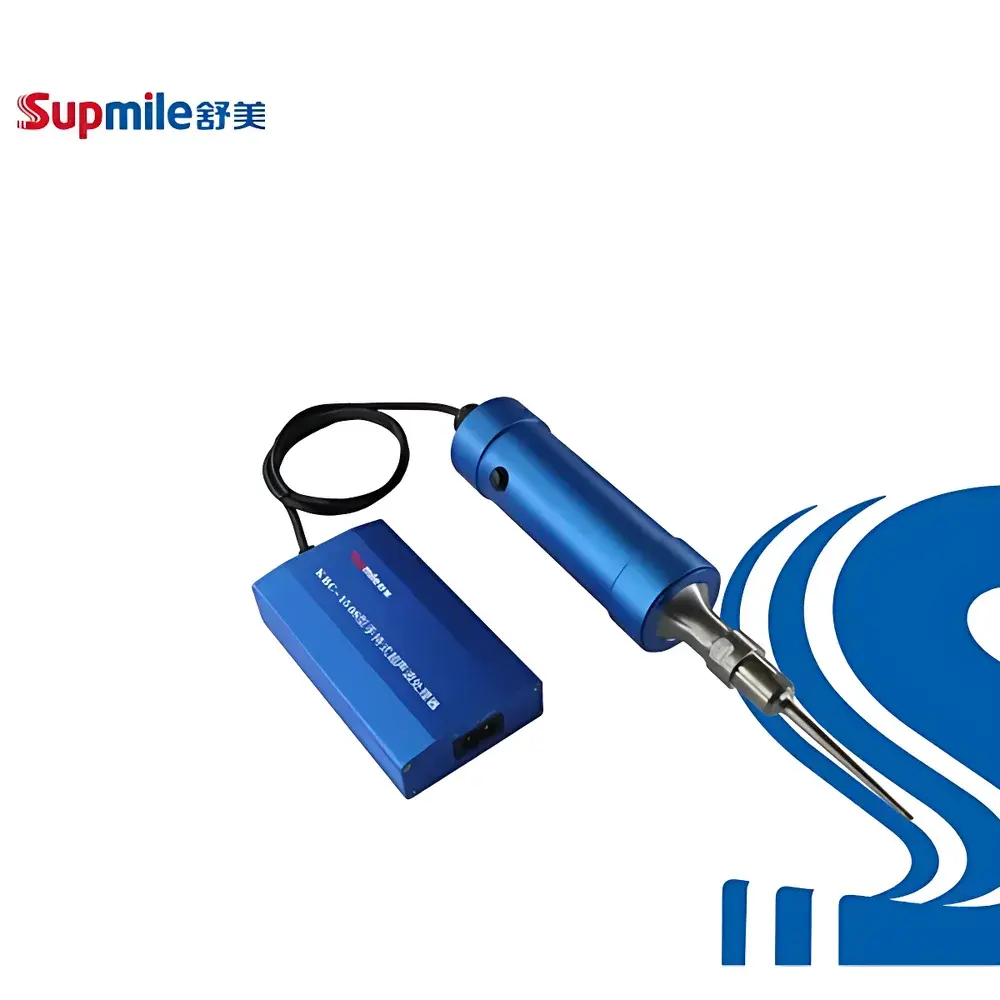
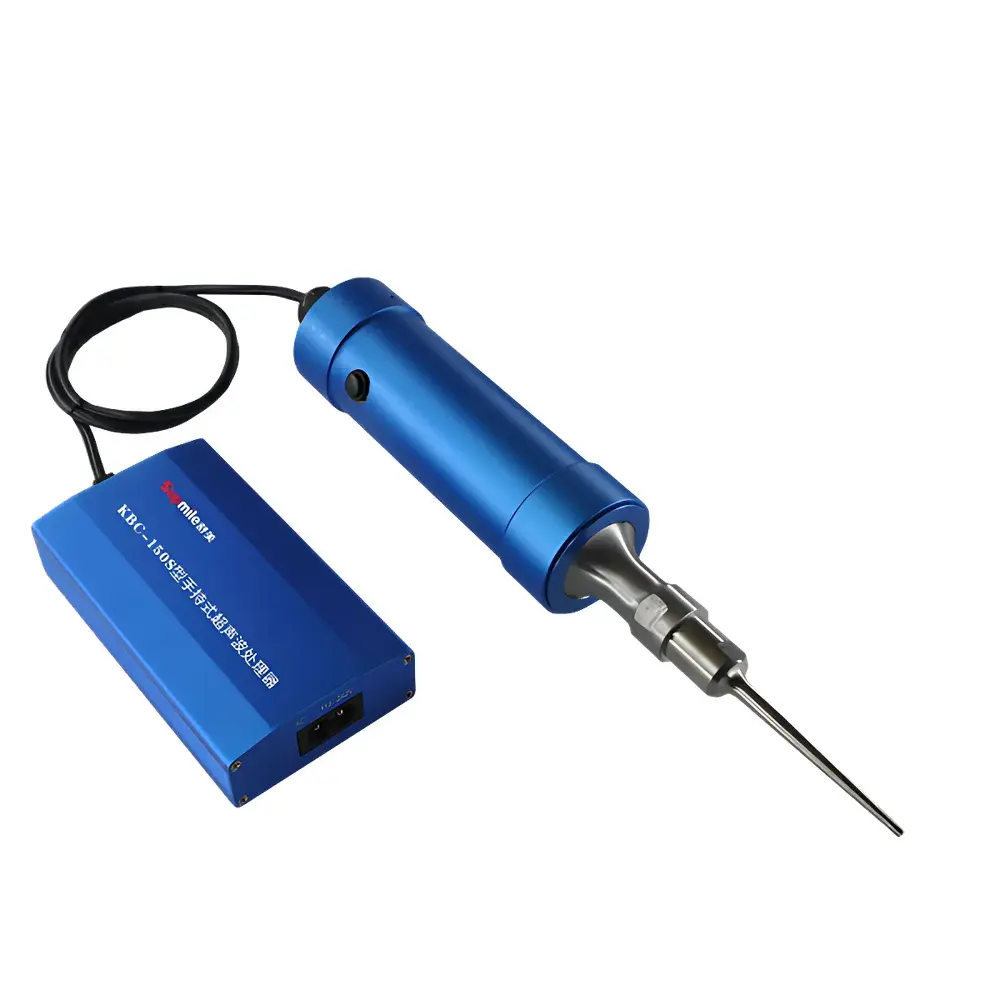
Shumei KBC-150S Handheld Ultrasonic Homogenizer
| Brand | Shumei |
|---|---|
| Origin | Jiangsu, China |
| Manufacturer Type | OEM Manufacturer |
| Country of Origin | China |
| Model | KBC-150S |
| Price | USD 1,480 (approx.) |
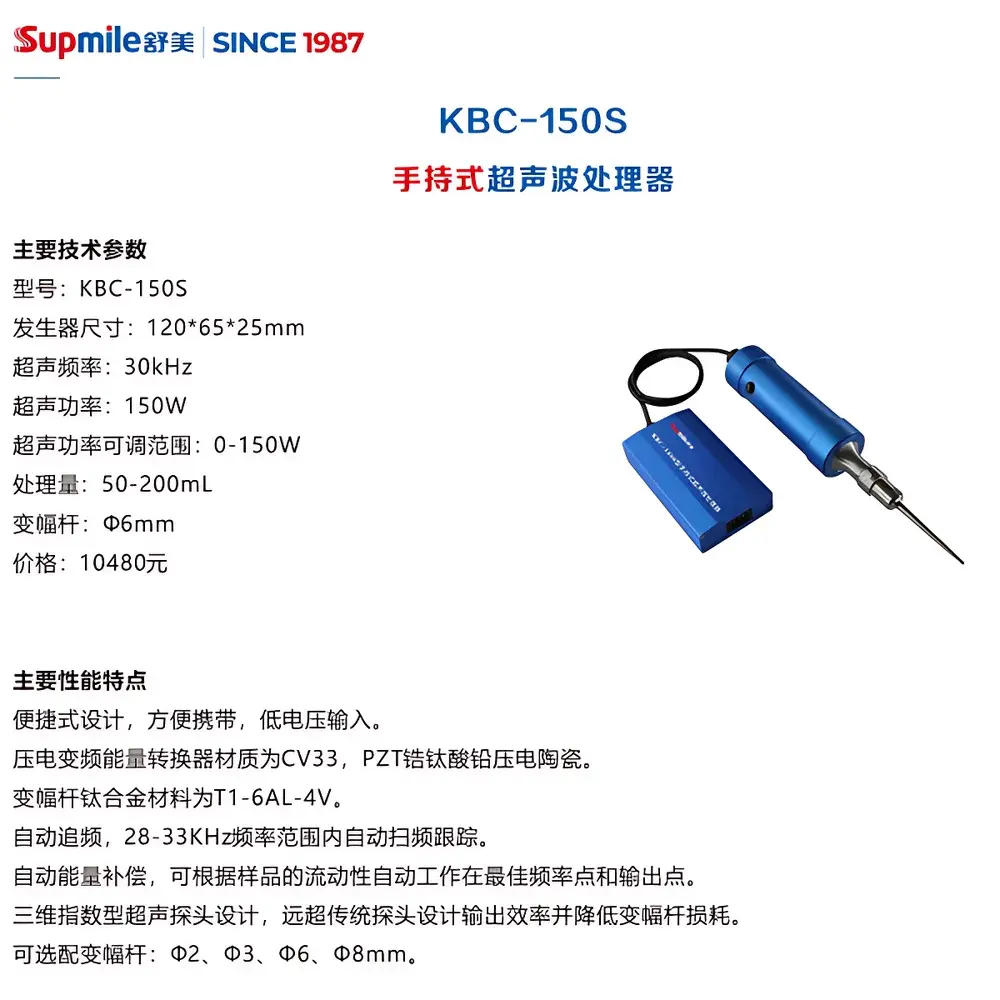
| Generator Dimensions | 120 × 65 × 25 mm |
| Ultrasonic Frequency | 30 kHz (auto-tracking range: 28–33 kHz) |
| Nominal Output Power | 150 W |
| Adjustable Power Range | 0–150 W |
| Recommended Sample Volume | 50–200 mL |
| Standard Probe Diameter | Φ6 mm |
| Optional Probe Diameters | Φ2, Φ3, Φ6, Φ8 mm |
| Transducer Material | CV33 piezoelectric ceramic with PZT (lead zirconate titanate) composition |
| Horn Material | Ti-6Al-4V titanium alloy |
| Probe Geometry | Three-dimensional exponential profile |
Overview
The Shumei KBC-150S Handheld Ultrasonic Homogenizer is an engineered solution for laboratory-scale cell disruption, emulsification, nanoparticle dispersion, and extraction in research and quality control environments. It operates on the principle of high-intensity ultrasonic cavitation—generated via piezoelectric transduction at a nominal frequency of 30 kHz—where rapid pressure fluctuations induce microbubble formation, growth, and violent collapse in liquids. This process delivers localized energy densities sufficient to disrupt biological membranes, reduce particle agglomerates, and accelerate chemical reactions. Designed for portability and operational flexibility, the KBC-150S integrates a compact generator (120 × 65 × 25 mm) with a lightweight handheld probe assembly, enabling direct immersion into vessels ranging from microcentrifuge tubes to 200 mL beakers. Its low-voltage input architecture supports stable operation in field labs or mobile analytical setups where mains power conditioning is limited.
Key Features
- Auto-frequency tracking across 28–33 kHz ensures consistent cavitation intensity despite load variations, temperature drift, or probe wear—critical for reproducible sonication across sample batches.
- Real-time energy compensation algorithm dynamically adjusts output amplitude to maintain optimal acoustic coupling, particularly when processing fluids with changing viscosity or suspended solids.
- Three-dimensional exponential probe geometry enhances acoustic energy transfer efficiency by minimizing standing-wave nodes and reducing mechanical stress concentration at the horn tip—extending service life and improving uniformity of treatment.
- CV33-class PZT piezoelectric ceramic transducer delivers high electromechanical coupling coefficient (>0.65) and thermal stability up to 80°C, supporting sustained duty cycles without performance degradation.
- Ti-6Al-4V (Grade 5) titanium alloy probe offers superior fatigue resistance, corrosion immunity in aqueous and mild organic media, and minimal metal leaching—essential for pharmaceutical and biotech applications.
- Modular probe compatibility (Φ2, Φ3, Φ6, Φ8 mm) allows precise scaling of energy density (W/cm²) to match application requirements—from gentle lysate clarification to aggressive nanoemulsion formation.
Sample Compatibility & Compliance
The KBC-150S is validated for use with aqueous buffers, saline solutions, ethanol/water mixtures, and low-viscosity organic solvents (e.g., chloroform, acetone). It is not rated for use with highly corrosive acids (e.g., concentrated HNO₃), halogenated hydrocarbons above 60°C, or abrasive slurries containing >10% silica or alumina particulates. While not certified to IEC 61000-6-3 (EMC) or UL 61010-1 out-of-the-box, its design adheres to general electrical safety principles for Class II portable laboratory equipment. Users performing GLP/GMP-regulated work are advised to implement instrument-specific SOPs, including daily amplitude verification using calibrated hydrophone systems and periodic probe tip erosion measurement per ASTM E2810-11 guidelines.
Software & Data Management
The KBC-150S operates as a standalone analog-controlled device without embedded firmware or digital connectivity. All parameter settings—including power level (0–100% of 150 W), duration (manual trigger), and real-time status indicators—are managed via front-panel rotary encoder and LED display. For traceable operation in regulated environments, integration with external programmable timers or PLC-based control systems is supported via 0–5 V analog enable signal input. Audit trails must be maintained manually or through third-party data loggers compliant with FDA 21 CFR Part 11 requirements if electronic records are generated.
Applications
- Cell lysis of bacteria (E. coli, Bacillus), yeast (S. cerevisiae), and mammalian suspension cultures (CHO, HEK293) prior to protein purification.
- Preparation of liposomes, polymeric nanoparticles, and Pickering emulsions requiring narrow size distribution (Dv50 < 200 nm).
- Accelerated solvent extraction (ASE) of plant metabolites, mycotoxins, and environmental contaminants (e.g., PAHs, PCBs) from solid matrices.
- Disaggregation of amyloid fibrils and protein aggregates in neurodegenerative disease research.
- In-line homogenization during small-batch formulation development for topical gels, injectables, and diagnostic reagents.
FAQ
What is the maximum continuous operating time at full power?
The KBC-150S is rated for ≤5 minutes of continuous operation at 150 W output, followed by ≥10 minutes cooling interval to prevent transducer overheating.
Can this unit be used underwater or in sealed reactors?
No—submersion beyond the probe’s threaded connection interface voids warranty and risks electrical hazard; only the titanium probe tip is designed for liquid immersion.
Is calibration documentation provided with shipment?
A factory power output verification report (per ISO 17025-accredited methodology) is available upon request at time of order; no NIST-traceable certificate is included standard.
Does the KBC-150S meet CE or RoHS requirements?
It complies with RoHS 2011/65/EU for restricted substances; CE marking is not applied as it falls outside EU Directive 2014/30/EU (EMC) and 2014/35/EU (LVD) scope for non-standalone lab equipment.
How often should the probe tip be inspected for erosion?
Visual inspection is recommended before each use; dimensional verification using micrometer measurement is advised every 50 hours of cumulative operation or after processing abrasive samples.



