
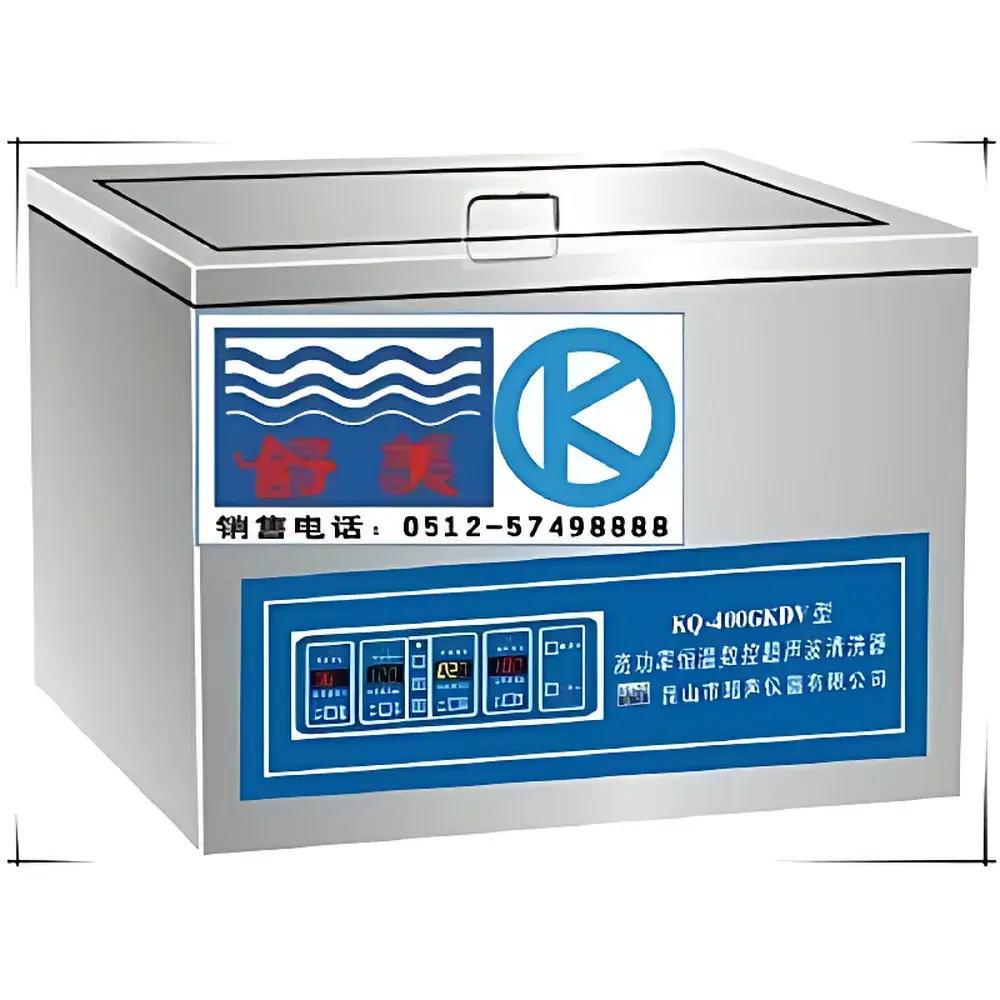
SHUMEI KQ-400GKDV Benchtop High-Power Temperature-Controlled Digital Ultrasonic Cleaner
| Brand | SHUMEI |
|---|---|
| Model | KQ-400GKDV |
| Dimensions (W×D×H) | 640 × 350 × 400 mm |
| Inner Tank Dimensions | 300 × 240 × 180 mm |
| Capacity | 13 L |
| Ultrasonic Frequency | 40 kHz |
| Ultrasonic Power Output | 400 W (adjustable 40–100%) |
| Heating Power | 400 W |
| Cooling Power | 350 W |
| Temperature Control Range | 0–80 °C |
| Timer Range | 1–480 min |
| Cumulative Operating Time Counter | up to 999,999 h |
| Water Level Detection Range | 1–140 mm |
| Tank Material | 304 Stainless Steel |
| Lid & Housing Material | 304 Stainless Steel |
| Optional Frequencies | 20 / 25 / 28 / 40 kHz |
| Accessories | Plastic Mesh Basket |
| Vapor Recovery System | Integrated |
| Auto-Fill & Drain | Electrically Controlled |
| Noise Reduction | Acoustic Lid Included |
Overview
The SHUMEI KQ-400GKDV is a benchtop high-power digital ultrasonic cleaner engineered for precision temperature control and uninterrupted operation in demanding laboratory and industrial cleaning applications. Unlike conventional ultrasonic cleaners where bath temperature rises uncontrollably during prolonged sonication—limiting process repeatability and risking thermal degradation of sensitive samples—the KQ-400GKDV integrates active heating and thermoelectric cooling modules within a single integrated system. This dual-mode thermal regulation enables precise setpoint maintenance (±0.5 °C typical stability) across the full 0–80 °C range, even during continuous 480-minute ultrasonic cycles. The unit operates at a fixed 40 kHz frequency—a balanced compromise between cavitation intensity and penetration depth—delivered via high-efficiency piezoelectric transducers bonded to the stainless-steel tank base. Its 400 W nominal acoustic output supports robust cleaning of particulate, organic, and oily residues from substrates including metals, glass, ceramics, and precision optics—without requiring solvent-intensive or manual scrubbing protocols.
Key Features
- Integrated dual-mode thermal management: simultaneous heating (400 W) and cooling (350 W) ensures stable bath temperature under extended ultrasonic duty cycles
- Digital microprocessor control with real-time display of seven operational parameters: actual and set bath temperature, ultrasonic power level (%), elapsed time, remaining time, liquid level (mm), and cumulative operating hours (up to 999,999 h)
- Multi-safety monitoring: automatic shutdown triggered by low liquid level, over-temperature, over-current, or open-circuit transducer conditions
- Stainless-steel construction: 304-grade inner tank (300 × 240 × 180 mm), reinforced lid, and housing ensure corrosion resistance and structural integrity in aqueous and mild solvent environments
- Vapor recovery system minimizes solvent loss and improves lab safety when using volatile cleaning agents such as isopropanol or acetone
- Electrically actuated fill-and-drain valves enable programmable fluid handling without manual intervention
- Acoustic-dampening lid reduces ambient noise to ≤65 dB(A) at 1 m distance, meeting ISO 11201 occupational exposure guidelines
Sample Compatibility & Compliance
The KQ-400GKDV accommodates a broad range of sample geometries and materials—including assembled electronic components, surgical instruments, optical lenses, semiconductor wafers, and biological tissue carriers—within its 13 L capacity tank. Its non-aggressive 40 kHz cavitation profile avoids micro-pitting on soft metals (e.g., aluminum alloys) while maintaining sufficient energy density for sub-micron particle removal. The system complies with IEC 61000-6-3 (EMC emission limits) and IEC 61000-6-2 (immunity requirements). All electrical interfaces meet IP20 ingress protection standards. For regulated environments, the device supports GLP-compliant documentation through timestamped event logging (power-on, start/stop, fault triggers) and optional RS232/USB data export—facilitating audit trails per FDA 21 CFR Part 11 when paired with validated third-party software.
Software & Data Management
While the KQ-400GKDV operates autonomously via its front-panel interface, it includes an RS232 serial port and USB Type-B connector for external communication. Users may log operational parameters—including real-time temperature, power setting, elapsed time, and fault codes—to CSV files using standard terminal emulation or custom Python/Node-RED scripts. The embedded firmware stores up to 10 user-defined cleaning protocols, each preserving temperature setpoint, duration, power level, and pre-fill volume. No proprietary software is required; configuration and diagnostics are accessible via ASCII command protocol documented in the technical manual. Firmware updates are performed via USB drive—ensuring long-term maintainability without vendor lock-in.
Applications
This instrument serves critical roles across multiple domains: residue removal from metal parts prior to SEM/EDS analysis; degassing of HPLC mobile phases and casting resins; cell lysis optimization in microbiology workflows; cleaning of fiber-optic connectors and MEMS devices; descaling of heat exchanger coupons in corrosion studies; and preparation of nanoparticle dispersions for DLS characterization. Its stable thermal environment enables reproducible sonochemical reactions—such as hydrolysis or emulsification—where reaction kinetics depend strongly on solution temperature. In QC/QA labs, the cumulative timer and parameter logging support equipment qualification (IQ/OQ) and preventive maintenance scheduling per ISO/IEC 17025 requirements.
FAQ
Does the KQ-400GKDV support remote control via Ethernet or Wi-Fi?
No. Communication is limited to RS232 and USB interfaces. Network connectivity requires external serial-to-Ethernet converters.
Can the unit operate continuously for more than 8 hours?
Yes—provided the cooling system is unobstructed and ambient temperature remains below 30 °C. The cumulative timer supports up to 999,999 hours of logged runtime.
Is the plastic mesh basket autoclavable?
No. The supplied polypropylene basket is rated for temperatures up to 100 °C but is not designed for repeated steam sterilization. A stainless-steel alternative is available upon request.
What cleaning solutions are compatible with the vapor recovery system?
Aqueous detergents, ethanol, isopropanol, and acetone are supported. Chlorinated solvents (e.g., chloroform) and strong acids/bases must be avoided to prevent damage to seals and condenser surfaces.
How frequently should the transducer bonding layer be inspected?
Visual inspection is recommended every 6 months or after 2,000 operating hours. Delamination manifests as reduced cavitation intensity and audible transducer “buzzing” at full power.



