
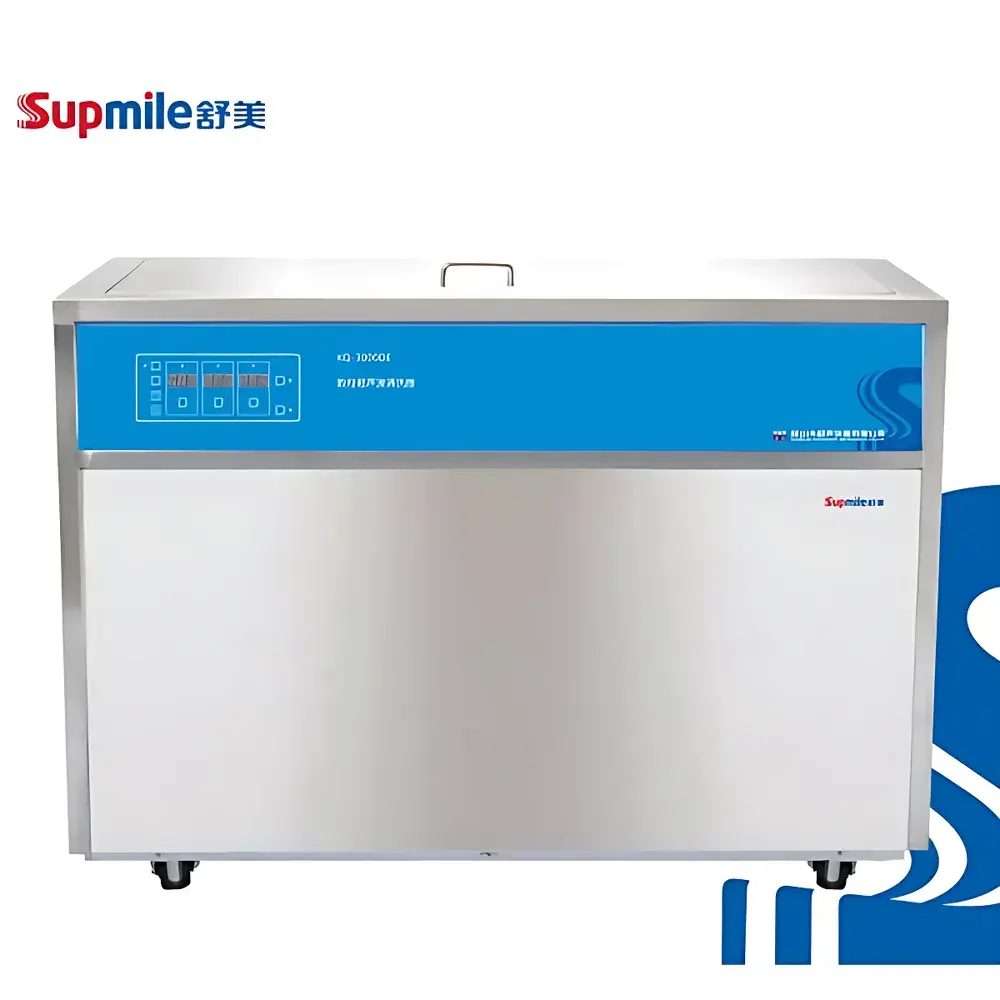
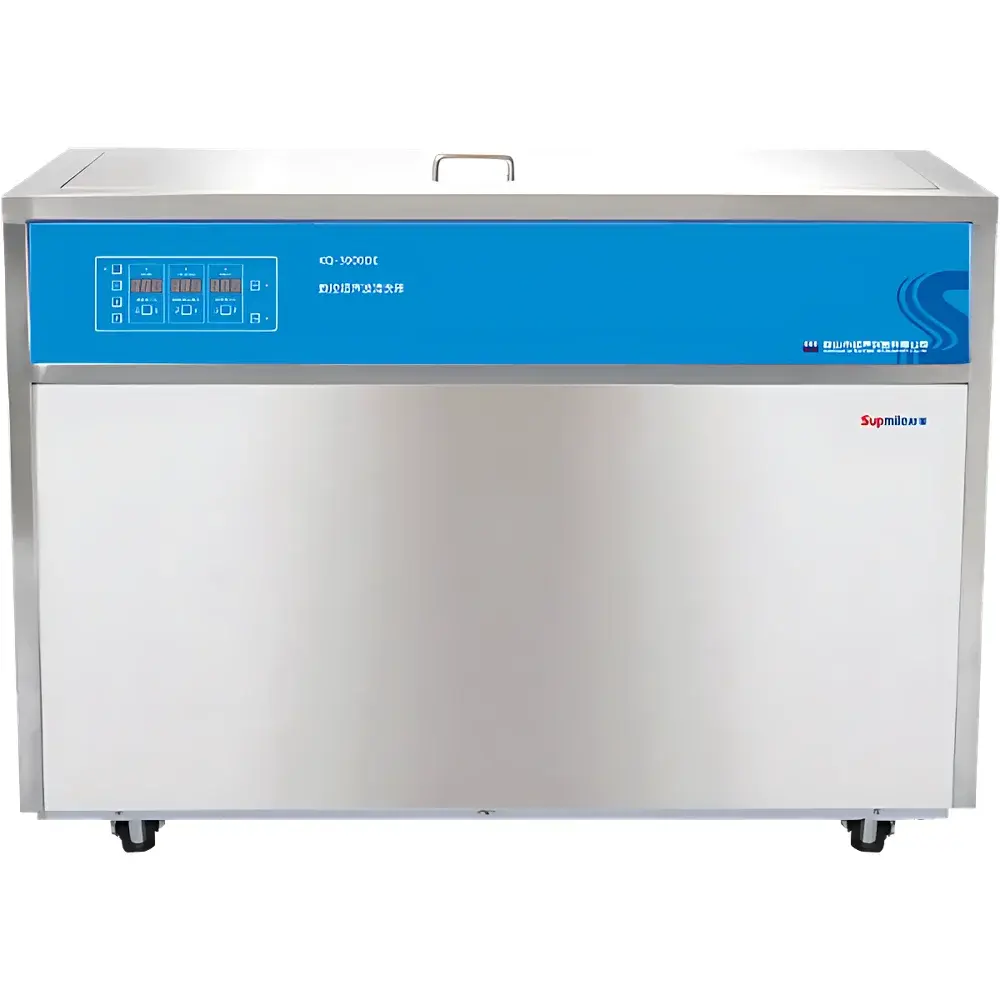
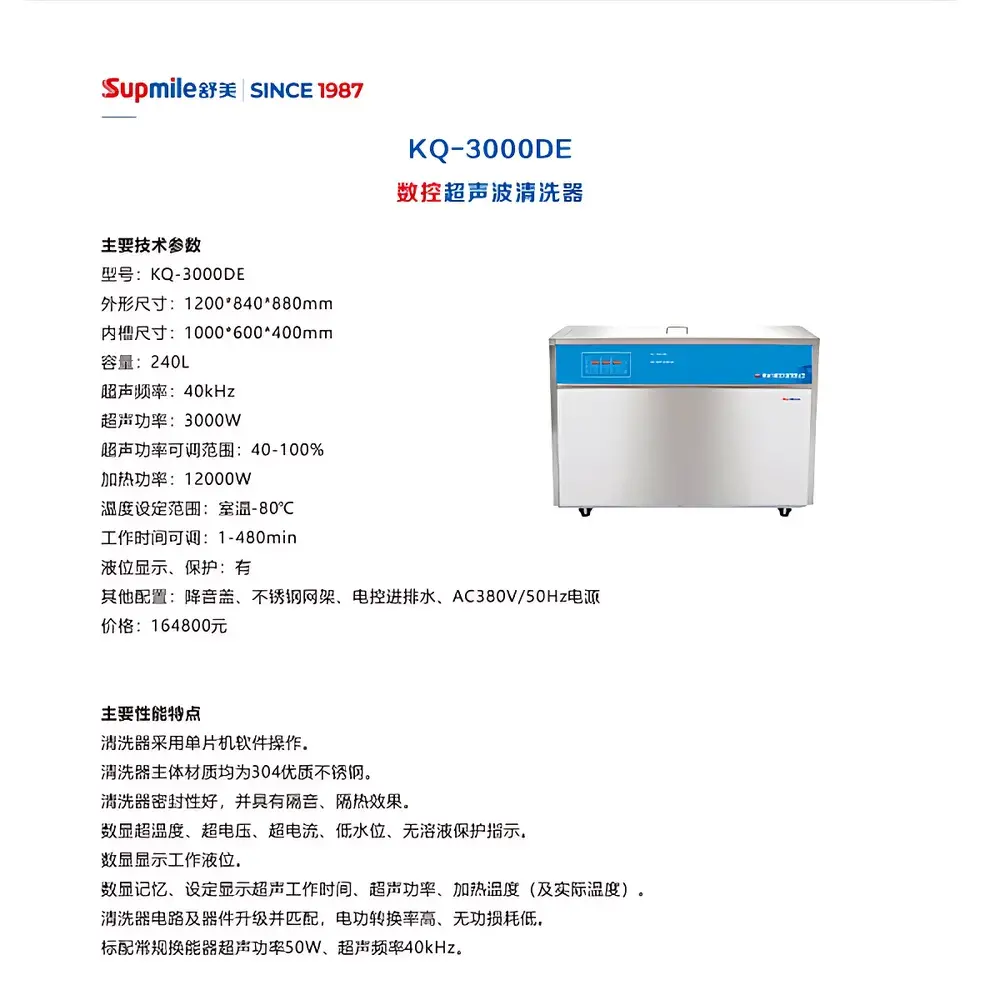
Shumei KQ-3000DE Digital Ultrasonic Cleaner
| Brand | Shumei |
|---|---|
| Origin | Jiangsu, China |
| Manufacturer Type | Direct Manufacturer |
| Product Category | Domestic (China-made) |
| Model | KQ-3000DE |
| Instrument Type | General-Purpose Ultrasonic Cleaner |
| Tank Capacity | 240 L |
| Ultrasonic Frequency | 40 kHz |
| Ultrasonic Power Output | 3000 W |
| Power Adjustment Range | 40–100% |
| Heating Temperature Range | Ambient to 80 °C |
| Heating Power | 12,000 W |
| Timer Range | 1–480 min |
| Sound-Dampening Lid | Yes |
| Automatic Fill/Drain Control | Electrically Actuated |
| Power Supply | AC 380 V / 50 Hz |
| Internal Tank Dimensions | 1000 × 600 × 400 mm |
| Overall Dimensions | 1200 × 840 × 880 mm |
| Construction Material | 304 Stainless Steel |
| Safety Protections | Low-level liquid detection, overtemperature, overvoltage, overcurrent, and dry-run prevention |
| Display | Digital LCD with real-time parameter monitoring and memory function |
Overview
The Shumei KQ-3000DE Digital Ultrasonic Cleaner is a high-capacity, industrial-grade cleaning system engineered for reproducible, non-destructive removal of particulate, organic, and oily contaminants from complex geometries in research laboratories, quality control facilities, and precision manufacturing environments. It operates on the principle of cavitation—generated by high-frequency (40 kHz) ultrasonic energy transmitted through aqueous or solvent-based cleaning media—producing microscopic implosions that dislodge surface-bound residues without mechanical abrasion. With a 240-liter stainless steel tank constructed entirely from ASTM A240 304-grade material, the unit supports large-volume batch processing of components such as optical lenses, surgical instruments, metal substrates, printed circuit boards, and analytical sample holders. Its robust architecture integrates digital microprocessor control, thermal regulation, and programmable timing to ensure process consistency across GLP- and GMP-aligned workflows.
Key Features
- Digital microcontroller-based operation with full parameter memory: stores and recalls preset values for ultrasonic power (%), heating temperature (°C), and cycle duration (min).
- Adjustable ultrasonic output (40–100% of 3000 W nominal power) enables optimization for delicate vs. heavily soiled loads.
- Integrated heating system (12,000 W) maintains stable bath temperatures from ambient up to 80 °C, enhancing detergent efficacy and contaminant solubility.
- Comprehensive safety interlocks include low-level liquid detection, overtemperature cutoff, overvoltage/overcurrent protection, and automatic shutdown during dry-run conditions.
- Sound-dampening lid reduces operational noise to ≤65 dB(A) at 1 m distance, meeting ISO 7779 and OSHA workplace acoustic guidelines.
- Electrically actuated fill-and-drain system allows hands-free, repeatable fluid management; compatible with deionized water, ethanol, isopropanol, and alkaline or acidic cleaning solutions.
- High-contrast LCD display shows real-time bath temperature, actual ultrasonic power delivery, elapsed time, and liquid level status.
Sample Compatibility & Compliance
The KQ-3000DE accommodates diverse sample types—including glassware, ceramic substrates, stainless steel fixtures, aluminum alloys, and polymer components—without risk of surface pitting or dimensional distortion under standard operating parameters. Its 304 stainless steel tank complies with ASTM A240 for corrosion resistance and cleanability. The unit meets CE marking requirements for electromagnetic compatibility (EN 61326-1) and electrical safety (EN 61010-1). While not certified for sterile processing per ISO 13485, it supports validation protocols aligned with ISO 14971 (risk management) and ASTM D2293 (ultrasonic cleaning performance testing). Optional documentation packages support IQ/OQ qualification for regulated environments.
Software & Data Management
The embedded control firmware supports audit-ready operation through persistent parameter logging: each cleaning cycle records start time, setpoints, actual measured values (temperature, power, duration), and fault events. Data export is available via RS-232 serial interface for integration into LIMS or electronic lab notebooks. Though no proprietary PC software is bundled, the device responds to standard SCPI-like ASCII commands, enabling automation via LabVIEW, Python, or PLC-based control systems. All user-modifiable settings are password-protected to prevent unauthorized changes—a prerequisite for FDA 21 CFR Part 11 compliance when paired with validated third-party data acquisition platforms.
Applications
- Pre-analytical sample preparation: cleaning HPLC vials, GC autosampler trays, and ICP-MS nebulizer components to eliminate trace metal carryover.
- Medical device reprocessing: removal of biofilm and proteinaceous residue from endoscopic accessories prior to sterilization.
- Electronics manufacturing: defluxing SMT assemblies and deburring micro-machined sensors without damaging solder joints or thin-film coatings.
- Materials science labs: degassing ceramic slurries, dispersing nanomaterials in suspension, and preparing metallographic specimens for SEM imaging.
- Pharmaceutical QC: cleaning dissolution apparatus baskets, tablet friability testers, and filter housings in accordance with USP and .
FAQ
What is the maximum allowable operating temperature for aqueous cleaning solutions?
The system supports continuous operation at up to 80 °C; prolonged exposure above this threshold may compromise transducer adhesion and gasket integrity.
Can the ultrasonic frequency be changed to 80 kHz or 130 kHz?
No—the KQ-3000DE is fixed at 40 kHz, optimized for general-purpose cleaning of macro-scale contaminants; higher frequencies require different transducer arrays and are offered in specialized models.
Is the tank drain valve compatible with standard laboratory floor drain connections?
Yes—the electrically actuated drain outlet features a 1/2-inch NPT male thread, adaptable to common PVC or stainless steel drainage lines.
Does the unit include validation documentation for GxP environments?
Factory calibration certificates and mechanical drawings are provided; full IQ/OQ documentation must be generated on-site using user-defined protocols and third-party metrology tools.
How often should the transducers be inspected for performance drift?
Annual verification using a calibrated hydrophone or calorimetric power measurement is recommended per ISO 13074 for critical applications.



