
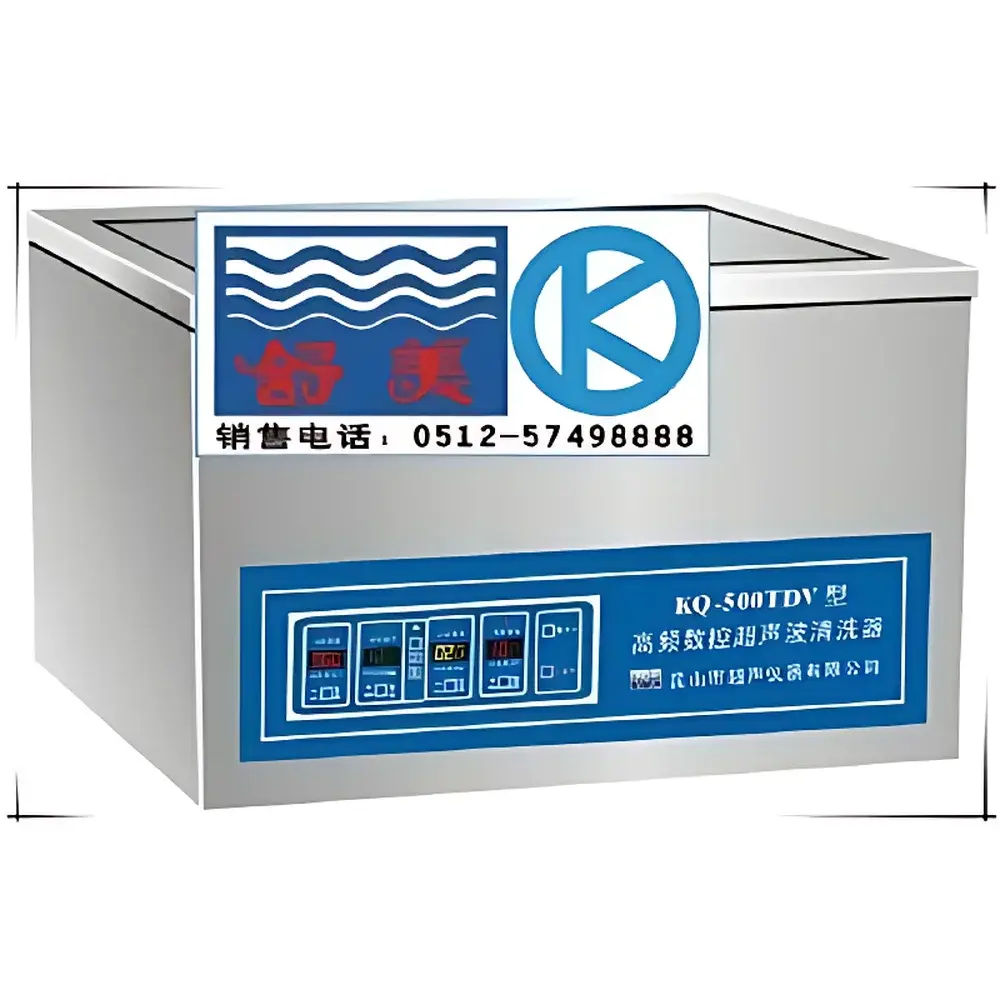
Shumei KQ-500TDV Desktop High-Frequency Digital Ultrasonic Cleaner
| Brand | Shumei |
|---|---|
| Origin | Jiangsu, China |
| Manufacturer Type | Direct Manufacturer |
| Country of Origin | China |
| Model | KQ-500TDV |
| Dimensions (W×D×H) | 610×410×380 mm |
| Inner Tank Dimensions | 500×300×180 mm |
| Capacity | 27 L |
| Ultrasonic Frequency | 80 kHz |
| Ultrasonic Power | 500 W |
| Power Adjustment Range | 40–100 % |
| Fill Level Range | 1–140 mm |
| Heating Power | 1000 W |
| Temperature Control Range | 10–80 °C |
| Timer Range | 1–480 min |
| Cumulative Operating Time | 999999 h |
| Tank Material | Stainless Steel (304) |
| Lid | Acoustic-Dampening Stainless Steel Cover |
| Water Inlet/Drain | Electrically Controlled |
| Vapor Recovery System | Integrated Automatic Condensate Recovery |
| Frequency Options | 50 / 60 / 70 / 80 / 100 kHz (model-specific) |
Overview
The Shumei KQ-500TDV is a precision-engineered desktop ultrasonic cleaner designed for laboratories and R&D facilities requiring high-fidelity cleaning, degassing, emulsification, cell disruption, and solvent-based extraction. Unlike conventional low- to mid-frequency units (typically 25–40 kHz), the KQ-500TDV operates at a fixed 80 kHz frequency—optimized to generate finer, more uniformly distributed cavitation bubbles with reduced acoustic shadowing and minimized surface erosion on delicate substrates. This higher frequency enables superior resolution in removing sub-micron particulates, organic residues, and biofilm contaminants from complex geometries such as microfluidic channels, optical lenses, semiconductor wafers, and analytical sample vials. Its integrated transducer-and-tank architecture ensures mechanical stability, thermal consistency, and long-term amplitude reproducibility—critical for method transfer across GLP-compliant environments.
Key Features
- Microprocessor-controlled digital interface with simultaneous real-time display of ultrasonic time, power level (%), bath temperature (°C), actual liquid level (mm), and cumulative operational hours (up to 999,999 h)
- Programmable ultrasonic power output (40–100 % in 1 % increments) and heating control (10–80 °C in 1 °C steps) for protocol repeatability
- Stainless steel (AISI 304) seamless tank formed by deep-drawing technology; corrosion-resistant, non-porous, and compliant with ISO 15190:2020 laboratory safety standards
- Acoustically damped stainless steel lid with automatic vapor condensation recovery system—reduces solvent loss and meets OSHA PEL requirements for volatile organic compound (VOC) exposure
- Electrically actuated fill/drain valves with dual-level liquid sensing (low-water and dry-run protection) and over-current/voltage fault detection
- Embedded firmware with EEPROM-based parameter retention—retains user-defined settings after power cycling without battery backup
- Frequency-selectable platform architecture (50/60/70/80/100 kHz variants available under TDV series)—enabling application-specific optimization per ASTM D2603 and ISO 13847
Sample Compatibility & Compliance
The KQ-500TDV accommodates a broad range of sample formats—including Petri dishes, cuvettes, probe tips, surgical instruments, MEMS devices, HPLC columns, and glassware up to 300 mm in height. Its 27 L capacity and 500 × 300 × 180 mm internal volume support batch processing while maintaining uniform energy distribution across the tank floor (validated via IEC 61000-4-3 radiated immunity testing). The unit conforms to CE marking directives (2014/30/EU EMC, 2014/35/EU LVD), RoHS 2011/65/EU, and carries factory calibration documentation traceable to NIM (National Institute of Metrology, China). For regulated labs, its deterministic timer logic, non-volatile event logging, and immutable parameter memory support audit readiness per FDA 21 CFR Part 11 when paired with validated third-party data capture software.
Software & Data Management
While the KQ-500TDV operates as a standalone instrument, its RS-232 serial port (optional USB-to-serial adapter) enables integration with external laboratory information management systems (LIMS) or custom SCADA interfaces. All displayed parameters—including real-time temperature deviation (±0.5 °C), power delivery accuracy (±3 % full scale), and elapsed cycle time—are accessible via ASCII command protocol. Internal firmware logs critical events (e.g., overtemperature shutdown, low-level alarm activation) with timestamps into a circular buffer—accessible via diagnostic mode for root-cause analysis during QA investigations. No proprietary drivers or cloud dependencies are required; communication adheres to Modbus RTU conventions for interoperability with industrial automation platforms.
Applications
- Pre-analytical sample preparation: removal of adsorbed proteins from LC-MS vials and autosampler needles
- Microelectronics: post-lithography resist residue cleaning from silicon wafers without pattern lift-off
- Pharmaceutical QC: dissolution apparatus component cleaning per USP
- Materials science: dispersion stabilization of nanomaterials (e.g., graphene oxide, TiO₂ nanoparticles) in aqueous/organic media
- Biotechnology: gentle lysis of bacterial cultures and tissue homogenates prior to nucleic acid isolation
- Optics manufacturing: particulate-free cleaning of coated lenses and interferometric mirrors
FAQ
What is the maximum recommended operating temperature for aqueous solutions?
The heating system is rated for continuous operation at up to 80 °C in water-based baths; for organic solvents, consult flash point and vapor pressure data before setting temperature above 45 °C.
Can the unit be operated without the lid engaged?
No—the acoustic damper lid must be fully closed and latched to enable ultrasonic output; interlock circuitry prevents transducer activation otherwise.
Is the 80 kHz frequency fixed, or can it be adjusted on this model?
The KQ-500TDV is factory-configured for 80 kHz; frequency selection requires hardware-level transducer replacement—only available as a factory-order option within the TDV series.
How is calibration verification performed?
Users may validate temperature accuracy using a NIST-traceable Pt100 probe; ultrasonic intensity can be assessed via aluminum foil erosion test (ASTM E1755-00) or calorimetric power measurement per IEC 61849.
Does the unit support remote start/stop via external TTL signal?
Not natively; however, the RS-232 interface supports ASCII command initiation of cleaning cycles, pause/resume, and parameter queries—enabling PLC or PC-based orchestration.



