
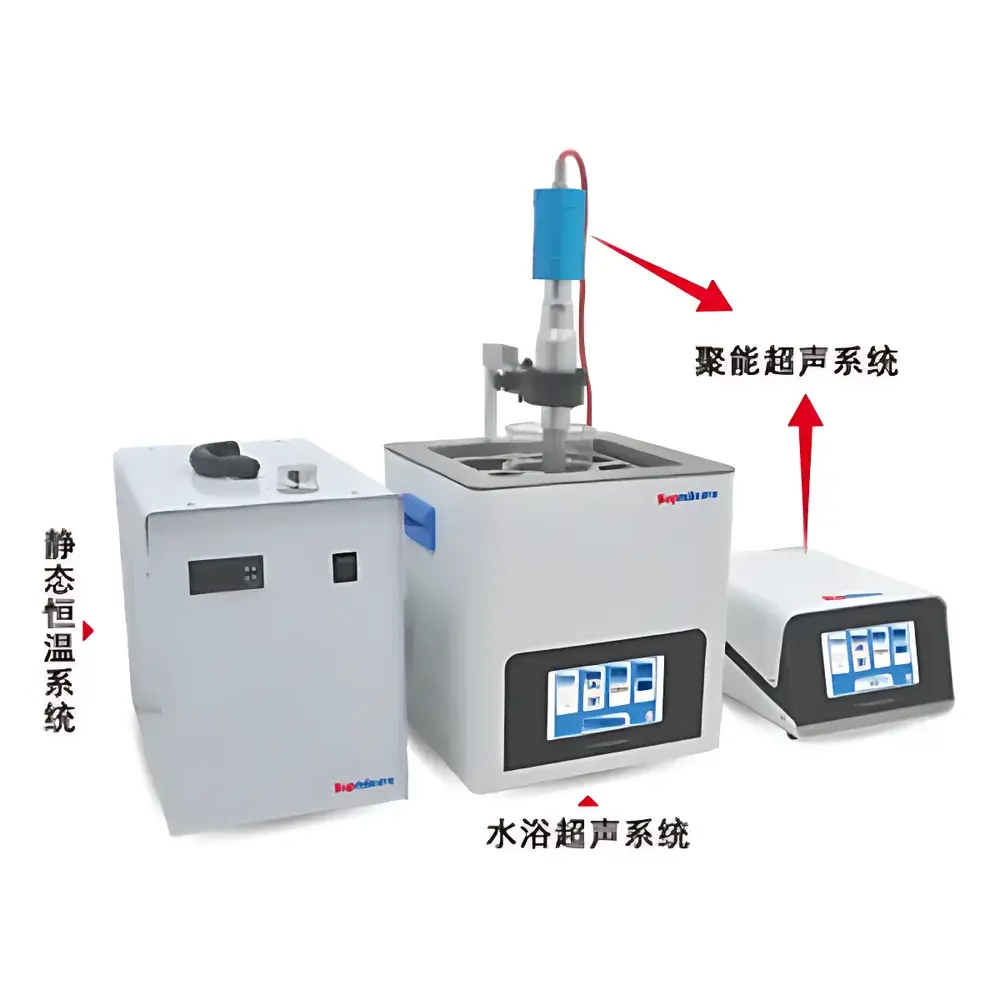
SHUMEI KBC-400ZH Tri-Mode Ultrasonic Processing System (Static Temperature-Controlled Bath + Immersion Ultrasonication + High-Intensity Probe Sonication)
| Brand | SHUMEI |
|---|---|
| Origin | Jiangsu, China |
| Manufacturer Type | Direct Manufacturer |
| Product Category | Domestic |
| Model | KBC-400ZH |
| Instrument Type | General-Purpose |
| Ultrasonic Frequency | 20 kHz ±1 kHz |
| Total Ultrasonic Power Output | 1000 W (Bath) + 1000 W (Probe) |
| Power Adjustment Range | 0–100% |
| Timer Range | 1 min – 99 h 59 min |
| Bath Tank Capacity | 15 L |
| Bath Dimensions (L×W×H) | 320 × 320 × 150 mm |
| Static Temperature Control Range | −60 °C to +100 °C |
| Circulating Cooling Capacity | 600 W @ −20 °C |
| Heating Power | 3000 W |
| Flow Rate | 10 L/min |
| Probe Tip Diameter | Φ13 mm |
| Compatible Volumes (Probe Mode) | 200–1000 mL |
| Pulse Mode Adjustable | 1 s – 59 min 59 s |
Overview
The SHUMEI KBC-400ZH Tri-Mode Ultrasonic Processing System is an integrated laboratory platform engineered for precision-controlled ultrasonic sample processing under thermally stable conditions. It combines three physically distinct ultrasonic modalities—temperature-regulated water bath sonication, high-intensity probe-based sonication (also known as “cup-horn” or “direct-contact” sonication), and static temperature control via a recirculating chiller-heater unit—within a single, modular architecture. Unlike conventional ultrasonic cleaners that rely solely on tank-based cavitation, the KBC-400ZH enables simultaneous or independent operation of bath and probe modes, while maintaining sample temperature within ±0.3 °C across extended durations (up to 99 h 59 min). Its core transduction principle is piezoelectric-driven mechanical oscillation at 20 kHz, generating controlled acoustic cavitation in liquid media. This facilitates reproducible physical disruption (e.g., cell lysis, particle deagglomeration), chemical enhancement (e.g., accelerated hydrolysis, Fenton-like reactions), and mass transfer intensification (e.g., solvent extraction, emulsification). The system is designed for applications demanding both thermal stability and localized energy delivery—critical in GMP-aligned sample prep, nanomaterial dispersion, and regulated bioanalytical workflows.
Key Features
- Triple-mode operational flexibility: Independent or concurrent use of water bath sonication, probe sonication, and static temperature control—enabling method optimization without hardware reconfiguration.
- Precision temperature management: Integrated recirculating chiller-heater with −60 °C to +100 °C setpoint range, 10 L/min flow rate, and dual-stage thermal regulation (600 W cooling / 3000 W heating) ensures minimal thermal drift during long-duration protocols.
- High-fidelity ultrasonic output: 20 kHz ±1 kHz frequency stability maintained across full power range (0–100%), with digital feedback control minimizing harmonic distortion and ensuring repeatable cavitation intensity.
- 7-inch TFT capacitive touchscreen interface: Graphical user interface supports multi-step program storage, real-time parameter monitoring (temperature, power, elapsed time), and fault diagnostics (over-temperature, over-current, over-voltage).
- Corrosion-resistant construction: Electropolished stainless steel tank and powder-coated steel chassis meet ISO 14644-1 Class 8 cleanroom-compatible surface requirements; all wetted parts are 316L-grade stainless steel.
- Energy-efficient transducer design: Optimized electroacoustic conversion efficiency (>82%) reduces reactive power draw and thermal load on internal electronics, extending component service life.
Sample Compatibility & Compliance
The KBC-400ZH accommodates a broad spectrum of sample types—including aqueous suspensions, organic solvents (e.g., ethanol, chloroform, acetone), viscous matrices (e.g., glycerol, PEG solutions), and heterogeneous slurries (e.g., soil extracts, nanoparticle dispersions). Its sealed bath design and probe isolation minimize cross-contamination risks, supporting workflows compliant with GLP and ISO/IEC 17025 documentation requirements. The system’s programmable timer and power ramping functions align with ASTM E2887-22 (Standard Guide for Ultrasonic Cleaning Process Validation) and USP Analytical Instrument Qualification. Full audit trail capability—including operator ID, parameter changes, and event timestamps—is supported when paired with SHUMEI’s optional LabLink™ data logging software (compliant with FDA 21 CFR Part 11 Annex 11 requirements).
Software & Data Management
The embedded firmware supports up to 99 customizable protocols, each storing temperature setpoints, ultrasonic power profiles, pulse intervals, and duration parameters. Optional LabLink™ PC software enables remote configuration, real-time data streaming (CSV export), and electronic signature-enabled report generation. All operational logs—including thermal deviation alerts, transducer impedance shifts, and duty cycle history—are timestamped and stored in non-volatile memory for ≥12 months. Data integrity safeguards include write-protected archive mode, SHA-256 hash verification for exported files, and role-based access control (administrator/operator/viewer tiers).
Applications
- Life sciences: Chromatin immunoprecipitation (ChIP) shearing, microbial cell lysis, organelle isolation, and RNA/DNA extraction from fibrous tissues.
- Materials science: Exfoliation of 2D materials (graphene, MoS₂), dispersion of carbon nanotubes and metal oxides in polymer matrices, and synthesis of metal-organic frameworks (MOFs).
- Environmental analysis: Accelerated extraction of PAHs, PCBs, and organochlorine pesticides from soil/sediment per EPA Method 3550C.
- Pharmaceutical R&D: Herbal active ingredient recovery (e.g., curcumin, paclitaxel), nanoemulsion formulation, and crystallization nucleation control.
- Chemical synthesis: Ultrasound-assisted Suzuki coupling, esterification, and oxidative degradation of refractory organics (e.g., COD reduction in wastewater simulants).
FAQ
Can the bath and probe operate simultaneously without thermal interference?
Yes—the static temperature control system actively compensates for probe-induced heating by adjusting chiller output in real time, maintaining bath setpoint within ±0.5 °C even during continuous 100% probe operation.
Is the probe compatible with corrosive solvents such as concentrated HNO₃ or HF?
The standard Φ13 mm titanium alloy probe is rated for pH 1–12 and non-hydrofluoric acids; optional Hastelloy C-276 probes are available for HF-containing media.
Does the system support IQ/OQ/PQ documentation packages?
Yes—SHUMEI provides vendor-validated qualification templates aligned with ASTM E2500-22 and EU GMP Annex 15, including calibration certificates traceable to NIM (China National Institute of Metrology).
What is the minimum recommended volume for effective probe sonication?
200 mL is the validated lower limit for uniform energy distribution in the KBC-400ZH’s probe configuration; volumes below this require custom horn geometry or flow-cell integration.
How is acoustic output calibrated and verified?
Each unit undergoes calorimetric power verification per IEC 61847-2 using a calibrated aluminum calorimeter; calibration reports include uncertainty budgets (k=2) and traceability statements.



