
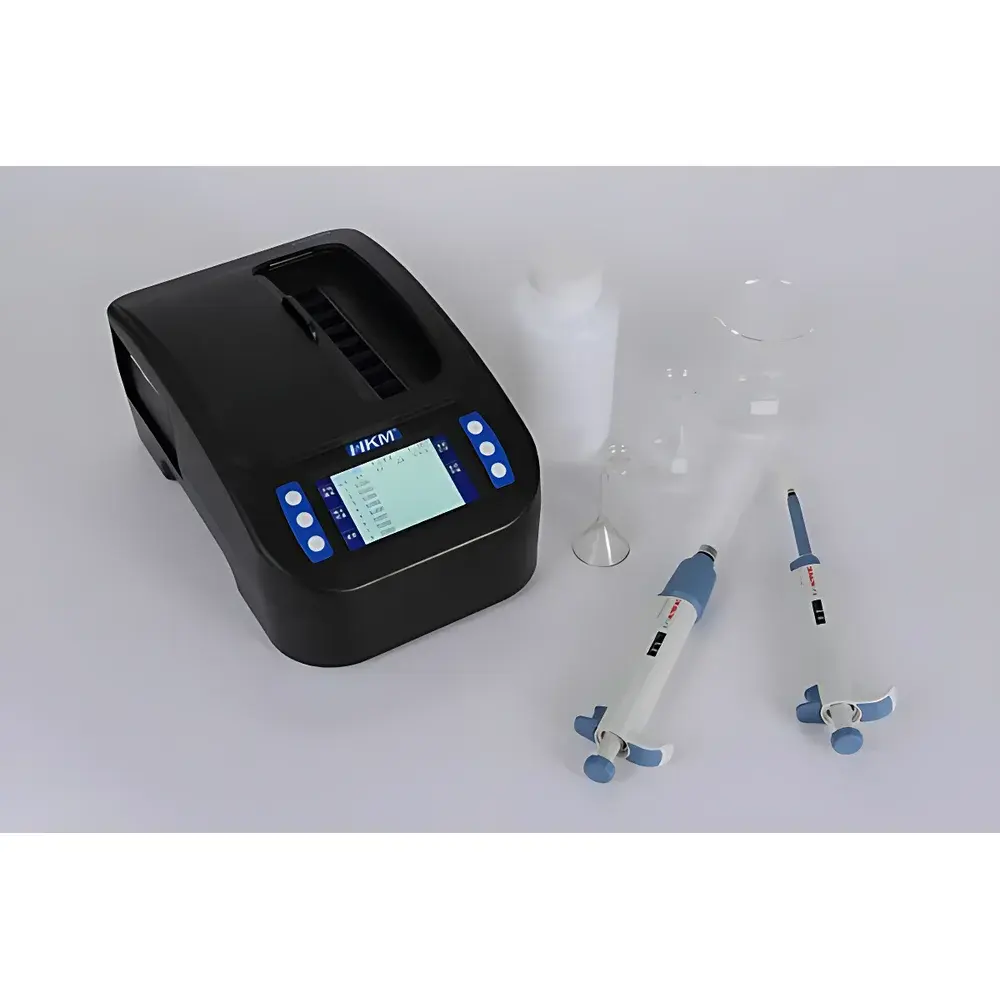
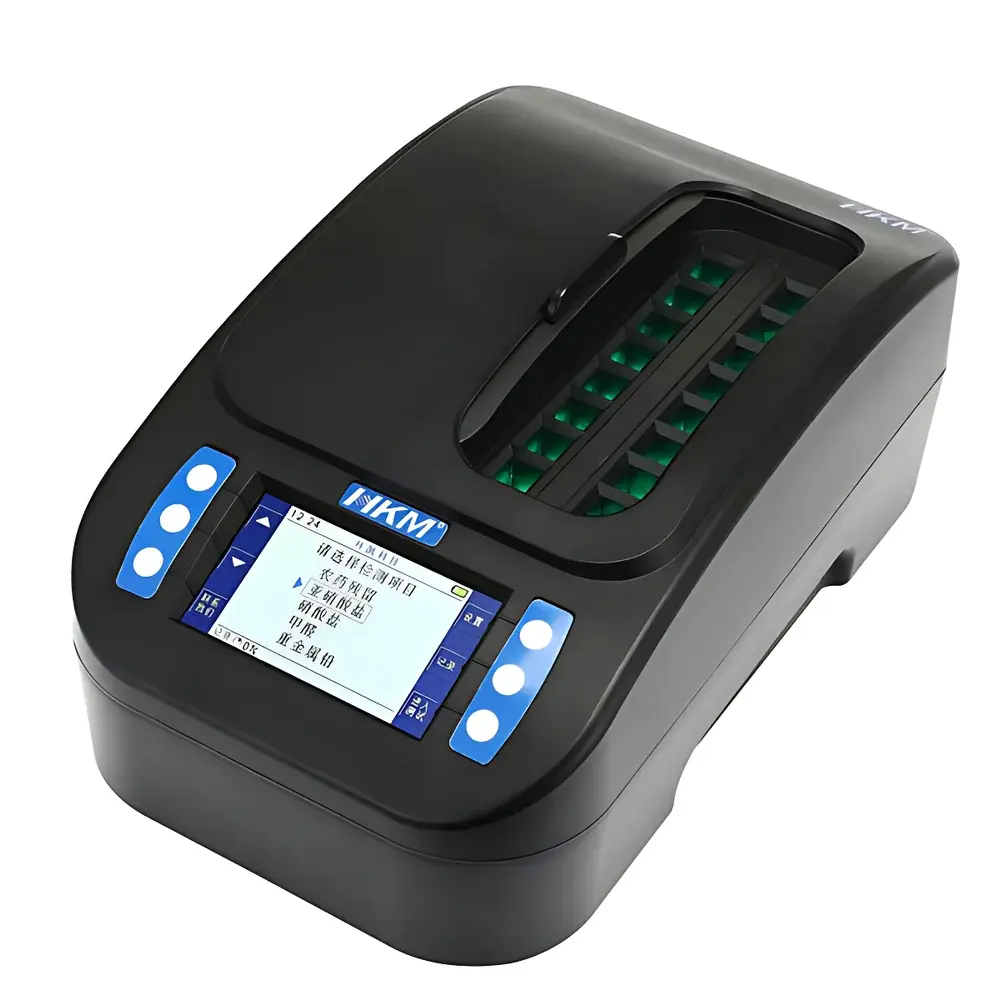
HKM NC Series Pesticide Residue Rapid Tester (Enzyme Inhibition Method)
| Brand | HKM |
|---|---|
| Origin | Guangdong, China |
| Model | NC Series |
| Detection Method | Enzyme Inhibition Spectrophotometry |
| Measurement Range | 0–100% inhibition rate |
| Channel Count | 8 or 16 independent optical channels |
| Measurement Error | ±0.5% (inhibition rate) |
| Limit of Detection (LOD) | 0.3 ppm (for common organophosphates and carbamates) |
| Absorbance Range | 0–3.0 AU |
| Absorbance Accuracy | ±0.01 (0–2.0 AU) |
| Zero Drift | ≤0.1%/3 min |
| Repeatability | ±0.5% (transmittance) |
| Assay Time | 1–9 minutes per sample |
| Display | 4.3″ color TFT LCD (480×272 resolution) |
| Dimensions | 300 × 200 × 130 mm |
| Battery | 6400 mAh rechargeable Li-ion (≥24 h continuous operation) |
| Data Storage | Up to 780,000 test records |
| Interface | USB 2.0 |
| Compliance | GB/T 5009.199–2003, NY/T 448–2001 |
Overview
The HKM NC Series Pesticide Residue Rapid Tester is a dedicated benchtop spectrophotometric analyzer engineered for quantitative determination of organophosphate and carbamate pesticide residues in fresh agricultural commodities—primarily fruits and vegetables. It operates on the principle of acetylcholinesterase (AChE) enzyme inhibition: active AChE hydrolyzes a chromogenic substrate (e.g., indoxyl acetate), yielding a colored product measurable at 412 nm; residual pesticides inhibit AChE activity proportionally, resulting in reduced color development and quantifiable absorbance suppression. This method aligns with internationally recognized rapid screening paradigms for food safety surveillance and conforms to Chinese national standard GB/T 5009.199–2003 and agricultural industry standard NY/T 448–2001. Designed for field-deployable reliability and laboratory-grade reproducibility, the instrument delivers consistent inhibition-rate measurements across diverse ambient conditions—enabling frontline food safety verification without reliance on centralized GC-MS or HPLC infrastructure.
Key Features
- Eight or sixteen fully independent optical detection channels, each equipped with a dedicated high-brightness LED light source (peak wavelength 412 nm), precision cuvette holder, and imported photodiode sensor—eliminating cross-channel interference and enabling true parallel analysis.
- Closed-loop automatic optical calibration system continuously monitors and adjusts LED output intensity to compensate for thermal drift or aging, ensuring stable photometric performance over extended operational cycles.
- Real-time auto-zero and auto-100% transmittance calibration prior to each assay cycle—no manual reference adjustment required.
- Integrated self-diagnostic firmware identifies hardware faults (e.g., lamp failure, sensor saturation, temperature sensor deviation) and displays actionable error codes on the 4.3″ color TFT screen.
- Robust ABS engineering plastic chassis with piano-black finish; ergonomic form factor optimized for mobile use in markets, distribution centers, and field laboratories.
- Onboard thermal printer supports immediate hardcopy documentation of results—including sample ID, timestamp, inhibition rate, pass/fail status, and operator ID.
- 6400 mAh lithium-ion battery enables ≥24 hours of continuous operation; includes 12 V DC automotive adapter for integration into mobile food safety inspection vehicles.
Sample Compatibility & Compliance
The NC Series accepts homogenized aqueous extracts from leafy greens, tomatoes, apples, cucumbers, peppers, and other produce matrices following standardized sample preparation protocols (e.g., 2 g sample + 20 mL extraction buffer, vortexed, centrifuged, supernatant used). It detects >15 priority pesticides—including dichlorvos (LOD: 0.1 mg/kg), carbofuran (0.05 mg/kg), methomyl (0.1 mg/kg), and omethoate (0.8 mg/kg)—with demonstrated sensitivity exceeding minimum required performance levels (MRPLs) stipulated in GB/T 5009.199–2003. All measurement data adhere to GLP-aligned traceability requirements: timestamps, channel-specific raw absorbance values, inhibition calculations, and operator metadata are embedded in each record. The system supports audit-ready data export via USB for integration into regional food safety information platforms, including China’s Food Safety Traceability Network.
Software & Data Management
The embedded firmware implements secure local data governance: 780,000 test records are stored with time-stamped metadata (date, time, channel ID, sample ID, inhibition %, pass/fail flag). USB connectivity enables bidirectional communication with Windows-based desktop software for batch result review, statistical summary (mean, SD, CV%), trend charting, and PDF report generation. Data export formats include CSV and XML—compatible with LIMS environments. While the instrument itself does not implement FDA 21 CFR Part 11 electronic signature controls, its deterministic measurement logic, immutable timestamping, and full audit trail support regulatory readiness during GMP or market supervision audits.
Applications
- Routine pre-harvest screening at commercial farms and cooperatives to verify compliance before shipment.
- Point-of-sale verification in wholesale markets, supermarket backrooms, and cold-chain distribution hubs.
- Regulatory enforcement testing by municipal Market Supervision Bureaus, CDC laboratories, and agricultural extension stations.
- Quality assurance workflows in certified organic production systems requiring documented residue absence.
- Educational use in food science curricula for hands-on instruction in rapid biochemical assay principles.
FAQ
What pesticides does the NC Series detect?
It quantifies inhibition caused by organophosphate and carbamate pesticides—including dichlorvos, parathion, omethoate, carbofuran, and methomyl—based on their shared mechanism of acetylcholinesterase inhibition.
Is enzymatic reagent stability guaranteed under tropical conditions?
Yes. The lyophilized AChE and substrate reagents exhibit validated thermal stability up to 40 °C for ≥6 months when stored desiccated at room temperature, eliminating cold-chain dependency.
Can test results be exported to national food safety databases?
Yes. Raw data files (CSV/XML) generated via USB can be ingested directly into provincial food safety monitoring platforms compliant with China’s GB 31604 series data exchange specifications.
How is measurement accuracy maintained over time?
Through dual stabilization: (1) closed-loop LED intensity control and (2) real-time photodiode baseline tracking—both correcting for environmental and component-level drift without user intervention.
Does the instrument require external calibration standards?
No. All calibrations (zero and 100% transmittance) are performed automatically using internal reference optics prior to each assay sequence.





