
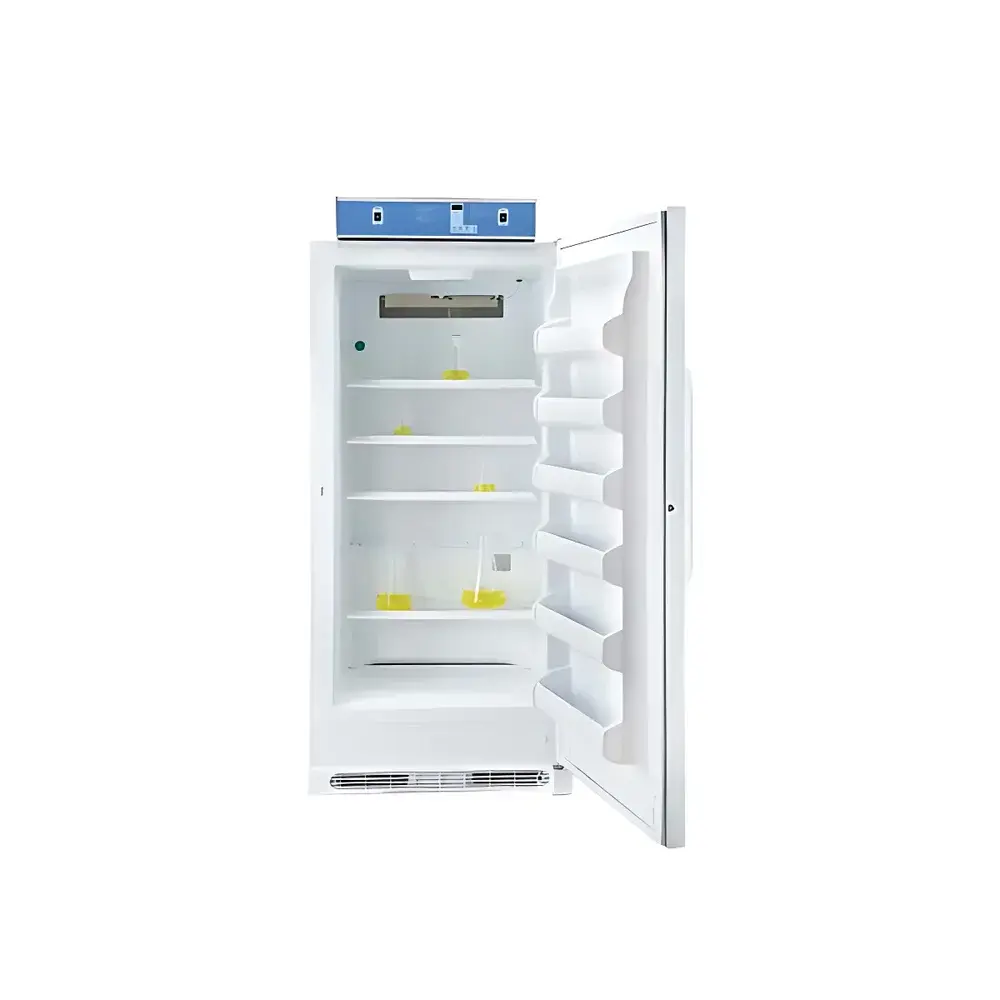
Cole-Parmer Model 39350-05 Plant Growth Chamber
| Brand | Cole-Parmer |
|---|---|
| Origin | USA |
| Model | 39350-05 |
| Chamber Volume | 566 L |
| Temperature Range | −10 to 50 °C (lamp off) |
| Temperature Uniformity | ±0.9 °C at −10 °C, ±0.5 °C at 20 °C, ±0.6 °C at 50 °C |
| Temperature Accuracy | ±0.1 °C |
| Air Circulation | Forced-air mechanical convection |
| Control System | Microprocessor-based with high-limit/low-limit safety cutoff and digital temperature calibration |
| Interface | RS232 serial port |
| Lighting | Two 1.2 m T8 fluorescent lamps (included) |
| Timer Function | Programmable 7-day schedule with up to two heating/light cycles per day |
| Shelving | 6 adjustable stainless-steel shelves |
| Internal Dimensions (W×H×D) | 67.3 × 144.8 × 50.8 cm |
| External Dimensions (W×H×D) | 70 × 191 × 66 cm |
| Power Supply | 230 V, 50/60 Hz, 800 W |
| Weight | 158 kg |
| Data Logging Port | Standard analog output connector for external recorder |
Overview
The Cole-Parmer Model 39350-05 Plant Growth Chamber is a precision-engineered environmental control system designed for reproducible, long-term cultivation of photobiological specimens under tightly regulated thermal and photoperiodic conditions. Built to meet the stringent requirements of academic plant physiology labs, pharmaceutical stability testing suites, and environmental microbiology facilities, this chamber employs forced-air convection and microprocessor-based PID temperature regulation to maintain stable setpoints across its full operating range of −10 to 50 °C (lamp off) or 10 to 50 °C (lamp on). Its dual-mode thermal architecture—capable of sub-zero cooling and precise ambient heating—enables studies involving cold-acclimation responses, vernalization protocols, and thermotolerance assays. The integrated fluorescent lighting system provides uniform photosynthetically active radiation (PAR) distribution, supporting both photomorphogenic development and quantitative physiological measurements such as BOD/COD analysis, algal growth kinetics, and tissue culture expansion.
Key Features
- Forced-air convection system ensures rapid thermal equilibration and minimizes vertical/horizontal gradients; temperature uniformity is validated per ISO 15272:2017 guidelines for environmental test chambers
- Microprocessor controller with dual-stage safety protection: programmable high- and low-temperature cutoffs prevent sample loss during power anomalies or sensor drift
- Digital temperature calibration function allows traceable field adjustment against NIST-traceable reference probes (±0.1 °C accuracy at 20 °C)
- RS232 serial interface supports bidirectional communication with LabVIEW, MATLAB, or custom SCADA systems for remote monitoring and automated data logging
- Seven-day programmable timer enables complex photoperiod scheduling—including staggered light-on/light-off sequences and ramped temperature profiles—without manual intervention
- Robust construction includes a fully gasketed, key-locked double-pane door with low-emissivity glass to reduce radiant heat transfer and improve energy efficiency
- Standard analog output port (0–5 V or 4–20 mA configurable) interfaces directly with strip-chart recorders or industrial DCS platforms for GLP-compliant audit trails
Sample Compatibility & Compliance
The 39350-05 accommodates diverse biological sample formats including Petri dishes, multi-well plates, Erlenmeyer flasks, hydroponic trays, and tissue culture vessels—up to six adjustable stainless-steel shelves support flexible load configuration. Its internal volume (566 L) and optimized airflow design minimize edge effects commonly observed in smaller chambers, ensuring consistent environmental exposure across all positions. The unit complies with IEC 61000-6-3 (EMC emissions), UL 61010-1 (electrical safety), and meets essential requirements of EU Directive 2014/30/EU (EMC) and 2014/35/EU (LVD). While not certified for GMP manufacturing environments, its temperature stability, calibration traceability, and data export capability make it suitable for preclinical research workflows aligned with FDA 21 CFR Part 11 expectations when paired with validated software.
Software & Data Management
No proprietary software is bundled; however, the RS232 interface enables integration with third-party platforms supporting Modbus RTU or ASCII command protocols. Users may configure continuous real-time logging via Python-based scripts (PySerial), MATLAB Instrument Control Toolbox, or commercial solutions such as NI DIAdem or A&D WinCT. The analog output port permits connection to standalone chart recorders compliant with ISO/IEC 17025 calibration standards. All temperature setpoints, alarm thresholds, and timer schedules are retained in non-volatile memory during power interruption—eliminating reprogramming overhead after utility outages.
Applications
- Plant phenotyping under controlled photoperiods and diurnal temperature cycles
- Biochemical oxygen demand (BOD5) and chemical oxygen demand (COD) incubation per ASTM D5210 and EPA Method 410.4
- Mycological culture maintenance and fungal sporulation studies
- Algal biomass production optimization under variable light intensity and spectral composition
- Seed germination assays requiring stratification at sub-zero temperatures followed by controlled warming
- Cell line propagation where circadian rhythm synchronization is critical (e.g., circadian reporter assays)
- Environmental stress response modeling—including drought simulation via humidity co-control (when integrated with optional external humidifier)
FAQ
Does the chamber support humidity control?
No—this model operates as a dry-air environment chamber. Humidity regulation requires external vapor delivery systems or retrofitting with aftermarket humidification modules.
Can the fluorescent lamps be replaced with LED arrays?
Yes—provided the LED driver voltage and physical mounting dimensions match the existing T8 fixture geometry and ballast interface. Spectral output must be verified for compatibility with experimental photobiology endpoints.
Is the RS232 interface optically isolated?
No—galvanic isolation is not built-in; users deploying in electrically noisy environments should employ externally powered USB-to-RS232 adapters with isolation circuitry.
What is the mean time between failures (MTBF) for the compressor system?
Based on field service data from Cole-Parmer’s North American distributor network, the sealed rotary compressor exhibits an MTBF exceeding 35,000 hours under continuous operation at 25 °C ambient.
Are calibration certificates included with shipment?
A factory-as-tested certificate of conformance is provided; NIST-traceable calibration documentation requires separate purchase and on-site verification by an accredited metrology provider.



