
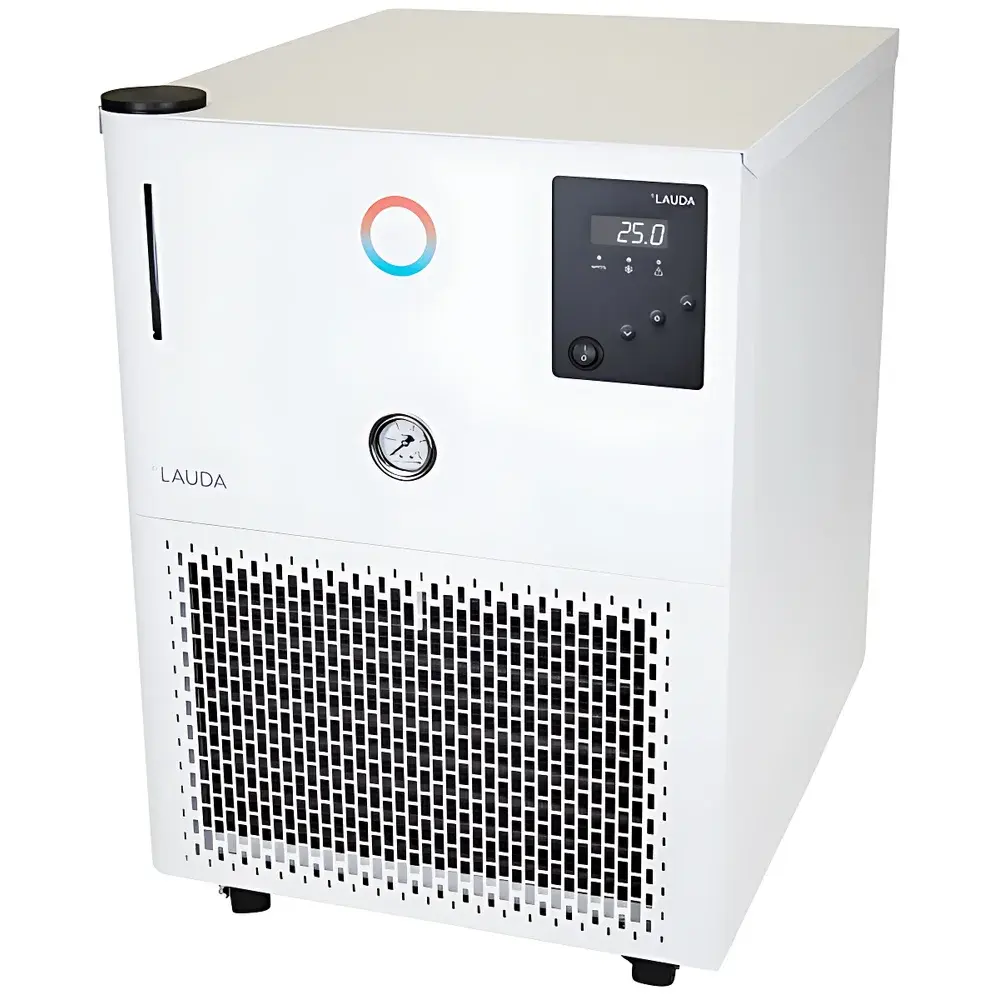
LAUDA Microcool Series Recirculating Chillers
| Brand | LAUDA |
|---|---|
| Origin | Germany |
| Model Range | MC250, MC350, MC600, MC1200 |
| Temperature Range | −10 to +40 °C |
| Temperature Stability | ±0.5 K |
| Cooling Capacity (at 20 °C) | 0.25–1.2 kW |
| Max. Pump Pressure | 1.3 bar |
| Max. Pump Flow Rate | 2–14 L/min |
| Bath Volume | 2–7 L |
| Construction | Benchtop (MC250/MC350) and Floor-Standing (MC600/MC1200) |
Overview
The LAUDA Microcool Series recirculating chillers are precision-engineered thermal management systems designed for stable, continuous temperature control in laboratory and analytical applications. Operating on a closed-loop vapor-compression refrigeration cycle with R-410A refrigerant, these units deliver accurate heat extraction across a wide ambient-compatible range of −10 °C to +40 °C. Engineered for integration with heat-generating instruments—including rotary evaporators, distillation assemblies, HPLC column ovens, spectrophotometer detectors, and laser sources—the Microcool series ensures thermal equilibrium critical for reproducible experimental outcomes. Each model features a corrosion-resistant stainless-steel bath reservoir, hermetically sealed scroll compressors, and intelligent PID-based temperature regulation, enabling consistent thermal performance under variable load conditions typical of multi-instrument lab environments.
Key Features
- Four scalable models (MC250, MC350, MC600, MC1200) covering cooling capacities from 0.25 kW to 1.2 kW at 20 °C—optimized for both benchtop and floor-standing deployment.
- Precision temperature stability of ±0.5 K across the full operating range, validated per DIN EN 61000-4-30 for thermal repeatability in GLP-compliant workflows.
- High-efficiency centrifugal pump with adjustable flow (2–14 L/min) and pressure up to 1.3 bar, supporting long fluid paths and multiple parallel instrument connections.
- Compact footprint design: MC250 and MC350 occupy ≤0.08 m²; MC600 and MC1200 feature reinforced chassis and castor-mounted bases for under-bench installation.
- Integrated safety architecture including dry-run protection, overtemperature cutoff, refrigerant leak detection, and automatic system shutdown upon sensor fault or bath level depletion.
- Intuitive LED interface with dual-display (setpoint/actual temperature), programmable ramping profiles, and real-time pump status feedback.
Sample Compatibility & Compliance
The Microcool series is compatible with water, water-glycol mixtures (up to 30 % v/v), and other non-corrosive heat-transfer fluids approved by LAUDA Material Compatibility Guidelines. All models meet CE marking requirements under the EU Machinery Directive 2006/42/EC and Electromagnetic Compatibility Directive 2014/30/EU. Refrigeration components comply with F-Gas Regulation (EU) No. 517/2014. Units support audit-ready operation in regulated environments: optional RS485 Modbus RTU or Ethernet TCP/IP interfaces enable integration into LabVantage, STARLIMS, or custom SCADA systems for 21 CFR Part 11-compliant data logging when paired with LAUDA’s optional software suite. Bath materials conform to USP Class VI and ISO 10993-5 standards for biocompatibility where applicable.
Software & Data Management
While standalone operation requires no external software, LAUDA’s optional ChillerControl Suite (v3.2+) provides remote monitoring, event-driven alarm notifications (email/SNMP), and time-stamped parameter logging (temperature, flow, compressor duty cycle, error codes). Data export is supported in CSV and XML formats, with configurable sampling intervals (1 s–60 min). The suite supports role-based access control (RBAC), electronic signature workflows, and automated report generation aligned with ISO/IEC 17025 internal audit requirements. Firmware updates are performed via secure HTTPS upload with SHA-256 signature verification.
Applications
- Condenser cooling for rotary evaporation and fractional distillation under vacuum.
- Thermal stabilization of UV-Vis, FTIR, and fluorescence spectrometers during extended acquisition sequences.
- Cooling jacket support for glass reaction vessels (e.g., Diehm reactors) during exothermic synthesis.
- Heat dissipation for high-power analytical light sources (e.g., xenon arc lamps, diode lasers).
- Temperature conditioning of HPLC autosampler trays and detector flow cells to minimize baseline drift.
- Environmental simulation pre-conditioning in materials testing labs (e.g., ASTM D5272 thermal cycling setups).
FAQ
What is the recommended heat-transfer fluid for extended service life?
Deionized water is optimal for temperatures above 0 °C; for sub-zero operation, use LAUDA Thermofluid G30 (propylene glycol/water, 30 % v/v), which maintains viscosity <25 cSt at −10 °C and inhibits microbial growth.
Can the MC1200 be integrated into a building BMS via analog I/O?
Yes—optional 4–20 mA analog output modules provide real-time temperature and cooling load signals; discrete inputs support remote start/stop and alarm acknowledgment per EN 14597.
Is calibration traceability available for the internal Pt100 sensor?
Each unit ships with a factory calibration certificate traceable to PTB (Physikalisch-Technische Bundesanstalt); on-site recalibration services are offered annually via LAUDA-certified field engineers.
How does the system handle intermittent load fluctuations during overnight runs?
Adaptive compressor modulation and buffer volume optimization minimize temperature overshoot; the PID controller dynamically adjusts refrigerant expansion valve position based on real-time delta-T and flow rate feedback.
What maintenance intervals are specified under continuous 24/7 operation?
Compressor oil inspection every 12 months; filter replacement every 24 months; full refrigerant circuit integrity check (leak test + moisture analysis) every 36 months—documented in accordance with ISO 5149-2.



