
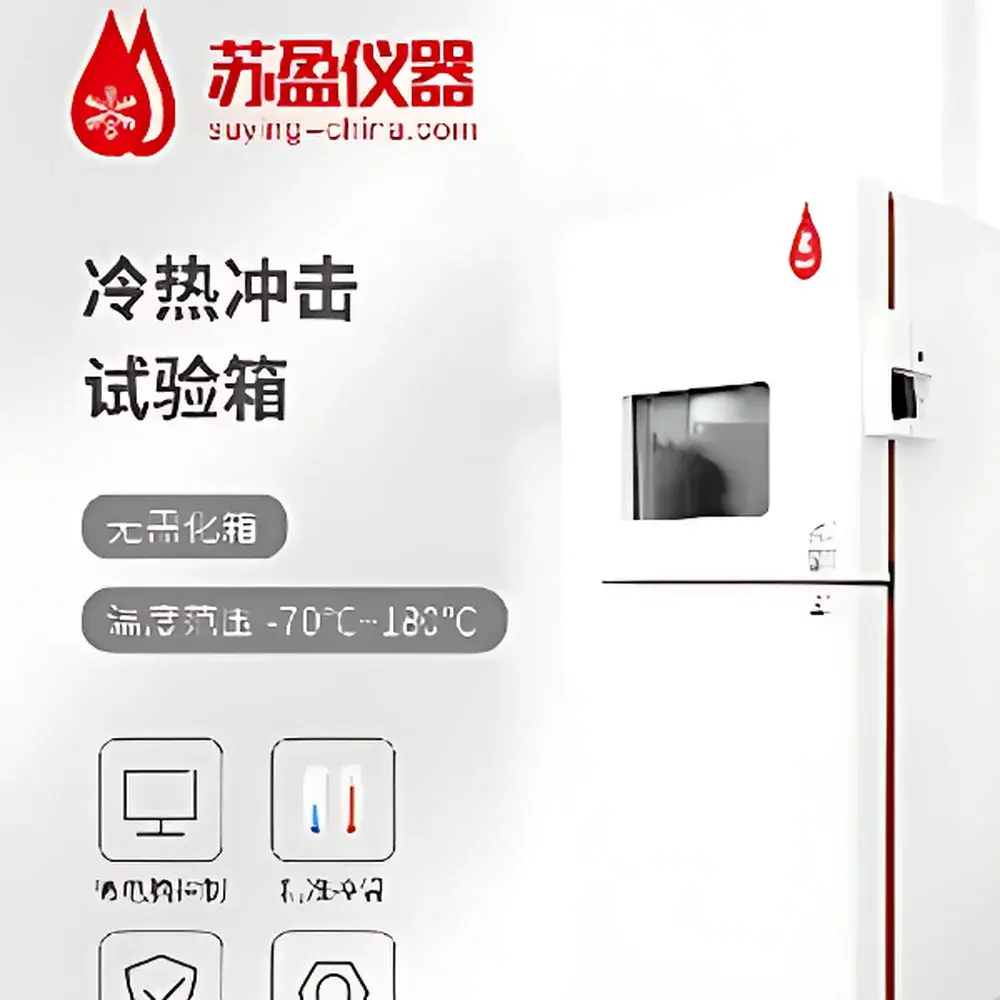
SuYing WDCJ-100/250/500 Series Thermal Shock Test Chamber
| Brand | SuYing |
|---|---|
| Origin | Shanghai, China |
| Model | WDCJ-100 / WDCJ-250 / WDCJ-500 |
| Temperature Range (A/B/C) | -20/-40/-60 ℃ to 200 ℃ |
| Transfer Time (Hot ↔ Cold) | ≤15 s |
| Temperature Recovery Time | ≤5 min |
| Sample Zone Temp. Uniformity | ±0.5 ℃ (at steady state) |
| Sample Load Capacity | 20–50 kg |
| Compressor System | Dual-stage cascade refrigeration (R404A/R23) |
| Controller | OYO 9882 dual-loop touch-screen PID controller |
| Compliance | GB/T 2423.1–2, GB 10592–1989, GJB 150A–2009 |
| Power Consumption | 5.7–16 kW (model-dependent) |
Overview
The SuYing WDCJ Series Thermal Shock Test Chamber is an engineered environmental stress screening (ESS) system designed for rapid, repeatable thermal cycling between extreme high- and low-temperature zones. Based on the principle of mechanical thermal shock—where specimens undergo abrupt transitions between independently controlled hot and cold chambers—the system subjects components to accelerated aging effects induced by repeated expansion and contraction of dissimilar materials. This methodology is critical for identifying latent defects in solder joints, wire bonds, encapsulants, and PCB laminates prior to field deployment. The chamber implements a three-zone architecture (hot chamber, cold chamber, and test zone), enabling true “one-chamber-three-functions” operation: thermal shock, high-temperature soak, and low-temperature soak—without requiring reconfiguration or external conditioning units. Its dual-stage cascade refrigeration system ensures stable operation across extended test cycles while maintaining precise thermal gradients essential for compliance with MIL-STD-810, JEDEC JESD22-A104, and IEC 60068-2-14 protocols.
Key Features
- Independent dual-zone temperature control: Hot chamber (up to +200 ℃) and cold chamber (down to –60 ℃) operate simultaneously with zero cross-contamination via sealed, interlocked doors and physical thermal barriers.
- High-speed basket transfer mechanism: Achieves ≤15-second transition between temperature extremes, minimizing dwell time and maximizing thermal gradient severity per cycle.
- OYO 9882 dual-loop PID touchscreen controller: Supports up to 99 programmable segments across 10 stored profiles; features auto-tuning, real-time curve plotting, data logging, and 485 RS-communication for SCADA integration.
- Cascade refrigeration architecture: Utilizes separate R404A (high-stage) and R23 (low-stage) circuits with evaporative condenser coupling—ensuring reliable sub–40 ℃ performance and energy-efficient load modulation.
- Safety-integrated interlock system: Automatic power cutoff to circulation fans and transfer basket upon door opening; over-temperature cutouts on both chambers; oil-level and high-pressure monitoring on compressors.
- Standardized interface provisions: Three 50-mm diameter stainless steel feedthrough ports on top panel, rated IP54, for thermocouple leads, strain gauge wiring, or optical fiber ingress under operational vacuum or inert gas purge conditions.
Sample Compatibility & Compliance
The WDCJ series accommodates samples ranging from discrete semiconductors (QFN, BGA, CSP) to full printed circuit assemblies (PCBAs), automotive ECUs, and optoelectronic modules. Sample zone dimensions scale with model (WDCJ-100 to WDCJ-500), supporting maximum loads of 20–50 kg with uniform airflow distribution ensured by multi-blade centrifugal impellers and aerodynamically optimized ductwork. All models comply with national and international standards including GB/T 2423.1 (cold testing), GB/T 2423.2 (dry heat), GB 10592–1989 (test chamber specifications), and GJB 150A–2009 (military environmental test methods). Optional validation packages support IQ/OQ documentation aligned with ISO/IEC 17025 and GLP requirements. Calibration certificates traceable to NIM (National Institute of Metrology, China) are available upon request.
Software & Data Management
Built-in controller firmware provides local data storage for ≥30 days of continuous timestamped readings (temperature, cycle count, alarm events, compressor runtime). Export formats include CSV and PDF reports compatible with LIMS environments. Optional PC-based software (SuYing LabLink v3.2) enables remote monitoring, multi-chamber synchronization, statistical process control (SPC) charting, and audit-trail generation compliant with FDA 21 CFR Part 11 requirements—including electronic signatures, user access tiers, and immutable event logs. Data encryption (AES-256) and TLS 1.2 communication protocols ensure secure transmission when integrated into enterprise MES platforms.
Applications
- Qualification testing of avionics components per DO-160 Section 4 (temperature shock).
- Screening of automotive electronics (ECUs, sensors, ADAS modules) against AEC-Q200 stress requirements.
- Failure analysis root cause identification in wafer-level packaging and flip-chip interconnects.
- Reliability assessment of medical device PCBs subjected to sterilization-cycle thermal transients.
- Material compatibility studies involving polymer adhesives, conformal coatings, and underfill epoxies.
- Process validation for reflow soldering line changeovers where thermal inertia mismatches may induce microcracking.
FAQ
What is the minimum temperature transition time between hot and cold zones?
The basket transfer mechanism achieves ≤15 seconds for full movement between chambers, verified per IEC 60068-2-14 Annex A.
Can the chamber operate in non-standard ramp rates?
Yes—custom profiles support linear or stepwise ramps from 5 ℃/min to 15 ℃/min, configurable via controller interface or LabLink software.
Is nitrogen purging supported for moisture-sensitive devices?
Standard configuration includes inlet/outlet ports for inert gas purge; optional mass flow controllers and dew point sensors are available for Class 1000 cleanroom-grade operation.
How is temperature uniformity validated across the sample zone?
Uniformity is measured using 9-point sensor mapping (per GB 10592–1989); results are documented in factory acceptance test (FAT) reports supplied with each unit.
Does the system support automated pass/fail decision logic based on thermal excursion thresholds?
LabLink software supports conditional scripting: users define upper/lower limits per channel and assign automatic annotation (e.g., “FAIL_THERMAL_DRIFT”) when thresholds are exceeded during runtime.



