
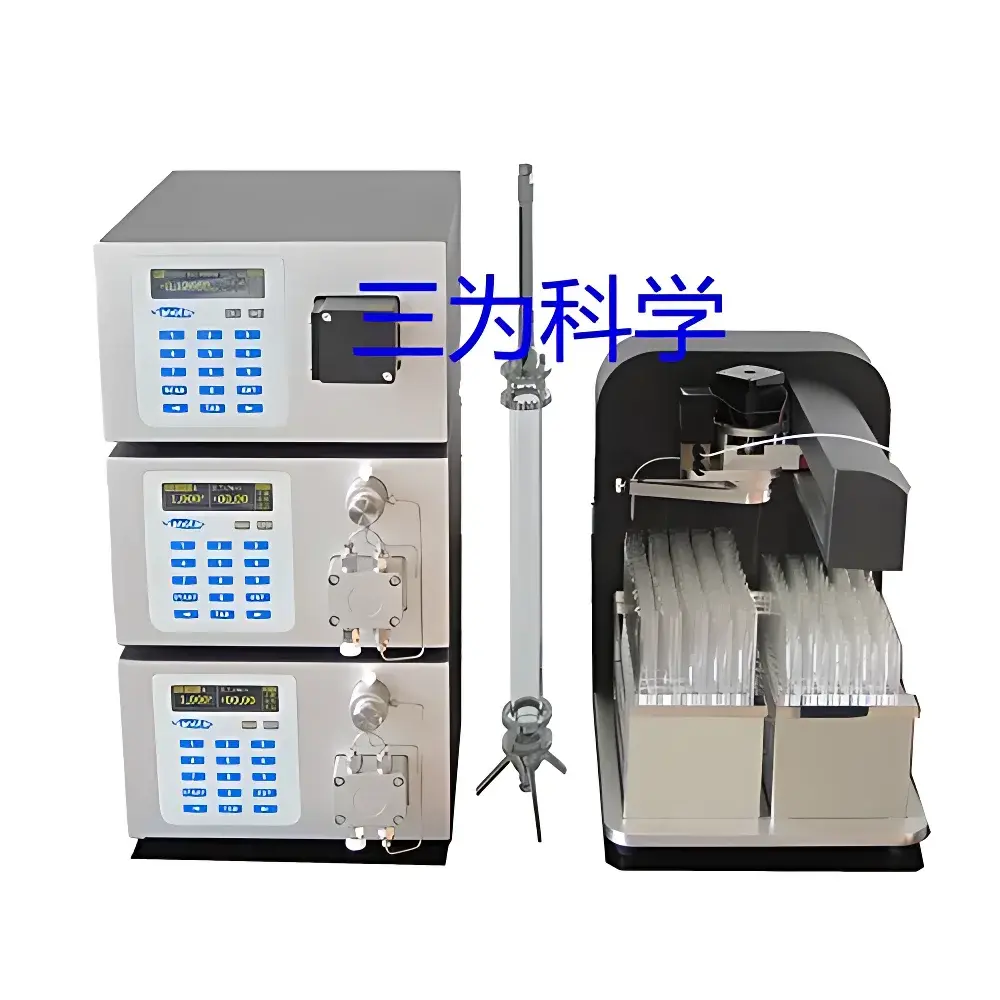
Sanotac FS-50 High-Pressure Preparative Liquid Chromatography System for Phenolic Acid Isolation and Purification from Traditional Chinese Medicinal Herbs
| Brand | Sanotac |
|---|---|
| Origin | Shanghai, China |
| Manufacturer Type | Direct Manufacturer |
| Regional Classification | Domestic (China) |
| Model | FS-50 |
| Price Range | USD 14,000 – 28,000 (FOB Shanghai) |
| Application Level | Laboratory-Scale |
| Instrument Type | High-Pressure Preparative LC |
| Flow Rate Range | 0.01–50.00 mL/min |
| Flow Accuracy | ±1% |
| Flow Precision (RSD) | ≤0.5% |
| Maximum Pressure | 30 MPa |
| Wavelength Range | 190–800 nm |
| Wavelength Accuracy | ±1 nm |
| Wavelength Repeatability | 0.2 nm |
| Baseline Noise | ±0.75×10⁻⁵ AU (254 nm, TC = 1 s) |
| Data Acquisition Frequency | 10 Hz |
Overview
The Sanotac FS-50 High-Pressure Preparative Liquid Chromatography System is an engineered platform designed for the isolation, fractionation, and purification of low-to-medium molecular weight natural products—particularly phenolic acids—from complex botanical matrices such as traditional Chinese medicinal (TCM) herbs. Based on reversed-phase or mixed-mode liquid chromatography principles, the system operates under high-pressure conditions (up to 30 MPa) to deliver robust separation performance with high resolution, reproducibility, and scalability from analytical to early-preparative scale. Its modular architecture integrates a dual-pump gradient solvent delivery system, dual-wavelength UV-Vis detection, programmable fraction collection, and PC-based control software compliant with regulatory data integrity requirements. The FS-50 is optimized for applications requiring rigorous method transfer, trace-level compound recovery, and structural fidelity preservation—critical for pharmacological validation, reference standard preparation, and preclinical metabolite profiling.
Key Features
- Modular high-pressure LC architecture supporting stainless steel and high-pressure glass columns (up to 30 MPa), compatible with C18, phenyl-hexyl, cyano, and HILIC stationary phases.
- Dual-solvent gradient capability with up to four mobile phase reservoirs; programmable linear, stepwise, or custom gradient profiles with real-time adjustment during runs.
- High-precision dual-plunger reciprocating pump (316L stainless steel head; PEEK option available) delivering flow rates from 0.01 to 50.00 mL/min with ≤0.5% accuracy and RSD ≤0.5%.
- Broadband UV-Vis detector with deuterium/tungsten lamp source (190–800 nm), simultaneous dual-wavelength monitoring (e.g., 254 nm + 320 nm), ±1 nm wavelength accuracy, and low baseline noise (±0.75×10⁻⁵ AU at 254 nm, 1 s time constant).
- Automated fraction collector with dual 60-position racks (Φ15 mm × 150 mm tubes); supports time-based, peak-triggered, threshold-based, sequential, and cyclic collection modes.
- Integrated Sanochrom™ control software running on Windows 7/8/10; full instrument control via USB/RS-232; audit-trail enabled; compliant with CFDA GxP and FDA 21 CFR Part 11 for electronic records and signatures.
Sample Compatibility & Compliance
The FS-50 accommodates both solid-phase and liquid-phase sample introduction via a standard 10 mL preparative injection valve. It is routinely applied to crude extracts of Salvia miltiorrhiza, Lonicera japonica, Echinacea purpurea, Cichorium intybus, and Paeonia lactiflora, among others—enabling isolation of structurally sensitive phenolic acids including salvianolic acids A/B/C, rosmarinic acid, chlorogenic acid isomers (neochlorogenic, cryptochlorogenic, isochlorogenic A/B/C), cynarin, and echinacoside. All separations are performed under validated conditions aligned with ISO 17025 laboratory quality management systems. Method documentation, raw data archiving, user access controls, and electronic signature workflows meet GLP/GMP-aligned data governance expectations for natural product characterization in regulated environments.
Software & Data Management
Sanochrom™ software provides unified control of pump gradients, UV detection parameters, fraction triggering logic, and hardware synchronization. Raw chromatograms are stored in vendor-neutral formats (e.g., .cdf), with metadata embedded per ICH M7 and WHO TRS 1019 guidelines. The software includes built-in tools for peak integration, retention time alignment, purity assessment (peak homogeneity analysis), and method export/import across FS-series instruments. Audit trails record all parameter changes, user logins, method executions, and data exports—fully traceable to individual operators and timestamps. Data backups support network drive mapping and encrypted local storage, satisfying long-term archival requirements per USP and EU Annex 11.
Applications
The FS-50 serves as a core tool in natural product chemistry laboratories for:
- Isolation of reference standards (>98.0% purity) for pharmacopoeial monographs (e.g., Chinese Pharmacopoeia, EP, USP).
- Preparative-scale purification of phenolic acid analogues for structure–activity relationship (SAR) studies and metabolite identification.
- Method development and scale-up bridging between analytical HPLC and pilot-scale purification.
- Supporting stability-indicating assays for herbal drug substance qualification.
- Generating purified fractions for NMR, HRMS, and enzymatic bioassay workflows.
Typical throughput ranges from 10 mg to 500 mg per run depending on column dimensions (e.g., 20 × 250 mm to 50 × 250 mm), loading capacity, and matrix complexity.
FAQ
What column types are compatible with the FS-50 system?
Stainless steel and high-pressure-rated glass columns (ID 10–50 mm) packed with C18, phenyl, cyano, diol, or HILIC phases are fully supported.
Can the system be used for protein purification?
No—the FS-50 is optimized for small molecules (<2 kDa); for proteins or peptides, Sanotac’s dedicated AKTA-compatible medium-pressure or FPLC systems are recommended.
Is method transfer possible from analytical to preparative scale?
Yes—scaling rules based on constant linear velocity and volumetric loading are implemented in Sanochrom™, with automatic flow and gradient time recalculations.
Does the software support 21 CFR Part 11 compliance out-of-the-box?
Yes—user authentication, role-based permissions, electronic signatures, and immutable audit logs are enabled by default upon installation.
What maintenance intervals are recommended for routine operation?
Pump seal replacement every 6 months (under continuous use), UV lamp replacement every 2,000 hours, and system pressure calibration annually—per ISO/IEC 17025 preventive maintenance protocols.




