
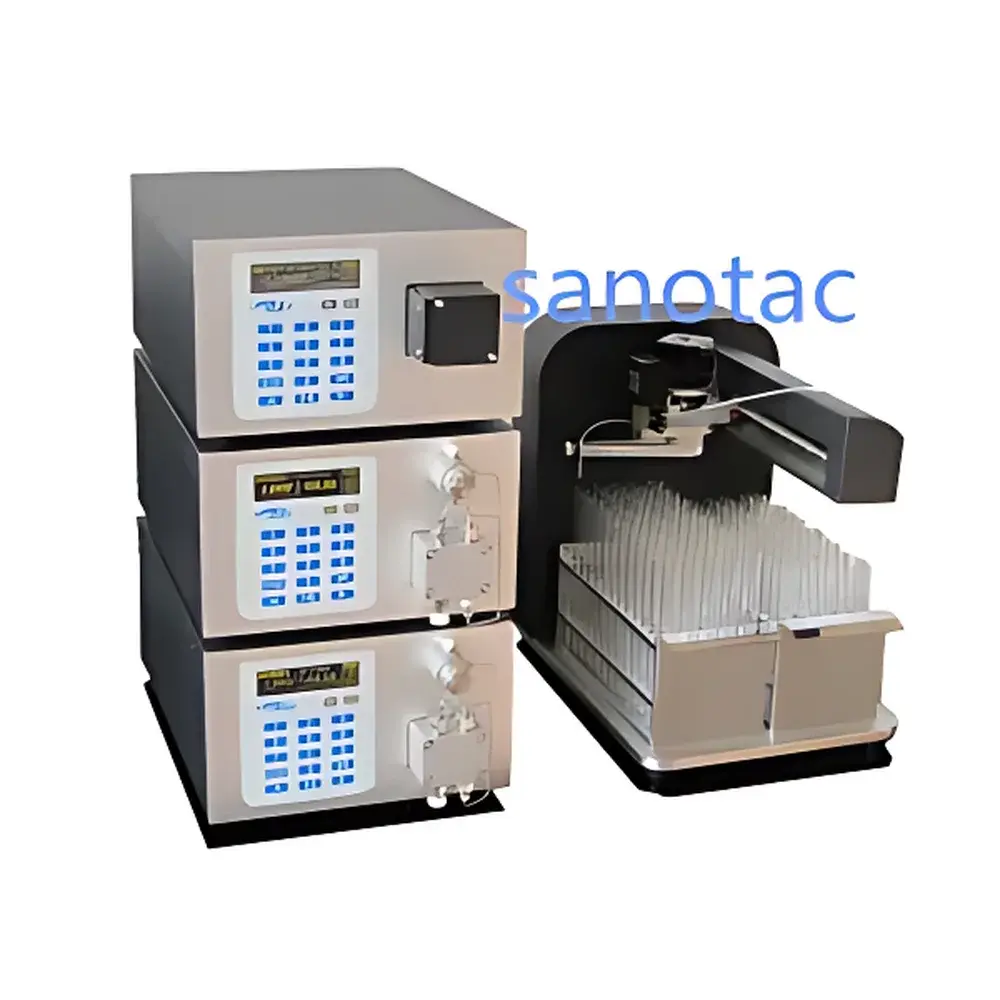
Sanotac Apurifier 100 Medium-Pressure Preparative Liquid Chromatography System
| Brand | Sanotac |
|---|---|
| Origin | Shanghai, China |
| Manufacturer Type | Direct Manufacturer |
| Product Category | Domestic |
| Model | Apurifier 100 |
| Application Level | Laboratory-Scale |
| Instrument Type | Medium-Low Pressure Preparative LC System |
| Flow Rate Range | 0.01–100.00 mL/min |
| Flow Accuracy | ±1% |
| Flow Precision (RSD) | ≤0.5% |
| Maximum Operating Pressure | 20 MPa |
| Wavelength Range | 190–800 nm |
| Wavelength Accuracy | ±1 nm |
| Wavelength Repeatability | 0.2 nm |
| Baseline Noise | ±0.75×10⁻⁵ AU (254 nm, TC = 1 s) |
| Data Acquisition Frequency | 10 Hz |
Overview
The Sanotac Apurifier 100 is a medium-pressure preparative liquid chromatography (PLC) system engineered for high-fidelity isolation and purification of bioactive compounds—particularly antibiotics and structurally complex natural products—from crude extracts or synthetic reaction mixtures. Built upon a dual-piston, microprocessor-controlled parallel pump architecture, the system delivers precise, pulse-free solvent delivery across a wide dynamic flow range (0.01–100.00 mL/min), enabling robust method scalability from analytical scouting to gram-scale purification. Its 20 MPa maximum pressure rating positions it between low-pressure flash systems and high-pressure preparative HPLC platforms—offering optimal balance of resolution, throughput, and column compatibility with standard 10–25 µm silica, C18, amino, cyano, and ion-exchange media. The integrated dual-wavelength UV-Vis detector (190–800 nm), featuring deuterium and tungsten lamp auto-switching, supports simultaneous monitoring of primary analytes and co-eluting impurities across broad spectral windows—critical for tracking degradation products, isomers, or chromophore-lacking compounds via wavelength-programmed detection.
Key Features
- High-stability dual-piston PEEK or 316L stainless-steel pump heads with real-time chamber pressure feedback, compensating for solvent compressibility and refill dynamics to ensure consistent flow under gradient conditions.
- Advanced cam-profile flow pulsation suppression and multi-point volumetric calibration across the full flow range—achieving ≤0.5% RSD flow precision and ±1% absolute accuracy.
- Floating plunger seal design extends seal lifetime under sustained medium-pressure operation (up to 20 MPa) while maintaining leak-free integrity with aggressive organic/aqueous mobile phases.
- Programmable gradient capability—including linear, step, and user-defined profiles—with on-the-fly adjustment of flow rate and composition during runtime.
- Dual-wavelength detection with time-programmable wavelength switching, stop-flow spectral scanning, and baseline drift compensation algorithms—reducing noise to ±0.75×10⁻⁵ AU at 254 nm (1 s time constant).
- Intelligent lamp management: automatic D₂/W lamp selection based on wavelength setting; hot-swap accessible lamp and flow cell modules minimizing instrument downtime.
Sample Compatibility & Compliance
The Apurifier 100 accommodates diverse sample formats including dissolved solids (e.g., lyophilized fermentation broths), clarified cell lysates, and synthetic reaction quenches. Its 10 mL fixed-loop manual injection valve supports both solid-phase loading (via pre-packed cartridges) and direct liquid injection—enabling reproducible loading of up to 500 mg of crude material per run when paired with 20–30 mm ID columns. The system complies with fundamental requirements of Good Laboratory Practice (GLP) and Good Manufacturing Practice (GMP)-aligned workflows: audit-trail-enabled Sanochrom software meets FDA 21 CFR Part 11 criteria for electronic records and signatures, including user access control, event logging, and immutable data archiving. All hardware components—including fluidic paths, pump seals, and detector flow cells—are chemically resistant to common solvents (acetonitrile, methanol, THF, DCM, aqueous buffers pH 2–9), ensuring long-term reliability in antibiotic purification campaigns involving acidic β-lactams, basic aminoglycosides, or zwitterionic tetracyclines.
Software & Data Management
Control and data acquisition are managed through Sanochrom—a Windows-based chromatography workstation compatible with Windows 7/8/10 (64-bit). The interface provides drag-and-drop method building, real-time overlay of multi-wavelength chromatograms, and synchronized control of pump, detector, and fraction collector. All acquisition parameters—including flow gradients, wavelength programs, and collection triggers—are stored as encrypted .scm files with embedded metadata (operator ID, timestamp, instrument serial number). Raw data (.raw) files adhere to ANDI/NetCDF format standards for third-party processing (e.g., Chromeleon, OpenChrom). Audit trails record every user action—including method edits, run starts/stops, and parameter overrides—with tamper-proof timestamps. Electronic signatures support role-based approval workflows for SOP-compliant purification protocols in regulated environments.
Applications
The Apurifier 100 is routinely deployed in academic, industrial, and contract research laboratories for the isolation of pharmacologically active antibiotics, including but not limited to: β-lactams (penicillins, cephalosporins), aminoglycosides (gentamicin, neomycin), tetracyclines (doxycycline, minocycline), chloramphenicol derivatives, macrolides (erythromycin, clarithromycin), glycopeptides (vancomycin analogs), antifungal polyenes (nystatin), and immunosuppressive macrolactones (rapamycin). Its flexibility extends to chiral separations (using polysaccharide-based CSPs), peptide purification (C4/C8 resins), and removal of endotoxins or host-cell proteins from bioprocess streams. Method transfer from analytical UHPLC to preparative scale is facilitated by retention time normalization and linear velocity matching—ensuring predictable loading capacity and resolution retention.
FAQ
What column dimensions and particle sizes are recommended for optimal performance with the Apurifier 100?
Standard configurations include 20–30 mm ID × 150–500 mm length columns packed with 10–25 µm spherical silica or polymer-based media. Smaller particles (5–10 µm) may be used at reduced flow rates to enhance resolution—but require careful backpressure monitoring to remain within the 20 MPa limit.
Can the system be validated for GMP use in pharmaceutical development?
Yes—the Sanochrom software includes 21 CFR Part 11 compliance features (electronic signatures, audit trail, data integrity controls), and IQ/OQ documentation packages are available upon request for installation and operational qualification.
Is remote monitoring or integration with LIMS supported?
The system communicates via RS-232 and USB virtual COM port; custom API integration (DLL-based) is available for LIMS interfacing. Remote desktop access for troubleshooting is permitted under controlled network security policies.
What maintenance intervals are recommended for routine operation?
Pump seal inspection every 500 hours; UV lamp replacement every 1,000–1,500 hours; flow cell cleaning with 10% isopropanol weekly; full system leak test and pressure calibration annually—or after any major fluidic component replacement.
Does the fraction collector support custom tube rack configurations beyond 120 × 15 mm tubes?
Yes—modular rack adapters accommodate 8 mm, 13 mm, and 16 mm diameter tubes; deep-well plates (96-well) and custom vial trays are supported via optional accessories with position-mapping calibration in Sanochrom.




