
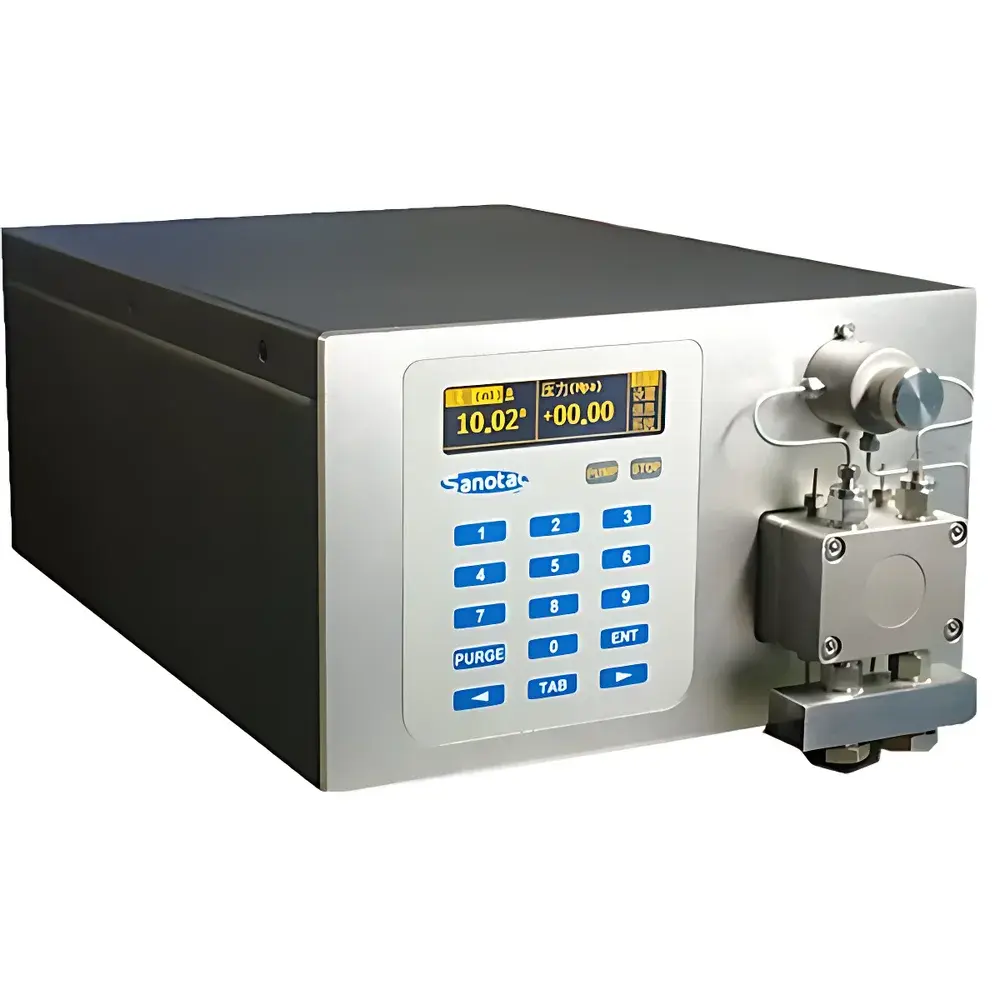
Sanotac TSP0530 High-Pressure Dual-Piston Solvent Delivery Pump
| Brand | Sanotac |
|---|---|
| Origin | Shanghai, China |
| Manufacturer Type | OEM Manufacturer |
| Product Category | Domestic |
| Model | TSP0530 |
| Price Range | USD 1,400 – 2,800 |
| Maximum Pressure | 30 MPa |
| Pump Head Volume | 50 mL |
| Flow Rate Range | 0.001–50.000 mL/min (typical for dual-piston HPLC-grade pumps) |
| Flow Accuracy | ≤ ±0.1% RSD (at ≥ 1 mL/min, water, 10 MPa) |
| Flow Precision | ≤ ±0.05% RSD (repeatability) |
| Gradient Composition Accuracy | ≤ ±0.2% |
| Pressure Sensor Accuracy | ±0.5% FS |
| Communication Interface | RS-232, CAN bus, optional Ethernet |
| Control Protocol | Open ASCII-based command set compliant with industry-standard pump control frameworks |
Overview
The Sanotac TSP0530 is a high-pressure, dual-piston solvent delivery pump engineered for precision fluid metering in analytical and preparative liquid chromatography systems, catalytic reaction platforms, supercritical fluid applications, and continuous-flow chemistry setups. Operating on positive displacement principle via synchronized ceramic-coated stainless-steel pistons, the TSP0530 delivers stable, pulse-dampened flow across a wide dynamic range — from nanoliter-per-minute microflow regimes to 50 mL/min at up to 30 MPa (4,350 psi). Its design integrates real-time solvent compressibility compensation and multi-point volumetric calibration, enabling traceable flow accuracy under variable mobile-phase composition and temperature conditions. Unlike single-piston or syringe-based alternatives, the dual-piston architecture ensures continuous delivery without dwell volume interruption, making it suitable for gradient-elution HPLC, UHPLC-compatible workflows, and closed-loop reactor feed control where reproducibility and long-term stability are critical.
Key Features
- Dual-piston parallel drive system with cam-profiled motion control and electronic pulse suppression for <0.1% pressure ripple (measured at 10 MPa, 1 mL/min)
- Microprocessor-based flow regulation with built-in solvent compressibility database for acetonitrile, methanol, water, THF, CO₂, and common ionic liquids
- Floating piston assembly with PTFE-reinforced seals and self-aligning ceramic guide sleeves — extends seal life beyond 10,000 operating hours under continuous 25 MPa load
- Swiss-sourced sapphire-ball check valves rated for >50 million cycles; validated per ASTM F2622 for valve leakage integrity
- Open communication protocol (ASCII over RS-232/CAN) supporting integration with third-party CDS platforms including Chromeleon, Empower, LabSolutions, and custom Python/Node.js control scripts
- Front-panel programmable method storage: 10 user-defined methods with independent flow ramping, gradient slope definition, and pressure limit enforcement
Sample Compatibility & Compliance
The TSP0530 accommodates a broad chemical compatibility matrix via configurable wetted materials: standard 316L stainless steel pump heads, optional PEEK, titanium, or fluoropolymer-lined variants support aggressive solvents (e.g., concentrated acids, halogenated organics, supercritical CO₂), oxidizers (HNO₃, H₂O₂), and high-pH mobile phases (pH 1–14). All fluidic pathways conform to USP Class VI biocompatibility requirements. The pump meets CE marking directives (2014/30/EU EMC, 2014/35/EU LVD), complies with ISO 9001:2015 manufacturing controls, and supports 21 CFR Part 11 audit trail generation when operated through validated workstation software. It is routinely deployed in GLP-compliant QC labs for pharmaceutical dissolution testing and in GMP-aligned catalyst injection systems for fine chemical synthesis.
Software & Data Management
The embedded firmware supports time-stamped event logging (power-on, pressure fault, flow deviation alert, valve actuation) with internal non-volatile memory retention for ≥12 months of operational history. When connected to external controllers, raw flow/pressure data streams at 10 Hz resolution can be captured in CSV or HDF5 format. The open command set enables bidirectional parameter interrogation (e.g., “GET:FLOW?”, “SET:GRADIENT 0.5,ACN,0.5,H2O”) and supports script-driven method sequencing for DoE (Design of Experiments) workflows. Firmware updates are delivered via signed .bin files verified using SHA-256 checksums — no proprietary drivers required.
Applications
- HPLC/UHPLC gradient pumping with sub-0.1% RSD flow stability for peptide mapping and small-molecule impurity profiling
- Continuous-feed catalytic reactors requiring precise stoichiometric reagent addition (e.g., asymmetric hydrogenation, cross-coupling)
- Supercritical fluid chromatography (SFC) with CO₂/methanol mixtures at 10–30 MPa
- Electrochemical flow cells demanding ultra-low pulsation to prevent electrode fouling
- Lab-scale polymer extrusion and foam formation where metered co-injection of blowing agents and initiators is essential
- Renewable energy research: electrolyte delivery in flow battery test rigs and catalyst slurry feeding in PEM electrolyzer prototypes
FAQ
What is the maximum recommended backpressure for continuous operation?
The TSP0530 is rated for continuous duty at 30 MPa (4,350 psi); however, sustained operation above 25 MPa requires active cooling of the pump head and use of low-compressibility solvents.
Does the pump support binary or quaternary gradient mixing?
No — the TSP0530 is a single-channel high-pressure pump. Gradient formation must be achieved externally via a high-pressure mixer or by pairing two TSP0530 units with a proportioning valve.
Can I validate flow accuracy per ISO 5725 or ASTM D3243?
Yes — the pump includes factory-certified gravimetric calibration reports traceable to NIM (China National Institute of Metrology), and users may perform in-house verification using certified microbalances and temperature-controlled collection vessels.
Is remote monitoring possible over Ethernet or Modbus TCP?
Ethernet and Modbus TCP interfaces are available as optional hardware modules (TSP0530-E and TSP0530-MB), both supporting TLS 1.2 encrypted command transmission and SNMPv3 trap reporting.
What maintenance intervals are recommended for the check valves and piston seals?
Under typical HPLC usage (10 h/day, 15 MPa avg), check valves require inspection every 6 months and replacement every 18 months; piston seals are rated for ≥2 years before scheduled replacement — logbook entries are auto-generated upon each seal change cycle.



