
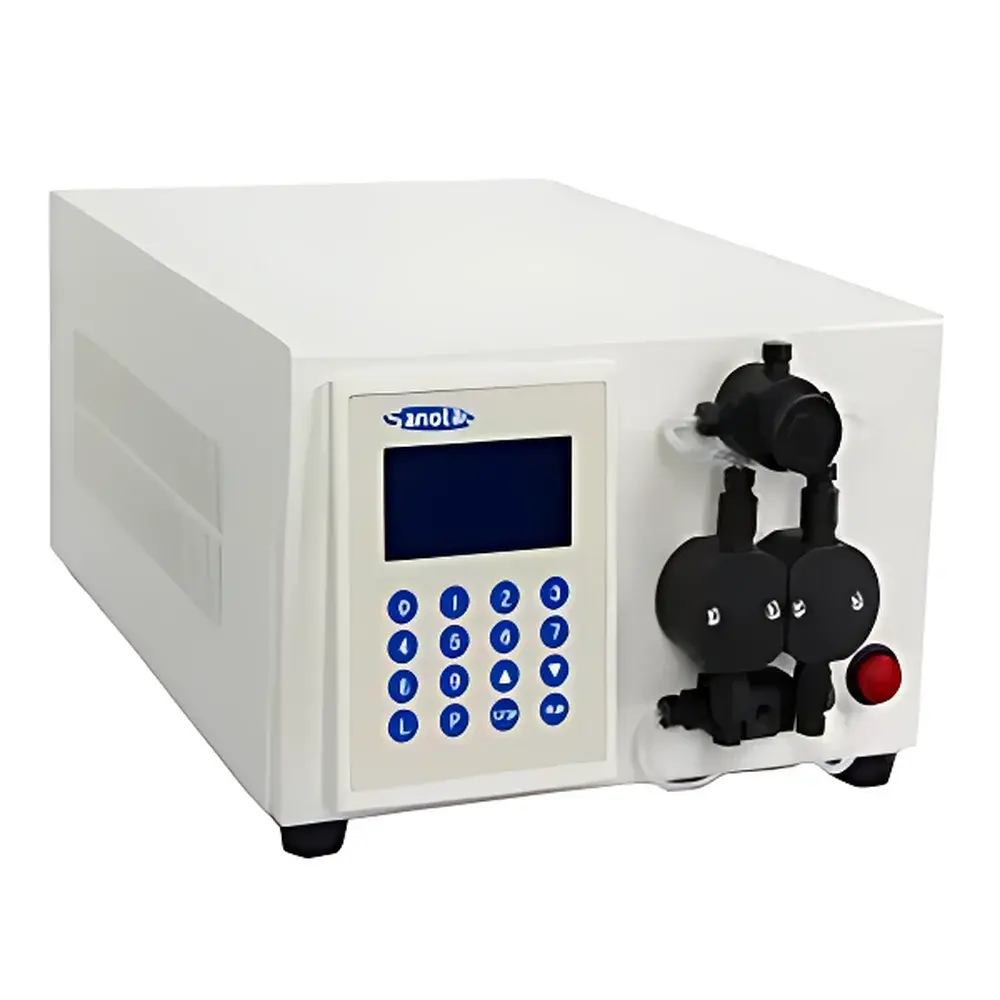
Sanotac QJ0502 High-Precision PTFE-Lined High-Pressure Constant Flow Pump for Alkaline Fluids
| Brand | Sanotac |
|---|---|
| Origin | Shanghai, China |
| Manufacturer Type | Direct Manufacturer |
| Product Category | Domestic |
| Model | QJ0502 |
| Price Range | USD 1,400 – 2,800 |
| Flow Rate | 0.1–50.0 mL/min |
| Flow Accuracy | ±1% |
| Flow Precision (RSD) | ≤1% |
| Maximum Pressure | 2 MPa |
| Pressure Pulsation | ≤0.1 MPa |
| Wetted Materials | PTFE, Sapphire, Zirconia Ceramic |
| Control Interface | Front-panel Keypad + RS232/USB Open Protocol |
| Power Supply | 85–264 VAC, 50 Hz |
| Power Consumption | 75 W |
| Weight | 12 kg |
Overview
The Sanotac QJ0502 is a high-precision, low-pulsation, constant-flow positive displacement pump engineered specifically for the reliable and accurate delivery of highly aggressive alkaline solutions under elevated pressure conditions. Designed around a dual-driven parallel plunger architecture with microprocessor-based flow regulation, the QJ0502 leverages solvent compressibility compensation and multi-point flow calibration to maintain consistent volumetric output across its full dynamic range—from 0.1 mL/min to 50.0 mL/min. Its core operational principle relies on reciprocating PTFE-lined plungers actuated via precision-machined cam profiles, enabling stable, pulse-suppressed fluid displacement without reliance on passive dampeners. This design eliminates mechanical hysteresis and ensures long-term stability in environments where conventional stainless-steel or PEEK-based pumps would suffer rapid degradation—particularly when handling concentrated KOH, NaOH, Ca(OH)₂, Mg(OH)₂, and Al(OH)₃ solutions up to 2 MPa.
Key Features
- PTFE-wetted fluid path including plunger seals, pump head, inlet/outlet valves, and tubing interfaces—ensuring full chemical compatibility with strong alkalis and other corrosive reagents.
- Floating plunger mechanism reduces radial loading on high-pressure seals, extending service life of PTFE components and minimizing maintenance intervals.
- Cam-profile optimization combined with real-time electronic pulsation suppression delivers pressure ripple <0.1 MPa (RMS), critical for sensitive downstream applications such as chromatographic separation or electrochemical cell feeding.
- Integrated gradient capability supports isocratic, linear, and stepwise solvent programming—enabling flexible method development without external mixing modules.
- Open communication protocol (RS232/USB) compliant with standard SCPI command sets; fully compatible with third-party chromatography data systems (CDS), LIMS, and custom LabVIEW or Python-based control environments.
- Front-panel interface with 10 programmable methods, intuitive parameter navigation, and real-time pressure/flow display—designed for rapid setup in QC laboratories and pilot-scale process validation.
Sample Compatibility & Compliance
The QJ0502 is validated for continuous operation with aqueous alkaline media at concentrations commonly used in industrial scrubbing, catalyst regeneration, battery electrolyte formulation, and flue gas desulfurization research. Its wetted materials—PTFE (ASTM D1711), synthetic sapphire (Al₂O₃, ≥99.6% purity), and yttria-stabilized zirconia ceramic (ISO 13356)—meet ISO 10993 biocompatibility requirements and exhibit negligible leaching under static and dynamic exposure per USP . While not certified to ATEX or IECEx standards, the unit complies with CE marking requirements (EMC Directive 2014/30/EU, LVD Directive 2014/35/EU) and supports GLP-compliant audit trails when integrated with validated CDS platforms supporting 21 CFR Part 11 electronic signatures.
Software & Data Management
The pump operates natively via embedded firmware supporting ASCII-based SCPI commands for remote configuration of flow rate, gradient profile, pressure limits, and system diagnostics. Sanotac provides a Windows-compatible SDK with DLL libraries and documented API calls for integration into enterprise-level automation frameworks. All parameter changes—including manual keypad entries—are timestamped and logged internally (non-volatile memory, 10,000-event buffer). When connected to compliant chromatography software (e.g., Chromeleon, Empower, OpenLab), the QJ0502 contributes to full audit trail generation, including operator ID, method version, and deviation alerts triggered by pressure excursions beyond user-defined thresholds.
Applications
- High-pH mobile phase delivery in ion chromatography (IC) and suppressed conductivity detection systems.
- Controlled dosing of caustic regenerants in analytical-scale ion exchange columns and solid-phase extraction (SPE) manifolds.
- Feedstock metering in electrochemical flow cells for CO₂ reduction and water splitting studies.
- Calibration and validation of online pH and conductivity sensors in wastewater treatment pilot plants.
- Reagent delivery in automated titration systems operating above pH 13, where glass syringe pumps exhibit unacceptable drift.
- Process analytical technology (PAT) deployments requiring traceable, repeatable alkaline reagent addition in pharmaceutical intermediate synthesis.
FAQ
Is the QJ0502 suitable for sodium hydroxide solutions above 30% w/w?
Yes—the PTFE/sapphire/zirconia fluid path remains dimensionally stable and chemically inert at temperatures up to 60°C and concentrations up to 50% NaOH, provided particulate filtration (≤5 µm) is maintained upstream.
Can the pump be operated in constant pressure mode?
No—the QJ0502 is a constant flow device only; pressure is a dependent variable. For pressure-regulated applications, Sanotac recommends pairing it with an external back-pressure regulator (BPR) calibrated to 2 MPa maximum.
Does the pump support gradient delay compensation?
Yes—internal flow calibration includes dead-volume correction factors for common tubing IDs (0.25 mm, 0.5 mm, 1.0 mm) and allows user-defined dwell volume inputs to align gradient arrival time at the detector.
What maintenance schedule is recommended for continuous 24/7 alkaline operation?
Plunger seals and check valves should be inspected every 500 hours; typical service life exceeds 2,000 hours under 1 MPa and 25°C conditions with filtered, particle-free KOH solutions.
Is firmware upgrade capability available remotely?
Yes—field updates are performed via USB stick using signed binary packages; each release includes SHA-256 checksum verification and rollback support.



