
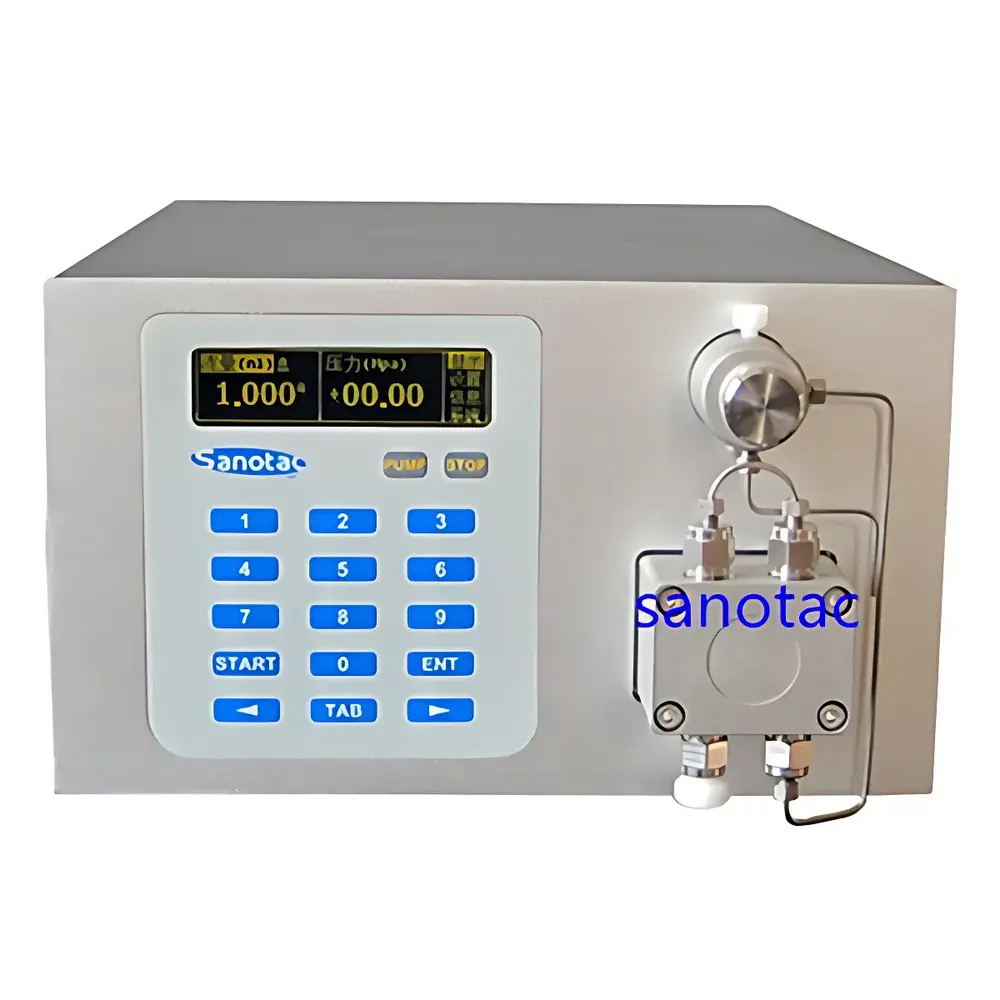
Sanotac S-0150 High-Pressure Constant Flow Pump (10 mL, 50 MPa)
| Brand | Sanotac |
|---|---|
| Origin | Shanghai, China |
| Manufacturer Type | Manufacturer |
| Model | S-0150 |
| Flow Rate | 0.001–9.999 mL/min |
| Increment | 0.001 mL/min |
| Flow Accuracy | ±0.1% |
| Flow Precision (RSD) | ≤0.1% |
| Maximum Pressure | 50 MPa |
| Pressure Pulsation | ≤0.1 MPa |
| Pump Head Material | 316L Stainless Steel, Sapphire, PTFE, Ceramic |
| Tubing Connection | 1/16″ Standard Fitting |
| Display | 256×64 Dot Matrix LCD with Backlight |
| Communication | RS232 & USB (Standard), RS485/RS422 (Optional) |
| Power Supply | 85–264 VAC, 50 Hz |
| Dimensions | 370 × 240 × 152 mm |
Overview
The Sanotac S-0150 High-Pressure Constant Flow Pump is an engineered precision fluid delivery system designed for laboratory and pilot-scale applications requiring stable, pulse-free flow under extreme pressure conditions. Operating on a dual-piston serial displacement principle with floating piston architecture, the pump delivers highly reproducible volumetric flow rates across its full range—0.001 to 9.999 mL/min—with resolution down to 0.001 mL/min. Its maximum rated pressure of 50 MPa (7,250 psi) enables reliable operation in demanding environments such as supercritical fluid processing, catalytic reaction evaluation, microreactor feed control, and high-pressure chromatography systems. Unlike conventional peristaltic or syringe-based pumps, the S-0150 employs positive displacement mechanics with sapphire-hardened check valves and ceramic-plated plungers to ensure long-term stability, minimal wear, and chemical compatibility with aggressive solvents and corrosive reagents.
Key Features
- Dual-piston serial configuration with dynamically balanced floating piston design minimizes mechanical hysteresis and enhances long-term flow consistency.
- Multi-point flow calibration algorithm compensates for nonlinearities across the entire operational range, achieving ±0.1% flow accuracy and ≤0.1% RSD repeatability.
- Integrated cam-profile compensation and real-time electronic pulsation suppression reduce pressure ripple to ≤0.1 MPa—critical for sensitive analytical interfaces and reactor stability.
- Column cleaning function performs post-stroke solvent flush behind the plunger, significantly extending seal life and reducing maintenance frequency.
- Programmable pressure limit protection and zero-point drift correction mitigate thermal and mechanical drift effects during extended runs.
- Modular communication interface supports RS232, USB (standard), and optional RS485/RS422 ports with native support for Modbus RTU and proprietary Sanotac protocol for seamless integration into industrial control frameworks.
Sample Compatibility & Compliance
The S-0150 accommodates a broad spectrum of process fluids—including organic solvents (e.g., THF, DMF, chlorinated hydrocarbons), aqueous acids/bases, supercritical CO₂, ionic liquids, and viscous polymer solutions—thanks to its chemically inert wetted path constructed from 316L stainless steel, sapphire, PTFE, and technical ceramics. All fluid-contact components comply with ASTM F2136 (biocompatibility of elastomers) and ISO 10993-5 cytotoxicity standards where applicable. The pump’s architecture supports GLP/GMP-aligned workflows through audit-trail-capable firmware logging (when paired with Sanotac Control Suite), and its analog/digital I/O interface meets requirements for integration into FDA 21 CFR Part 11-compliant SCADA and DCS environments.
Software & Data Management
The Sanotac Control Suite (v3.2+) provides comprehensive local and remote management capabilities via Windows-based desktop application or web-enabled client. Users can define multi-step flow profiles—including constant, linear ramp, and gradient modes—with synchronized pressure monitoring and real-time curve plotting (flow vs. time, pressure vs. time). All operational parameters are timestamped and stored in CSV-compatible format with optional encryption. Calibration routines allow user-defined point mapping against gravimetric or volumetric reference standards; factory defaults can be restored at any time. Remote access functionality—enabled via optional Ethernet/WiFi module—supports secure SSH tunneling and TLS-encrypted command transmission, enabling off-site monitoring and intervention without compromising data integrity.
Applications
- Catalytic testing rigs: Precise co-feeding of catalyst precursors and reactants into fixed-bed or slurry-phase reactors.
- Supercritical fluid extraction (SFE) and impregnation: Stable CO₂ delivery at pressures up to 50 MPa with minimal thermal perturbation.
- Microfluidic synthesis platforms: Accurate metering for multi-stream laminar mixing in chip-based reactors.
- HPLC and preparative chromatography: Compatible with high-backpressure columns (>40 MPa) and low-diffusion detection schemes.
- Electrochemical flow cells: Controlled electrolyte replenishment under inert atmosphere with pulse-free delivery.
- Material science research: Continuous feeding in hot-melt extrusion, foaming, and reactive polymerization setups.
FAQ
What is the maximum continuous operating pressure for the S-0150?
The S-0150 is rated for continuous operation at up to 50 MPa (7,250 psi) with appropriate fluid compatibility verification.
Does the pump support automated calibration traceable to NIST standards?
Yes—calibration routines accept user-input gravimetric or volumetric reference values; raw mass/time data logs are exportable for third-party metrological validation.
Can the S-0150 be integrated into a PLC-controlled chemical plant skid?
Yes—the pump supports Modbus RTU over RS485 and offers discrete I/O for start/stop, fault signaling, and status feedback compatible with Siemens S7, Rockwell ControlLogix, and Schneider EcoStruxure platforms.
Is the wetted path suitable for hydrofluoric acid (HF) service?
No—while PTFE and sapphire provide excellent resistance to many strong acids, HF attacks silica-based ceramics and glass components; alternative materials require custom engineering consultation.
What maintenance intervals are recommended for daily 8-hour operation?
Plunger seals should be inspected every 500 hours; check valves and inlet filters every 200 hours; full recalibration advised quarterly or after any major component replacement.



