
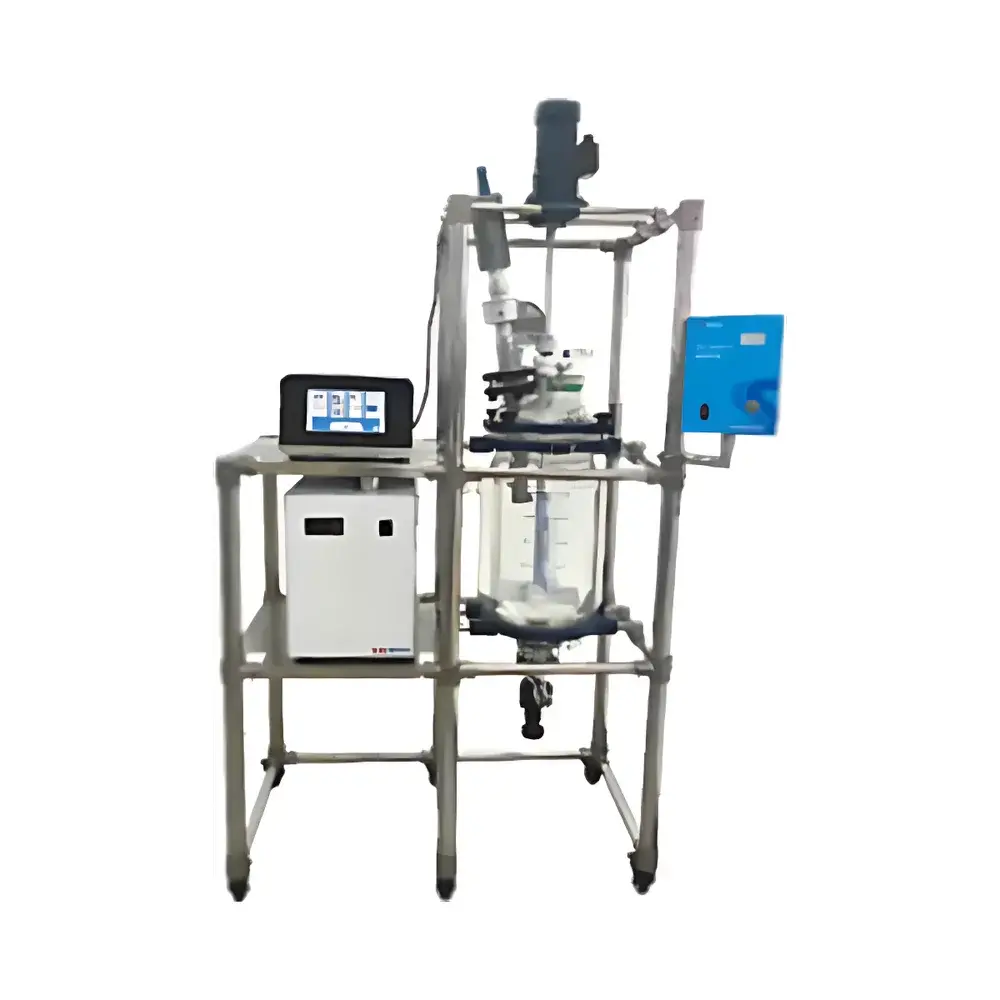
SHUMEI KBC-1000D-3L Ultrasonic Reaction Vessel with Integrated Temperature Control and Mechanical Stirring
| Brand | SHUMEI |
|---|---|
| Origin | Jiangsu, China |
| Manufacturer Type | Direct Manufacturer |
| Country of Origin | China |
| Model | KBC-1000D-3L |
| Capacity | 3 L (reaction volume), 2 L (jacket volume) |
| Motor Power | 120 W (low-speed high-torque motor, 1:3 gear ratio) |
| Stirring Speed Range | 50–1500 rpm |
| Torque | 273 N·cm |
| Ultrasonic Generator Output | Compatible with P25-class high-power ultrasonic transducer system |
| Probe Cooling | Integrated water-cooling for extended operation |
| Dimensions (L×W×H) | 520 × 500 × 1510 mm |
| Vessel ID/OD | 170 / 210 mm |
| Reflux Assembly | 500 mL reflux head + 85 mm Ø × 700 mm condenser |
| Coolant Flow Rate | 10 L/min |
| Price | USD 9,500 (FOB Jiangsu) |
Overview
The SHUMEI KBC-1000D-3L Ultrasonic Reaction Vessel is an engineered laboratory-scale reactor platform integrating high-intensity ultrasound, precision temperature control via double-jacket circulation, and variable-speed mechanical agitation. Unlike conventional ultrasonic cleaners repurposed for chemistry, this system is purpose-built for sonochemical synthesis and process intensification—leveraging cavitation-induced micro-mixing, localized hot-spot generation (~5,000 K), and transient radical formation to accelerate reaction kinetics, improve mass transfer, and enhance dispersion stability. Its modular architecture supports both batch and semi-continuous operation, making it suitable for R&D scale-up studies in pharmaceutical formulation, nanomaterial synthesis (e.g., graphene exfoliation, Al₂O₃ nanoparticle deagglomeration), botanical extraction, and electrocatalyst development. The vessel complies with standard laboratory pressure and temperature safety thresholds for ambient-to-moderate elevated conditions (≤100 °C, ≤0.3 MPa gauge), and all wetted parts are constructed from borosilicate glass 3.3 and 316L stainless steel for chemical compatibility with organic solvents, aqueous acids/bases, and ionic liquids.
Key Features
- Triple-function integration: simultaneous ultrasonication (via replaceable titanium alloy probe), jacketed thermal regulation (with external chiller or heater interface), and overhead mechanical stirring (digital speed control, 50–1500 rpm)
- High-torque drive system (273 N·cm) ensures stable agitation under viscous or heterogeneous reaction mixtures, including slurries and polymer solutions
- Water-cooled ultrasonic transducer assembly enables continuous duty cycles (>8 h) without thermal drift; coolant flow rate precisely regulated at 10 L/min
- Industrial-grade 7-inch color touchscreen HMI with programmable protocols (time, power, temperature, RPM profiles) and real-time parameter logging
- Glass vessel conforms to DIN/ISO 2859 sampling port dimensions; includes standardized ISO-KF 25 vacuum flange, reflux condenser port, and gas inlet/outlet fittings
- Modular probe design allows customization of horn length and tip geometry per application—e.g., stepped horns for high-amplitude delivery in deep-volume tanks
Sample Compatibility & Compliance
The KBC-1000D-3L accommodates a broad range of sample types: suspensions (nanoparticles, catalysts), emulsions (oil-in-water, polymer latexes), crude botanical extracts, and viscous prepolymers. Its double-jacket design supports precise thermal management during exothermic sonolysis or endothermic hydrolysis. All electrical components meet IP54 ingress protection standards; the control cabinet is CE-marked per EN 61000-6-2 (EMC immunity) and EN 61000-6-4 (EMC emission). While not certified for hazardous area use (ATEX/IECEx), the system adheres to GLP-aligned operational documentation practices—including audit-trail-enabled parameter change logs and user-access-level authentication (admin/operator modes). It supports compliance with USP for particle size distribution analysis in dispersion R&D and ASTM E2810 for ultrasonic processor calibration verification.
Software & Data Management
The embedded controller runs on a deterministic real-time OS with onboard SD-card data storage (up to 32 GB). Each experimental run generates a timestamped CSV file containing synchronized records of ultrasonic power output (% nominal), jacket temperature (±0.3 °C), stirrer RPM (±1 rpm), and elapsed time. Optional Ethernet/Wi-Fi connectivity enables remote monitoring via SHUMEI’s LabLink software (Windows/macOS compatible), supporting export to LIMS platforms via ASTM E1384-compliant .xml metadata wrappers. Audit trails comply with FDA 21 CFR Part 11 requirements for electronic records: all parameter modifications are logged with user ID, timestamp, and pre-/post-change values. No cloud storage is enabled by default; data residency remains fully on-premise unless explicitly configured.
Applications
- Green synthesis of metal–organic frameworks (MOFs) and perovskite precursors under mild thermal conditions
- Cell disruption and intracellular metabolite extraction from microbial cultures and plant tissues
- Stabilization of Pickering emulsions using silica or cellulose nanocrystals
- In-line homogenization of battery slurry formulations prior to coating (anode/cathode pastes)
- Accelerated aging studies of polymer electrolytes via controlled sonolytic degradation
- Scale-down validation of industrial ultrasonic reactors for wastewater micropollutant degradation (e.g., pharmaceutical residues)
FAQ
Can the ultrasonic probe be replaced with a different frequency or amplitude configuration?
Yes—SHUMEI offers optional 20 kHz, 28 kHz, and 40 kHz transducer modules compatible with the KBC-1000D mounting interface; amplitude tuning is achieved via digital gain control (0–100%) and mechanical booster horns.
Is the system compatible with corrosive media such as concentrated HNO₃ or HF?
The standard titanium alloy probe (Grade 5) resists most mineral acids except hydrofluoric acid; for HF applications, Hastelloy C-276 probe inserts and fluoropolymer-lined jackets are available as custom options.
Does the unit support automated pH or dissolved oxygen feedback control?
Not natively—but analog 4–20 mA input ports are provided for third-party sensor integration (e.g., Mettler Toledo InPro sensors); control logic must be implemented externally via PLC or LabVIEW.
What maintenance intervals are recommended for long-term reliability?
Ultrasonic transducer performance should be verified quarterly using ASTM E2810 acoustic power measurement; jacket gaskets and O-rings require replacement every 12 months under continuous use; stirrer motor brushes are rated for 10,000 hours.
Can the reactor be operated under inert atmosphere or vacuum?
Yes—the vessel includes dual ISO-KF 25 ports for gas purging and vacuum connection; maximum allowable vacuum is 10 mbar absolute (mechanical pump compatible); inert gas flow rates up to 5 L/min are supported via mass flow controller integration.



