
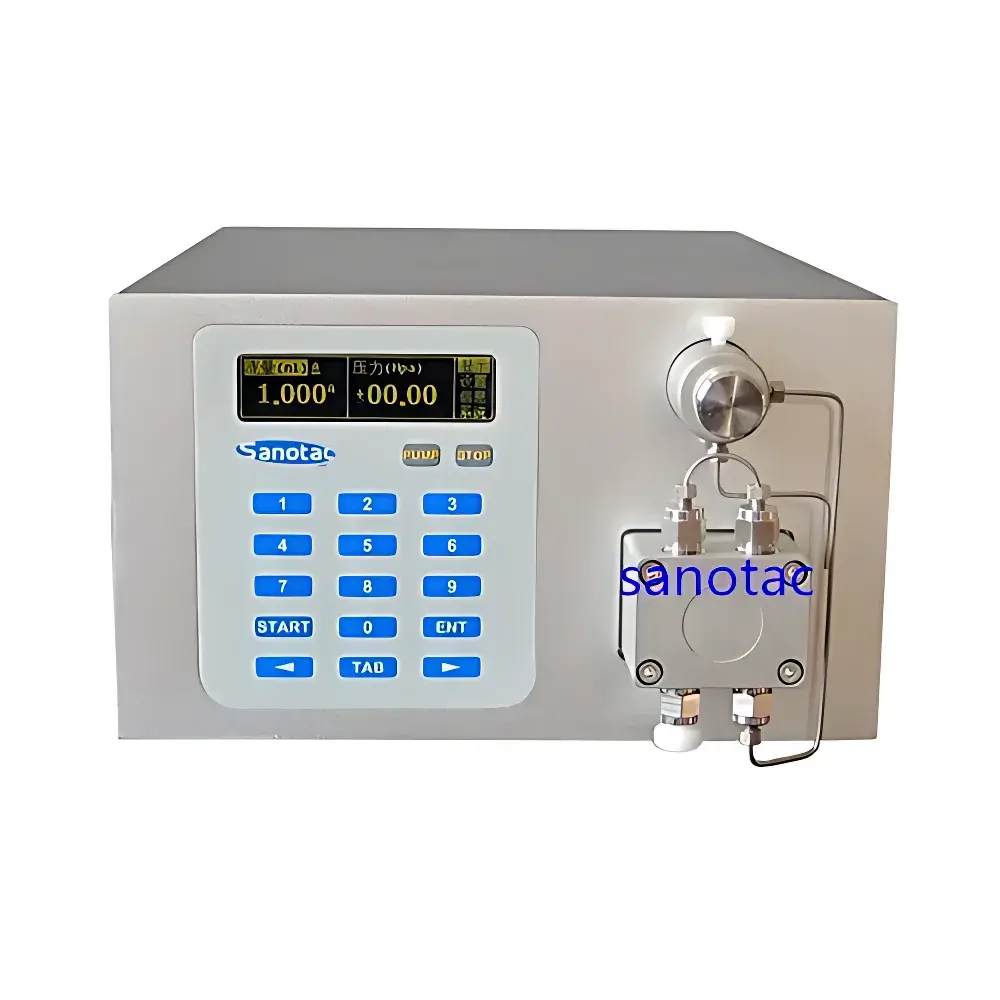
Sanotac GS0010 High-Pressure Constant Flow Pump for Tubular Reactor Systems
| Brand | Sanotac |
|---|---|
| Model | GS0010 |
| Flow Range | 0.001–9.999 mL/min |
| Flow Increment | 0.001 mL/min |
| Flow Accuracy | ±0.1% |
| Flow Precision (RSD) | ≤0.1% |
| Maximum Pressure | 42 MPa |
| Pressure Pulsation | ≤0.1 MPa |
| Pump Head Volume | 10 mL |
| Fluidic Path Materials | 316L Stainless Steel, Sapphire, PTFE, Ceramic |
| Connection | 1/16" Standard Fittings |
| Display | 256×64 Dot Matrix Backlit LCD |
| Control | Front Panel or Computer Reverse Control (Open Protocol) |
| Power Supply | 85–264 VAC, 50 Hz |
| Dimensions | 370 × 240 × 152 mm |
Overview
The Sanotac GS0010 High-Pressure Constant Flow Pump is an engineered solution designed specifically for continuous-flow chemistry applications requiring precise, stable, and pulse-free fluid delivery under elevated pressure conditions. Built upon a dual-piston series architecture with floating plunger design, the pump operates on positive displacement principles to ensure consistent volumetric output across its full operational range—from ultra-low flow rates of 0.001 mL/min up to 9.999 mL/min—while maintaining rated pressure capability up to 42 MPa (6,090 psi). Its core function is to serve as a reliable fluidic actuator in tubular reactor systems, where residence time control, stoichiometric accuracy, and long-term operational stability are critical for kinetic studies, catalytic screening, supercritical fluid processing, and high-pressure synthesis workflows. Unlike general-purpose peristaltic or diaphragm pumps, the GS0010 employs microprocessor-controlled dual-drive parallel pump heads with solvent compressibility compensation and multi-point flow calibration, enabling trace-level dosing fidelity required in modern process intensification and flow chemistry R&D.
Key Features
- Dual-piston serial configuration with floating plunger mechanism minimizes seal wear and extends service life under sustained high-pressure operation.
- Microprocessor-based flow control with real-time solvent compressibility compensation ensures accurate delivery across diverse mobile phases (e.g., CO₂, methanol, water, ionic liquids).
- Multi-point flow curve calibration supports high reproducibility (RSD ≤0.1%) over the entire dynamic range, validated per ISO 5725-2 guidelines.
- Low-pressure pulsation (<0.1 MPa) achieved via cam-profile optimization and active electronic pulse suppression—critical for minimizing backpressure fluctuations in narrow-bore tubular reactors.
- Chemically inert fluid path constructed from 316L stainless steel, sapphire check valves, PTFE seals, and ceramic components ensures compatibility with aggressive solvents and catalyst slurries.
- Open communication protocol enables seamless integration with third-party chromatography data systems (CDS), LIMS, or custom LabVIEW/Python automation frameworks.
- Front-panel interface with 256×64 backlit LCD and 10 programmable user methods supports standalone operation without external hardware.
Sample Compatibility & Compliance
The GS0010 is routinely deployed in applications involving corrosive reagents (e.g., HF,浓H₂SO₄ analogs), particulate-laden catalyst suspensions, supercritical CO₂, and high-viscosity polymer melts. Its wetted materials meet ASTM A276 Type 316L specifications and comply with USP Class VI biocompatibility standards for non-metallic components. While not certified for hazardous area use out-of-the-box, explosion-proof variants (e.g., EX-series) are available upon request and conform to IEC 60079-0/-15 requirements. The pump’s mechanical design adheres to ISO 13849-1 PL e safety integrity level for emergency stop integration. For regulated environments, audit trail functionality—including timestamped parameter changes, flow/pressure logs, and user authentication—can be enabled via optional firmware upgrade to support FDA 21 CFR Part 11 compliance when paired with compliant CDS software.
Software & Data Management
The GS0010 supports bidirectional RS-232 and optional USB/Ethernet interfaces using an openly documented ASCII command set. This allows direct integration into laboratory automation ecosystems via Python (pySerial), MATLAB Instrument Control Toolbox, or commercial platforms such as Agilent OpenLab, Waters Empower, or Thermo Chromeleon. All flow and pressure parameters are logged at user-defined intervals (100 ms to 10 s resolution) and exportable in CSV or HDF5 format. Firmware v2.4+ introduces TLS 1.2–secured remote monitoring over HTTPS, enabling secure cloud-based fleet management for multi-reactor installations. Raw sensor data—including motor current, encoder position, and pressure transducer output—is accessible for advanced diagnostics and predictive maintenance modeling.
Applications
- Continuous-flow catalytic hydrogenation and oxidation in fixed-bed tubular reactors
- Supercritical fluid extraction (SFE) and impregnation using CO₂ or ethane
- High-pressure polymerization (e.g., polyethylene, polycarbonate) in microchannel reactors
- Fuel reforming and electrocatalysis studies requiring precise co-reactant feed ratios
- Pharmaceutical continuous manufacturing (CM) unit operations per ICH Q5C/Q8(R2) guidance
- Material synthesis including MOFs, perovskites, and quantum dot nanocrystals
- Geochemical simulation experiments involving brine–CO₂–rock interactions at reservoir conditions
FAQ
What is the maximum allowable viscosity for stable operation?
The GS0010 maintains specified accuracy up to 500 cP at 42 MPa; for viscosities exceeding 1,000 cP, pre-heating or dilution is recommended to avoid excessive torque demand.
Can the pump handle abrasive slurries containing solid catalysts?
Yes—when equipped with optional ceramic-plunger and sapphire-valve kits, it achieves >2,000 hours MTBF with 5–50 µm particle-laden feeds at ≤5 wt% solids loading.
Is gradient elution supported?
While primarily a constant-flow device, the GS0010 supports step-gradient programming via timed flow-rate transitions; true linear gradients require external mixing modules or multi-pump synchronization.
Does it meet GLP/GMP documentation requirements?
With audit-trail-enabled firmware and electronic signature-capable CDS integration, it satisfies ALCOA+ data integrity principles when operated within a validated system environment.
What maintenance intervals are recommended?
Plunger seals and check valves should be inspected every 500 operating hours; full recalibration is advised annually or after any seal replacement.



