
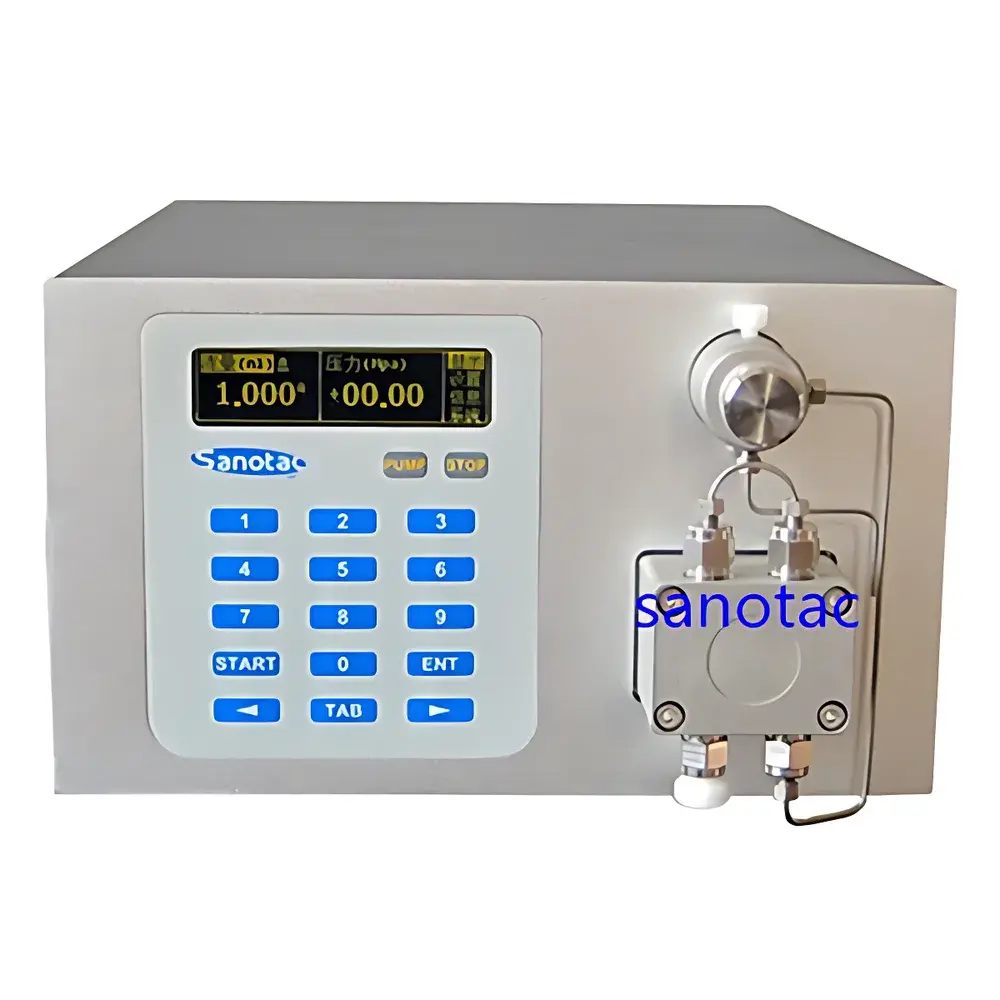
Sanotac S0142 High-Pressure Precision Metering Pump for Microchannel Reactors
| Brand | Sanotac |
|---|---|
| Origin | Shanghai, China |
| Manufacturer Type | OEM Manufacturer |
| Country of Origin | China |
| Model | S0142 |
| Drive Mode | Electric |
| Flow Range | 0.001–9.999 mL/min (adjustable in 0.001 mL/min increments) |
| Accuracy | ±0.1% |
| Precision (RSD) | ≤0.1% |
| Maximum Pressure | 42 MPa |
| Pressure Pulsation | ≤0.1 MPa |
| Wetted Materials | 316L stainless steel, sapphire, ruby, PTFE, ceramic |
| Tubing Connection | 1/16" standard fittings |
| Communication Interfaces | USB, RS232, RS485 |
| Protocols | Modbus RTU/TCP, analog/digital I/O |
| Power Supply | 100–240 VAC, 50/60 Hz |
| Dimensions | 370 × 240 × 152 mm |
Overview
The Sanotac S0142 is a high-pressure, dual-piston positive displacement metering pump engineered specifically for precision fluid delivery in continuous-flow chemical synthesis systems—particularly microchannel reactors, catalytic evaluation units, and supercritical fluid applications. Operating on a floating dual-plunger serial architecture, the pump delivers exceptional volumetric accuracy and pulse-free flow across its full operational range (0.001–9.999 mL/min), with resolution down to 0.001 mL/min. Its design adheres to core principles of laminar flow control and pressure-stabilized displacement, ensuring consistent residence time distribution, stoichiometric fidelity, and thermal-mass transfer reproducibility in milli- and micro-scale reaction environments. Unlike peristaltic or diaphragm-based alternatives, the S0142 eliminates elastic deformation-related hysteresis and compressibility artifacts—critical for quantitative kinetic studies, catalyst lifetime assessment, and GMP-aligned process development.
Key Features
- Precision Dual-Plunger Architecture: Floating plunger design with 316L stainless steel pump head, sapphire/ruby check valves, and ceramic/PTFE fluidic pathways ensures long-term dimensional stability and chemical compatibility with aggressive solvents, acids, bases, and supercritical CO₂.
- Ultra-Low Pulsation Performance: Integrated cam-profile compensation and real-time electronic flow pulsation suppression maintain pressure ripple ≤0.1 MPa—even at maximum rated pressure (42 MPa), enabling stable interfacial mass transfer in segmented or co-laminar flow regimes.
- Multi-Mode Pressure Protection: Configurable overpressure response includes automatic shutdown, manual reset, and low-pressure restart—fully compliant with ISO 13849-1 functional safety requirements for laboratory automation integration.
- Onboard Flow Calibration & Diagnostics: Supports user-executed single-point or full-range linear flow calibration; stores up to 16 independent calibration profiles; logs seal wear indicators via column backpressure drift analysis.
- Industrial-Grade Connectivity: Native support for Modbus RTU/TCP, analog voltage/current input (0–5 V / 4–20 mA), discrete I/O triggering, and Ethernet/WLAN-enabled remote orchestration—designed for seamless integration into SCADA, DCS, and PLC-controlled multi-pump reactor arrays.
- Column Cleaning Protocol: Automated post-injection plunger flush sequence reduces abrasive particulate accumulation at sealing interfaces—extending service intervals beyond 6,000 hours under typical organic solvent duty cycles.
Sample Compatibility & Compliance
The S0142 accommodates Newtonian and non-Newtonian fluids with viscosities from 0.3 to 1000 cP—including acetonitrile, DMF, ionic liquids, slurries (≤5 wt% solid loading), and near-critical hydrocarbons—without flow deviation exceeding ±0.15% of setpoint. All wetted materials conform to USP Class VI biocompatibility standards and ASTM F2023 for elastomer resistance. The pump meets CE Machinery Directive 2006/42/EC, EMC Directive 2014/30/EU, and RoHS 2011/65/EU. For regulated environments, audit trails, electronic signatures, and 21 CFR Part 11-compliant data logging are achievable via optional Sanotac ControlSuite™ software with role-based access control and immutable event timestamping.
Software & Data Management
Sanotac ControlSuite™ (v3.2+) provides deterministic real-time control of flow rate profiles—including constant, linear ramp, stepwise gradient, and user-defined time-segmented sequences. The interface displays synchronized pressure vs. time and flow vs. time plots with sub-second sampling resolution. All operational parameters—including valve timing, pressure thresholds, and calibration coefficients—are stored in encrypted binary method files. Raw datasets export to CSV, HDF5, or MATLAB-compatible formats; trend analysis tools support batch comparison, outlier detection (Grubbs’ test), and uncertainty propagation modeling per GUM (JCGM 100:2018). Firmware updates retain backward compatibility with legacy configuration files and third-party HMI templates.
Applications
- Microfluidic synthesis of pharmaceutical intermediates under PAT-guided QbD frameworks
- Catalyst screening in fixed-bed and monolithic reactors with precise reagent stoichiometry control
- Supercritical fluid impregnation for battery electrode coating and MOF synthesis
- Continuous photochemical and electrochemical flow cells requiring stable laminar co-flow
- High-throughput formulation development for nanocarriers (liposomes, polymeric NPs) using controlled antisolvent precipitation
- Accelerated aging studies in corrosion testing loops with trace-level inhibitor dosing
FAQ
What is the minimum programmable flow increment?
The S0142 supports 0.001 mL/min resolution across its entire 0.001–9.999 mL/min range.
Can the pump handle abrasive slurries?
Yes—when equipped with optional ceramic plungers and hardened sapphire valves, it supports slurries with ≤5 wt% solids and particle sizes <10 µm.
Is remote firmware update supported over Ethernet?
Yes—via HTTP(S)-based OTA protocol with SHA-256 signature verification and rollback capability.
Does the pump comply with GLP data integrity requirements?
When paired with ControlSuite™ and configured with audit trail logging enabled, it satisfies ALCOA+ principles for raw data attribution, contemporaneous recording, and retention.
What maintenance intervals are recommended for routine operation?
Plunger seals require replacement every 4,000–6,000 operating hours depending on solvent polarity and pressure profile; full calibration verification is advised quarterly.



