
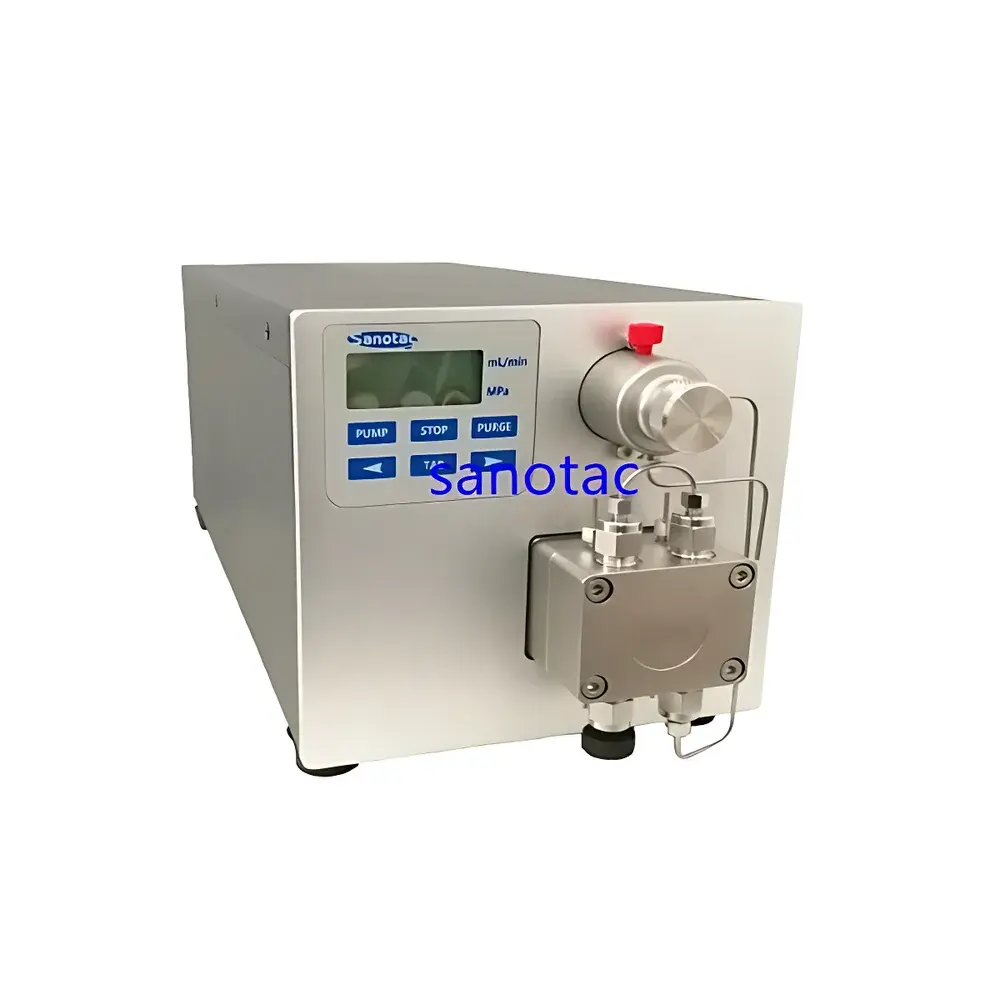
Sanotac JC0530 High-Pressure Constant Flow Pump for Extrusion Systems
| Brand | Sanotac |
|---|---|
| Origin | Shanghai, China |
| Manufacturer Type | Manufacturer |
| Country of Origin | China |
| Model | JC0530 |
| Price Range | USD 1,400 – 2,800 |
| Flow Range | 0.01–50.00 mL/min |
| Flow Increment | 0.01 mL/min |
| Flow Accuracy | ±0.5% |
| Flow Precision (RSD) | ≤0.1% |
| Max Pressure | 30 MPa |
| Pressure Pulsation | ≤0.2 MPa |
| Pump Head Volume | 50 mL |
| Drive Mechanism | Dual Parallel Plunger with Floating Plunger Design |
| Flow Control Mode | Constant Flow (Isocratic) & Gradient Capable |
| Wetted Materials | 316L Stainless Steel, Sapphire, PTFE, Ceramic |
| Tubing Connection | 1/16" Standard |
| Display | 256×64 Dot Matrix LCD with Backlight |
| Control Interface | Front Panel Keypad + RS232/USB Computer Reverse Control (Open Protocol) |
| Power Supply | 85–264 VAC, 50 Hz |
| Dimensions | 370 × 240 × 152 mm |
Overview
The Sanotac JC0530 High-Pressure Constant Flow Pump is an engineered fluid delivery solution designed specifically for integration with laboratory-scale extrusion systems—including twin-screw and single-screw extruders—where precise, pulse-free, high-pressure metering of additives, plasticizers, fillers, or reactive monomers is critical. Operating on a dual parallel plunger architecture with floating plunger mechanics, the JC0530 delivers stable volumetric flow across a wide dynamic range (0.01–50.00 mL/min) at pressures up to 30 MPa. Its core principle relies on positive displacement via synchronized cam-driven plungers, augmented by real-time solvent compressibility compensation and multi-point flow calibration algorithms. Unlike conventional peristaltic or diaphragm pumps, the JC0530 eliminates flow discontinuity through electronic pulse suppression and optimized cam profile compensation—ensuring laminar, non-pulsating delivery essential for consistent melt homogeneity, dosing reproducibility, and downstream process stability in polymer compounding, pharmaceutical hot-melt extrusion (HME), and functional material synthesis.
Key Features
- Dual parallel plunger design with floating plunger mechanism—reduces seal wear, extends service life of high-pressure sealing components, and maintains long-term flow integrity under sustained load.
- Microprocessor-based closed-loop control with real-time solvent compressibility compensation—enables accurate flow delivery across variable fluid densities and viscosities (e.g., molten polymers, viscous suspensions, or low-volatility solvents).
- Multi-point flow curve calibration (spanning 10+ discrete flow rates)—corrects for nonlinearities inherent in high-pressure piston dynamics, achieving ±0.5% flow accuracy and ≤0.1% RSD over full operational range.
- Low-pressure pulsation performance (≤0.2 MPa peak-to-peak)—validated per ISO 5199 Annex D methodology—minimizes mechanical disturbance to extruder screw torque and melt pressure transients.
- Open-protocol RS232/USB reverse control interface—fully compatible with third-party chromatography data systems (CDS), LabVIEW, Python-based automation frameworks, and custom PLC integrations.
- Chemically resistant wetted path (316L stainless steel body, sapphire check valves, PTFE seals, ceramic plungers)—certified for compatibility with aggressive solvents, halogenated monomers, and thermally sensitive APIs.
- Front-panel programmable memory supporting 10 user-defined methods—each storing flow rate, gradient profile, pressure limit, and runtime parameters for rapid method recall and SOP compliance.
Sample Compatibility & Compliance
The JC0530 accommodates a broad spectrum of process fluids relevant to extrusion R&D: polymer melts (LDPE, PLA, PVP-VA), suspensions (nanocellulose, nano-TiO₂), reactive formulations (epoxy prepolymers, UV-curable acrylates), and pharmaceutical excipients (PEG, HPMC-AS). All wetted materials comply with USP Class VI biocompatibility standards and meet ASTM F2028 requirements for elastomeric components. The pump’s mechanical design adheres to ISO 13849-1 (PL e) for functional safety in integrated machinery. While not intrinsically rated for Zone 1 hazardous areas, explosion-proof variants (model JC0530-EX) are available per ATEX Directive 2014/34/EU and IECEx certification for flammable vapor environments. For regulated pharmaceutical applications, audit trails, electronic signatures, and 21 CFR Part 11–compliant data logging can be implemented via validated third-party CDS platforms interfacing through its open communication protocol.
Software & Data Management
The JC0530 operates without proprietary software—its ASCII-based command set (documented in publicly available API manual) supports direct integration into existing lab informatics infrastructure. Users may configure isocratic, linear, or stepwise gradients using time–flow tables; gradient shapes are synthesized algorithmically from base functions, enabling complex multi-segment profiles (e.g., ramp-hold-ramp sequences for staged additive introduction). All operational parameters—including actual flow rate, system pressure, motor current, and temperature (via optional external sensor input)—are streamed in real time via serial output. When paired with compliant data acquisition systems, event timestamps, method versioning, and operator ID logging satisfy GLP/GMP documentation requirements. Firmware updates are performed via USB mass storage mode, with SHA-256 checksum verification to ensure integrity.
Applications
- Hot-melt extrusion (HME) of amorphous solid dispersions—precise metering of surfactants (e.g., TPGS), plasticizers (e.g., triethyl citrate), and APIs into molten polymer carriers.
- Reactive extrusion of polyurethanes or polyesters—controlled co-injection of diisocyanates and polyols to manage exothermic reaction kinetics and avoid gelation.
- Lab-scale compounding of conductive composites—pulse-free delivery of carbon nanotube dispersions or graphene masterbatches into thermoplastic matrices.
- Development of biodegradable scaffolds—gradient feeding of bioactive agents (e.g., BMP-2 peptides) during melt extrusion of PCL or PLGA filaments.
- Calibration and validation of inline rheometers or NIR probes—providing known, repeatable flow perturbations for sensor response characterization.
FAQ
What extrusion configurations is the JC0530 compatible with?
It integrates directly with standard 1/4″-28 UNF or M6 threaded feed ports on most benchtop twin-screw extruders (e.g., Thermo Scientific HAAKE MiniLab, Leistritz Micro 18, and Xplore MC15). Custom mounting brackets and heated transfer lines (up to 250 °C) are available upon request.
Does the pump support gradient elution in chromatographic applications?
Yes—the JC0530 implements gradient generation via time-programmed flow rate modulation, not solvent blending. It is commonly deployed as a high-pressure auxiliary pump in preparative SEC, GPC, or specialty LC systems requiring robust isocratic or pseudo-gradient operation.
Can the JC0530 handle abrasive slurries?
With optional ceramic-plunger and sapphire-valve configuration (standard on JC0530-CER), it achieves >5,000 hours MTBF with silica-filled polymer melts or micronized mineral suspensions at ≤30 vol% solids loading.
Is remote monitoring and alarm notification supported?
Via Modbus RTU over RS485 (adapter required), users can read real-time status registers—including pressure fault, flow deviation >2%, and motor stall—and trigger relay outputs for interlock with extruder safety circuits.
How is calibration traceability maintained?
Each unit ships with NIST-traceable calibration certificate (per ISO/IEC 17025 accredited lab), including gravimetric flow verification at five points across the range and pressure transducer calibration against dead-weight tester reference standard.



