
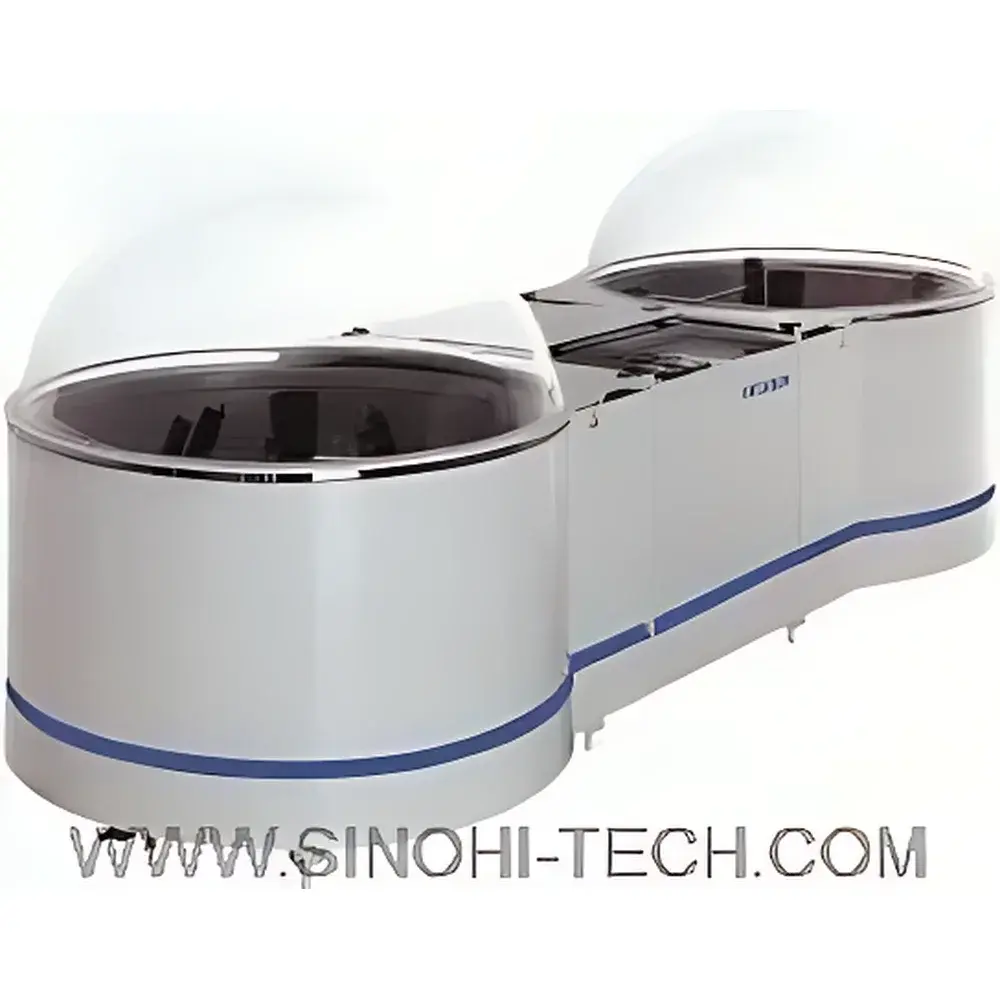
ILSIN #606 & #608 Corrosion Testing Chambers
| Origin | Germany |
|---|---|
| Manufacturer Type | Authorized Distributor |
| Origin Category | Imported |
| Model | #606 & #608 Series |
| Price | Upon Request |
| Chamber Volume | 400 L / 1000 L / 2000 L (customizable for #608) |
| Sample Capacity | ~100 / ~180 / ~400 specimens (shape-dependent) |
| Specimen Racks | 3 units (18 specimens per rack) |
| Chamber Load Capacity | 300 kg (reinforced versions available) |
| Temperature Range | Ambient to +50 °C |
| Power Supply | 230 V / 400 V, 50 Hz (custom voltage options available) |
| Power Consumption | ~2000 VA / ~3000 VA / ~4000 VA |
| Compressed Air Pressure | 4–10 bar |
| Compressed Air Consumption | 6 Nm³/h |
| Deionized Water Supply Pressure | 2–8 bar |
| Drain & Exhaust Connection | Standard BSP/NPT fittings |
| Chamber Geometry | Cylindrical (dual 400 L or dual 1000 L configurations) and Rectangular (400 L / 1000 L / 2000 L variants) |
| Control Cabinet Depth | 1000 mm |
Overview
The ILSIN #606 and #608 Corrosion Testing Chambers are precision-engineered environmental test systems designed to evaluate the corrosion resistance of metallic substrates, coated components, and protective surface treatments under standardized accelerated aging conditions. These chambers operate on the fundamental principles of salt spray (ASTM B117, ISO 9227) and cyclic corrosion testing (CCT), where controlled generation of corrosive aerosols—typically sodium chloride solution mist—is maintained within a thermally regulated test chamber. The system enables reproducible exposure of specimens to defined concentrations of chloride ions, humidity gradients, and temperature profiles, simulating decades of real-world atmospheric degradation in compressed timeframes. As such, they serve as indispensable tools for materials qualification, coating validation, supplier auditing, and process control in automotive, aerospace, marine, and industrial manufacturing sectors.
Key Features
- Modular chamber architecture supporting three standard volume classes: 400 L (#606 base), 1000 L (#606 extended / #608 standard), and 2000 L (#608 custom configuration), with optional dual-cylinder layouts for parallel test campaigns.
- Stainless steel 316L construction throughout critical wetted zones—including chamber walls, fog nozzles, and solution reservoirs—to ensure long-term integrity against aggressive chloride environments.
- Precision-controlled temperature regulation (ambient to +50 °C) via PID-driven heating elements and insulated chamber walls, compliant with ASTM B117 temperature uniformity requirements (±2 °C across working zone).
- Adjustable compressed-air atomization system delivering stable, non-drifting salt fog density (typically 1–2 mL/h/80 cm²), calibrated using gravimetric collection methodology per ISO 9227 Annex A.
- Three standardized specimen support racks (18 positions each), fabricated from inert PVC-coated steel, enabling consistent orientation and spacing to minimize shadowing and airflow obstruction.
- Integrated load-bearing platform rated for 300 kg total static load, with reinforced structural framing available for heavy-duty fixtures or multi-tier mounting configurations.
- Front-access service panels, quick-disconnect fluid lines, and tool-free nozzle maintenance design facilitating routine calibration, cleaning, and GLP-compliant preventive maintenance.
Sample Compatibility & Compliance
The #606 and #608 chambers accommodate flat, curved, or irregularly shaped specimens up to 600 mm × 400 mm × 150 mm (per rack position), with total capacity scaling linearly with chamber volume. Samples may include painted steel panels, galvanized fasteners, anodized aluminum extrusions, electroplated connectors, or polymer-coated battery housings. The systems are fully compatible with international corrosion testing standards including ASTM B117 (neutral salt spray), ASTM G85 Annex A5 (modified salt spray with SO₂), ISO 9227, DIN 50021, JIS Z2371, and VDA 621-415. Optional humidity cycling modules enable compliance with GMW 14872, Ford CETP, and SAE J2334 protocols when integrated with external climate conditioning units.
Software & Data Management
Each chamber is supplied with ILSIN TestControl Suite v4.x—a Windows-based supervisory application supporting real-time monitoring of chamber temperature, fog saturation, air pressure, and solution level. The software logs timestamped operational parameters at user-defined intervals (1 s to 60 min resolution), generates CSV/Excel-compatible reports, and supports audit trail functionality aligned with FDA 21 CFR Part 11 requirements (electronic signatures, change history, and data immutability). Optional Ethernet/IP or Modbus TCP interfaces allow integration into centralized MES or LIMS platforms for automated test scheduling, result aggregation, and statistical process control (SPC) charting.
Applications
- Qualification of conversion coatings (e.g., zinc phosphate, chromate, trivalent chromium) on ferrous substrates.
- Evaluation of organic coating adhesion, blistering, and creep resistance per ASTM D1654.
- Comparative assessment of cathodic protection performance in galvanic couples (e.g., Zn/Fe, Al/Mg).
- Validation of sealant integrity on automotive underbody components exposed to road-salt environments.
- Process capability studies for electroplating bath stability and rinsing efficiency.
- Supporting ISO/IEC 17025-accredited laboratories conducting third-party corrosion certification.
FAQ
What standards does the #606/#608 series comply with by default?
The base configuration meets ASTM B117 and ISO 9227 requirements for neutral salt spray testing. Optional accessories extend compliance to acidic salt spray (ASTM G85 Annex A2), cyclic humidity-salt-dry sequences (VDA 621-415), and automotive-specific protocols.
Is deionized water mandatory for operation?
Yes. DI water with resistivity ≥1 MΩ·cm is required to prevent nozzle clogging and ensure consistent fog chemistry. Integrated conductivity monitoring is available as an add-on module.
Can the chamber be configured for continuous monitoring during unattended operation?
Yes. With TestControl Suite and optional remote access license, users can monitor status, receive SMS/email alerts on parameter deviation, and review historical logs via secure HTTPS interface.
What maintenance intervals are recommended for GLP compliance?
Daily visual inspection of nozzles and solution levels; weekly calibration of temperature sensor and pressure transducer; quarterly verification of fog deposition rate and chamber uniformity per ISO 9227 Annex B.
Are custom chamber geometries supported beyond the listed rectangular and cylindrical options?
Yes. ILSIN offers engineering consultation for bespoke configurations—including vertical stack designs, walk-in chambers, or hybrid CCT/UV exposure integration—subject to feasibility review and lead-time confirmation.



