
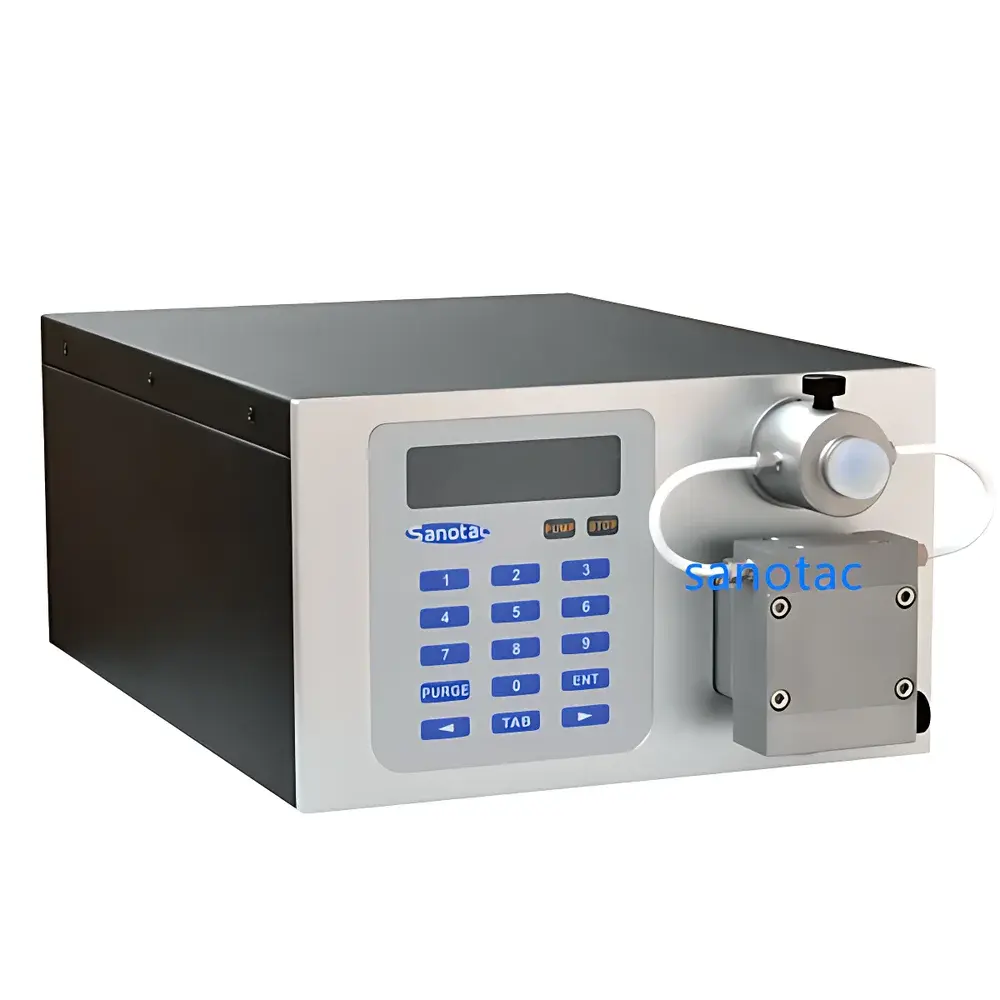
Sanotac SF1007A High-Pressure PTFE-Lined Constant Flow Pump
| Brand | Sanotac |
|---|---|
| Origin | Shanghai, China |
| Manufacturer Type | Direct Manufacturer |
| Model | SF1007A |
| Flow Rate | 0.01–100.00 mL/min |
| Maximum Pressure | 7 MPa |
| Flow Accuracy | ±0.5% |
| Flow Repeatability | ≤0.1% |
| Pressure Pulsation | ≤0.05 MPa |
| Pump Head Material | Stainless Steel with Embedded PCTFE Liner |
| Plunger Design | Dual Parallel Floating Plungers |
| Sealing Structure | Open-Type Seal with Hastelloy Spring in Contact with Fluid |
| Wetted Materials | PCTFE, PTFE, Sapphire, Ceramic, Hastelloy |
| Communication Interfaces | RS232 (standard), USB (standard), RS485/RS422 (optional) |
| Communication Protocols | Modbus RTU, Modbus ASCII, Custom Protocol |
| Control Inputs | 0–5 VDC analog, 4–20 mA analog, digital I/O |
| Software | SanoFlu Fluid Control Management System |
| Power Supply | 85–264 VAC, 50 Hz |
| Dimensions | 370 × 240 × 152 mm |
Overview
The Sanotac SF1007A High-Pressure PTFE-Lined Constant Flow Pump is an engineered solution for precise, pulse-minimized fluid delivery under aggressive chemical and high-pressure conditions. Designed specifically for catalytic evaluation, microreactor feeding, supercritical fluid processing, and continuous-flow chemical synthesis, the SF1007A operates on a dual parallel floating plunger principle—enabling stable volumetric displacement across its full flow range of 0.01–100.00 mL/min at pressures up to 7 MPa. Its core architecture integrates corrosion-resistant wetted path materials—including PCTFE, PTFE, sapphire, ceramic, and Hastelloy—ensuring compatibility with strong acids, alkalis, halogenated solvents, and oxidizing reagents commonly encountered in petrochemical refining, fine chemical synthesis, and energy materials research. Unlike conventional stainless-steel pumps, the SF1007A employs a stainless steel pump head with precision-machined internal PCTFE lining, eliminating direct metal-fluid contact while maintaining mechanical rigidity and thermal stability. The system adheres to fundamental principles of positive displacement pumping, with cam-profile compensation and real-time electronic pulsation suppression ensuring pressure ripple remains ≤0.05 MPa—critical for sensitive downstream instrumentation such as inline IR cells or mass spectrometry interfaces.
Key Features
- Dual parallel floating plunger mechanism with cam-curve compensation for reduced mechanical wear and enhanced long-term flow stability
- User-accessible multi-point flow calibration (9 points: 0.01, 0.1, 1, 10, 20, 40, 60, 80, 100 mL/min) enabling traceable accuracy adjustment across the entire operating range
- Open-type seal design featuring Hastelloy springs in direct fluid contact—providing dynamic load compensation and extended service life under cyclic pressure loading
- Integrated back-plunger cleaning function to minimize particulate accumulation and reduce PTFE seal abrasion during extended operation
- Real-time pressure and flow rate curve visualization via SanoFlu software, supporting time-synchronized data logging at configurable sampling intervals
- Analog control inputs (0–5 VDC, 4–20 mA) and digital I/O for seamless integration into PLC-based reactor automation systems
- Modbus RTU/ASCII protocol support over RS232, USB, and optional RS485/RS422 ports—enabling interoperability with SCADA, DCS, and industrial HMI platforms
Sample Compatibility & Compliance
The SF1007A is validated for use with chemically aggressive media including concentrated hydrochloric acid (≥37%), nitric acid (≥65%), sodium hydroxide (≥50%), hydrogen peroxide (≥30%), and supercritical CO₂. All wetted components comply with ASTM F2136-21 (Standard Specification for Fluoropolymer Lined Metallic Piping Components) and meet material compatibility requirements outlined in ISO 15142-1:2018 (Plastics piping systems — Fluoropolymers). While not intrinsically rated for hazardous area installation, the pump’s electrical architecture conforms to IEC 61000-6-3 (EMC emission limits) and IEC 61000-6-2 (immunity requirements). For GxP-regulated environments, audit trail functionality—including user login timestamps, parameter change logs, and method execution records—is fully supported within the SanoFlu software suite, aligning with FDA 21 CFR Part 11 data integrity expectations when deployed with appropriate IT validation protocols.
Software & Data Management
SanoFlu Fluid Control Management System provides a deterministic, deterministic Windows-based interface for configuring flow profiles (constant, linear ramp, multi-step gradient), setting pressure protection thresholds, and initiating remote diagnostics. Data acquisition supports simultaneous recording of flow rate, outlet pressure, motor current, and temperature (via optional external sensor input). Export formats include CSV, Excel-compatible XLSX, and PNG/PDF plots with embedded metadata (date, operator ID, method name). Method files (.sfl) store complete instrument state configurations—including calibration coefficients, communication settings, and analog input mapping—allowing rapid deployment across identical hardware units. Firmware updates are delivered via signed binary packages with SHA-256 hash verification. Optional remote access module enables TLS-encrypted web-based monitoring through standard browsers without requiring local network exposure.
Applications
- Catalytic reaction evaluation systems requiring metered co-feeding of catalyst precursors and substrates under elevated pressure
- Microreactor platforms where low-pulse delivery prevents channel clogging and ensures laminar residence time distribution
- Supercritical fluid chromatography (SFC) and extraction systems demanding stable CO₂ or CO₂/co-solvent delivery at >5 MPa
- Continuous hydrothermal synthesis reactors utilizing aqueous alkaline media at >300 °C and >6 MPa
- Electrochemical flow cells requiring precise stoichiometric reagent addition synchronized with potentiostat triggers
- Lab-scale polymerization reactors integrating gravimetric feed control at the inlet via load-cell feedback loops
FAQ
What materials are in direct contact with fluid?
PCTFE, PTFE, sapphire, ceramic, and Hastelloy C-276—all certified for resistance to strong oxidizers and halogenated solvents.
Is the pump suitable for ultra-high-purity applications?
Yes; surface roughness of wetted PCTFE components is Ra ≤ 0.4 µm, and all assemblies undergo ultrasonic cleaning and nitrogen purge prior to packaging.
Can flow be controlled by weight instead of volume?
Yes—the SanoFlu software supports mass-based dosing when integrated with calibrated load cells via analog input or Modbus register mapping.
Does the pump support gradient elution protocols?
Yes; up to 99 programmable steps with independent flow, dwell time, and pressure limit parameters per step.
What is the maximum allowable ambient temperature for continuous operation?
40 °C at 100% duty cycle; derating applies above this threshold per IEC 60034-1 insulation class F specifications.



