
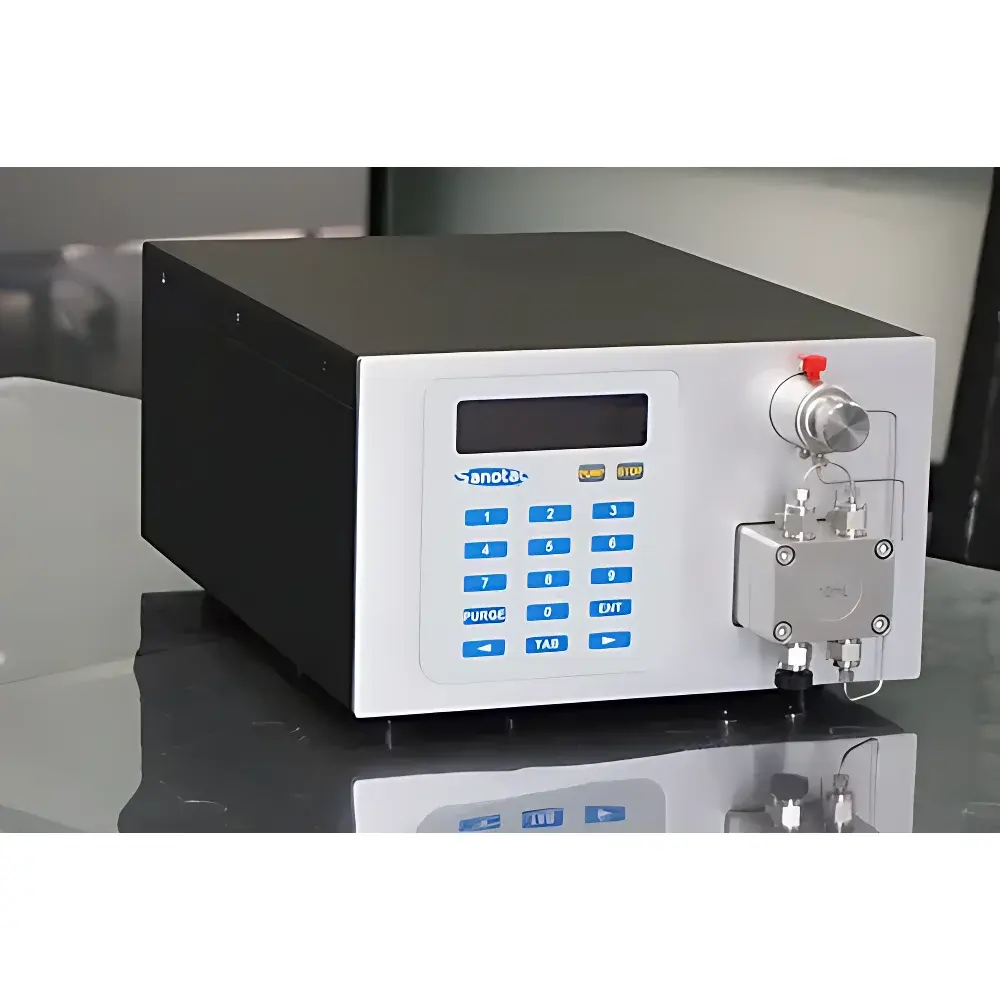
Sanotac IAP-1020 High-Pressure Intelligent Isocratic Pump
| Brand | Sanotac |
|---|---|
| Model | IAP-1020 |
| Origin | Shanghai, China |
| Manufacturer Type | Direct Manufacturer |
| Flow Range | 0.01–100.00 mL/min |
| Flow Increment | 0.01 mL/min |
| Flow Accuracy | ±0.5% |
| Flow Precision (RSD) | ≤0.1% |
| Maximum Pressure | 42 MPa |
| Pressure Pulsation | ≤0.2 MPa |
| Pumping Mechanism | Dual Parallel Piston with Floating Piston Design |
| Wetted Materials | 316L Stainless Steel, Sapphire, PTFE, Ceramic |
| Tubing Connection | 1/16" Standard Fitting |
| Display | 256×64 Dot Matrix Backlit LCD |
| Communication Interfaces | RS-232 (standard), USB (standard), RS-485/RS-422 (optional) |
| Protocols | Sanotac Proprietary, Modbus RTU, Modbus ASCII |
| Analog I/O | 0–5 V DC, 4–20 mA |
| Power Supply | 85–264 VAC, 50 Hz |
| Dimensions | 370 × 240 × 152 mm |
| Compliance | Designed for GLP/GMP-aligned laboratory and pilot-scale process environments |
Overview
The Sanotac IAP-1020 High-Pressure Intelligent Isocratic Pump is an engineered solution for precise, stable, and programmable fluid delivery in demanding analytical and process applications. Based on dual parallel piston architecture with floating piston compensation, the pump delivers high-pressure isocratic flow with minimal pulsation—critical for microreactor feeding, catalytic screening, supercritical fluid processing, and high-performance liquid chromatography (HPLC)-adjacent workflows. Unlike conventional peristaltic or single-piston systems, the IAP-1020 employs positive displacement via sapphire-hardened ceramic plungers and chemically inert wetted path materials (316L stainless steel, sapphire, PTFE, and technical ceramics), ensuring long-term stability under continuous operation at up to 42 MPa (6,090 psi). Its design conforms to core engineering principles of hydraulic integrity, thermal drift mitigation, and mechanical hysteresis reduction—making it suitable for integration into automated reaction platforms where reproducibility, traceability, and closed-loop control are mandatory.
Key Features
- Dual parallel piston mechanism with floating piston design minimizes flow deviation across pressure gradients and extends seal life.
- Programmable pressure protection thresholds: user-definable upper and lower pressure limits with automatic shutdown and alarm logging.
- Real-time pressure and flow curve visualization directly on the backlit 256×64 LCD display—no external software required for operational diagnostics.
- Flexible unit selection: volume-based (mL/min) or mass-based (g/min) flow control, enabling direct correlation with gravimetric feed systems.
- Two operational modes: constant-flow (isocratic) and multi-segment gradient profiles—each segment fully configurable for flow rate, duration, and ramp behavior.
- On-device flow calibration function with dedicated user parameter space to compensate for fluid viscosity, compressibility, and system backpressure effects.
- Zero-pressure initialization routine eliminates startup offset errors prior to pump engagement.
- Analog input compatibility (0–5 V DC, 4–20 mA) allows seamless integration with load cells, mass flow meters, or PLC-based supervisory control systems.
Sample Compatibility & Compliance
The IAP-1020 accommodates a broad range of process fluids—including organic solvents, aqueous acids/bases, supercritical CO₂, and slurries with suspended catalysts—thanks to its corrosion-resistant 316L stainless steel body, sapphire check valves, and chemically stable PTFE seals. All wetted surfaces comply with USP Class VI biocompatibility requirements for non-leachable testing. While not certified for ASME B31.3 or PED 2014/68/EU out-of-the-box, the pump’s pressure containment architecture meets internal design verification standards aligned with ISO 5171 (pumps for laboratory use) and ASTM D3417 (thermal analysis of polymers using controlled-flow injection). It supports audit-ready data integrity practices: all configuration changes, pressure/flow events, and calibration actions are timestamped and stored locally; optional Excel export enables alignment with FDA 21 CFR Part 11-compliant documentation workflows when paired with validated LIMS or ELN systems.
Software & Data Management
The pump operates natively via front-panel interface but is fully controllable through industry-standard serial protocols: Modbus RTU (RS-485/RS-232), Modbus ASCII, and Sanotac’s proprietary ASCII-based command set. USB virtual COM port support enables plug-and-play connectivity with Windows/Linux-based host applications. All communication channels support bidirectional command-response exchange, including real-time query of instantaneous pressure, flow rate, motor status, and error registers. Data logging—enabled per session—records pressure and flow time-series at user-selectable intervals (100 ms to 5 s) and exports structured CSV/Excel files containing absolute timestamps, engineering units, and metadata (e.g., active program ID, calibration offset). Configuration templates—including serial port settings, pressure limits, and gradient sequences—can be saved, recalled, and version-controlled externally.
Applications
- Continuous-flow chemistry: precise reagent dosing into microstructured reactors (MSRs) and chip-based catalytic systems.
- High-pressure reaction screening: automated feed control for autoclave and tube-reactor arrays operating above 20 MPa.
- Supercritical fluid processing: CO₂ delivery in extraction, impregnation, and particle formation systems requiring pulse-free flow.
- Gravimetric closed-loop control: integration with analytical balances for dynamic feed adjustment based on real-time mass loss feedback.
- Preparative HPLC and SFC auxiliary pumping: supplemental high-pressure solvent delivery where primary pumps lack sufficient headroom.
- Method development labs: rapid prototyping of multi-step synthesis protocols with synchronized pump-triggered valve actuation.
FAQ
What communication protocols does the IAP-1020 support?
It supports RS-232 (standard), USB CDC (standard), RS-485/RS-422 (optional), Modbus RTU, Modbus ASCII, and Sanotac’s native ASCII command protocol.
Can the pump perform gradient elution with variable flow rates?
Yes—two built-in program types are available: constant-flow (isocratic) and multi-segment gradient mode, each allowing independent rate, duration, and linear ramp specification.
Is flow calibration performed in-system or requires external instrumentation?
Full calibration is performed internally using user-provided reference measurements; no external flow meter is required for basic accuracy correction.
Does the pump meet regulatory requirements for GxP environments?
While not pre-certified, its deterministic behavior, audit-trail-capable logging, and deterministic command-response architecture enable validation under GLP, GMP, or ISO 17025 frameworks when deployed with documented SOPs and IQ/OQ protocols.
What is the maximum allowable backpressure for continuous operation?
The pump is rated for continuous operation up to 42 MPa at ambient temperature; derating is recommended above 40 °C per manufacturer’s thermal management guidelines.



