
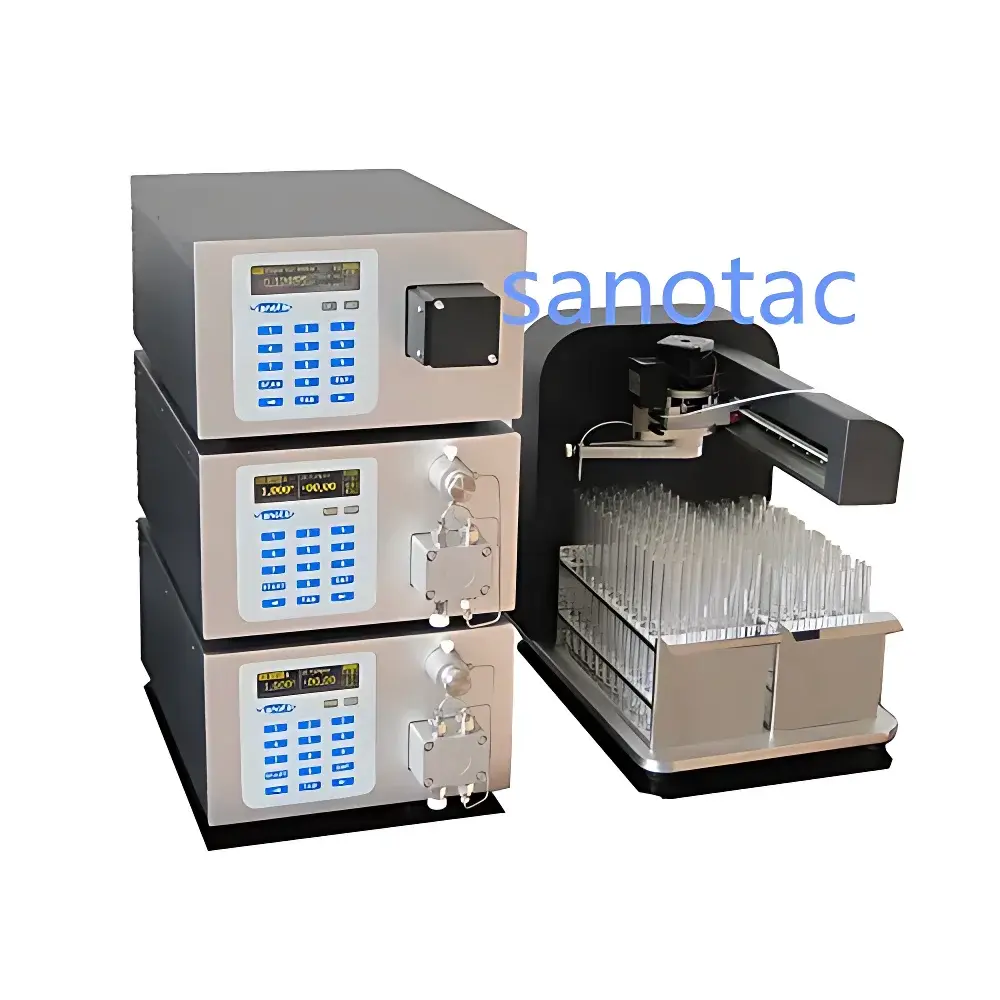
Sanotac S-100 Preparative High-Performance Liquid Chromatography System
| Brand | Sanotac |
|---|---|
| Origin | Shanghai, China |
| Manufacturer Type | Direct Manufacturer |
| Regional Category | Domestic (China) |
| Model | S-100 |
| Price Range | USD 14,000–28,000 |
| Application Level | Laboratory-Scale |
| Instrument Type | High-Pressure Preparative LC |
| Flow Rate Range | 0.01–100.00 mL/min |
| Flow Accuracy | ±1% |
| Flow Precision (RSD) | ≤0.5% |
| Maximum Pressure | 20 MPa |
| Wavelength Range | 190–800 nm |
| Wavelength Accuracy | ±1 nm |
| Wavelength Repeatability | 0.2 nm |
| Baseline Noise | ±0.75×10⁻⁵ AU (254 nm, TC = 1 s) |
| Data Acquisition Rate | 10 Hz |
Overview
The Sanotac S-100 is a modular, high-pressure preparative liquid chromatography (Prep-LC) system engineered for reproducible, scalable isolation and purification of bioactive alkaloids and other thermally labile or structurally complex natural products. It operates on the principle of reversed-phase or normal-phase liquid chromatography under controlled pressure gradients, utilizing precise solvent delivery, dual-wavelength UV-Vis detection, and automated fraction collection to enable method development from analytical screening to gram-scale purification. Designed specifically for laboratories engaged in phytochemical research, synthetic chemistry, and biopharmaceutical process development, the S-100 supports both stainless-steel and high-pressure glass columns—ensuring compatibility with a broad range of stationary phases (e.g., C18, silica, amino, cyano) and mobile phase chemistries including aqueous/organic gradients, acidic modifiers (e.g., TFA, formic acid), and basic buffers critical for resolving basic nitrogen-containing compounds such as alkaloids.
Key Features
- High-precision dual-plunger pump with 316L stainless-steel pump heads (PEEK option available), delivering flow rates from 0.01 to 100.00 mL/min with ≤0.5% accuracy and RSD ≤0.5% for robust gradient reproducibility
- Full-spectrum UV-Vis detector (190–800 nm) equipped with imported deuterium and tungsten lamps, enabling simultaneous dual-wavelength monitoring—essential for tracking co-eluting alkaloid analogs with differing extinction coefficients
- Real-time gradient programming with linear, stepwise, or user-defined profiles; online adjustment of flow rate and gradient composition during run execution
- Automated fraction collector supporting two 60-position racks (15 mm × 150 mm tubes); configurable collection modes include time-based, peak-triggered, threshold-based, sequential, and cyclic protocols
- Integrated preparative injection valve with standard 10 mL loop; compatible with solid loading (slurry or dry-load) and liquid sample introduction
- Compliance-ready architecture: hardware and software designed to support audit trails, electronic signatures, and secure user access control per FDA 21 CFR Part 11 requirements
Sample Compatibility & Compliance
The S-100 is routinely deployed for the isolation of structurally diverse alkaloids—including isoquinolines (e.g., berberine, tetrandrine), indoles (e.g., reserpine, camptothecin), tropanes (e.g., atropine), diterpenoid alkaloids (e.g., aconitine, mesaconitine), and steroidal glycoalkaloids (e.g., solasonine, solamargine). Its pressure tolerance up to 20 MPa allows use of sub-20 µm particle-size media for enhanced resolution without column degradation. The system conforms to GLP-aligned operational standards and supports documentation practices aligned with ISO/IEC 17025 and USP chromatographic method validation guidelines. All wetted parts are chemically resistant to common alkaloid eluents (e.g., ammonium acetate/acetonitrile, triethylamine-modified methanol/water), minimizing carryover and ensuring long-term column integrity.
Software & Data Management
Controlled via Sanochrom™ Chromatography Workstation—a Windows-native application (compatible with Windows 7/8/10)—the S-100 provides intuitive graphical method setup, real-time chromatogram visualization, and integrated data processing. The software logs all instrument parameters, user actions, and event timestamps with immutable audit trails. It supports export of raw data in .CDF format (ASTM E1983-compliant), peak integration using tangent skim or valley-to-valley algorithms, and customizable report templates meeting internal SOP or regulatory submission requirements. Electronic signature functionality, role-based permissions, and password-protected method locking ensure compliance with FDA 21 CFR Part 11 and EU Annex 11 expectations for regulated environments.
Applications
The S-100 has been validated for purification of over 40 alkaloid reference standards and natural isolates, including epigoitrin (from Isatis tinctoria), nitidine chloride (from Zanthoxylum nitidum), chelerythrine (from Chelidonium majus), fangchinoline (from Stephania tetrandra), and solamargine (from Solanum nigrum). It facilitates method transfer from analytical HPLC to preparative scale, enabling rapid isolation of milligram-to-gram quantities for structural elucidation (NMR, HRMS), biological assay, and formulation studies. Applications span botanical drug development, impurity profiling of synthetic intermediates, and purification of alkaloid-based chemical probes used in target identification workflows.
FAQ
What column types are supported by the S-100 system?
The system accommodates both stainless-steel and high-pressure borosilicate glass columns ranging from 10 mm to 50 mm internal diameter, with maximum operating pressure of 20 MPa.
Can the S-100 perform pH-sensitive separations for basic alkaloids?
Yes—the system supports mobile phases containing volatile buffers (e.g., ammonium formate, ammonium acetate) and low-pH modifiers (e.g., 0.1% formic acid), enabling retention control and peak shape optimization for protonatable nitrogen centers.
Is method validation documentation provided?
Sanotac supplies IQ/OQ documentation templates and performance qualification protocols aligned with ASTM D7522 and ICH Q2(R2) guidance, supporting laboratory-specific PQ execution.
Does the system support unattended overnight operation?
Yes—full automation includes scheduled start/stop, automatic solvent replenishment alerts, pressure fault recovery logic, and end-of-run shutdown sequences.
How is data integrity ensured during multi-day purification runs?
Raw data files are written continuously to non-volatile storage with cyclic backup; acquisition software enforces write-once-read-many (WORM) file attributes and generates SHA-256 checksums for each dataset.




