
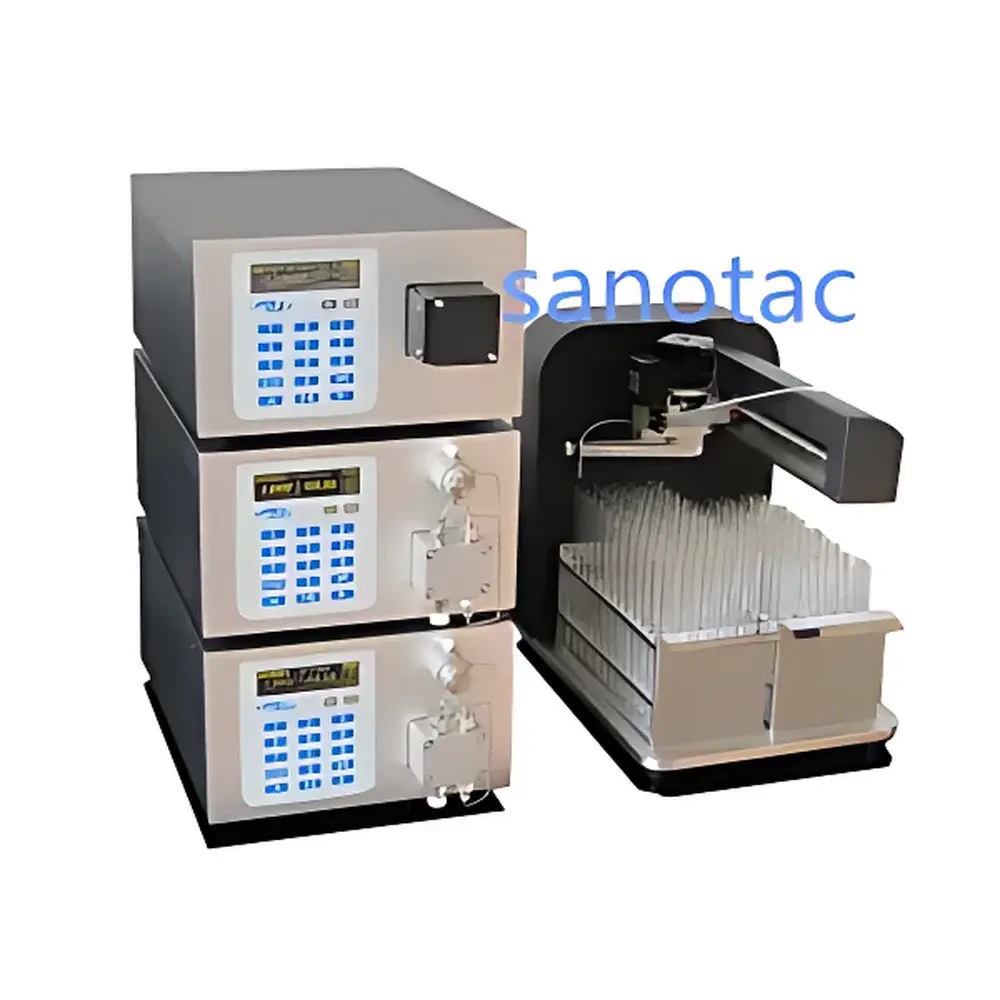
Sanotac aPurifier 50 Medium-Pressure Preparative Liquid Chromatography System
| Brand | Sanotac |
|---|---|
| Origin | Shanghai, China |
| Manufacturer Type | Direct Manufacturer |
| Product Category | Domestic |
| Model | aPurifier 50 |
| Price Range | USD $14,000–$28,000 (FOB) |
| Application Level | Laboratory-Scale |
| Instrument Type | Medium- to Low-Pressure Preparative HPLC |
| Flow Rate Range | 0.01–50.00 mL/min |
| Flow Accuracy | ±1% |
| Flow Precision (RSD) | ≤0.5% |
| Maximum Pressure | 20 MPa |
| Wavelength Range | 190–800 nm |
| Wavelength Accuracy | ±1 nm |
| Wavelength Repeatability | 0.2 nm |
| Baseline Noise | ±0.75×10⁻⁵ AU (254 nm, TC = 1 s) |
| Data Acquisition Rate | 10 Hz |
Overview
The Sanotac aPurifier 50 is a medium-pressure preparative liquid chromatography (PLC) system engineered for high-fidelity isolation and purification of bioactive small molecules—particularly antibiotic active pharmaceutical ingredients (APIs) and structurally complex natural product derivatives. Operating within a pressure range up to 20 MPa, it bridges the performance gap between low-pressure flash chromatography and high-pressure preparative HPLC, delivering robust separation resolution at scalable flow rates (0.01–50.00 mL/min) without requiring ultra-high-pressure infrastructure. Its core architecture leverages dual-syringe pump technology with real-time chamber pressure feedback, compensating for solvent compressibility and pulse-induced flow deviation. This enables precise gradient delivery and exceptional retention time reproducibility—critical for method transfer from analytical to preparative scale in antibiotic development workflows. Designed specifically for laboratories engaged in early-stage API purification, natural product fractionation, and synthetic compound library refinement, the aPurifier 50 supports regulatory-compliant operation under GxP frameworks including FDA 21 CFR Part 11 and CFDA GXP guidelines.
Key Features
- Microprocessor-controlled dual-piston pump system with dynamic pressure compensation for stable flow across full range (0.01–50.00 mL/min), minimizing pulsation-induced baseline noise.
- Advanced flow calibration using multi-point correction curves ensures ±1% flow accuracy and ≤0.5% RSD across all operating conditions.
- Patented floating plunger design extends seal lifetime under sustained medium-pressure operation (up to 20 MPa).
- Dual-wavelength UV-Vis detector (190–800 nm) with deuterium/tungsten lamp auto-switching, ±1 nm wavelength accuracy, and real-time dual-channel signal acquisition.
- Low-noise optical path design achieves baseline noise of ±0.75×10⁻⁵ AU at 254 nm (1 s time constant), supporting detection of trace impurities in antibiotic fractions.
- Intelligent fraction collector with hybrid linear-rotary motion mechanism enabling sub-second positioning to any of 120 collection positions (2 × 60 racks, Φ13–15 mm tubes).
- Flexible triggering modes: time-based, peak-threshold, slope-driven, or user-defined composite logic—fully programmable via Sanochrom software.
- Integrated delay volume compensation algorithm corrects for system dwell volume, ensuring accurate peak cutting and maximizing product purity.
- Modular hardware architecture: optional PEEK pump heads, 10 mL fixed-loop injector (standard), solid/liquid sample introduction capability, and field-upgradable detectors.
Sample Compatibility & Compliance
The aPurifier 50 is routinely deployed in the purification of structurally diverse antibiotics—including β-lactams (e.g., penicillins, cephalosporins), aminoglycosides (e.g., gentamicin, streptomycin), tetracyclines, chloramphenicol analogues, macrolides (e.g., erythromycin, azithromycin), antifungal polyenes (e.g., nystatin), and immunosuppressive macrolactones (e.g., rapamycin derivatives). Its chemically resistant fluidic path (316L stainless steel, optional PEEK) accommodates aggressive solvents (e.g., DMSO, DMF, TFA-containing mobile phases) commonly used in polar antibiotic separations. The system meets ISO/IEC 17025-aligned instrument qualification requirements and supports full audit trail generation, electronic signatures, and role-based access control per FDA 21 CFR Part 11 and CFDA GXP Annexes. All operational parameters—including gradient profiles, collection events, and detector settings—are timestamped, immutable, and exportable in CSV/PDF formats for regulatory submission.
Software & Data Management
Controlled exclusively via Sanochrom Chromatography Workstation (v4.2+), the aPurifier 50 provides a Windows 10-native GUI with intuitive drag-and-drop method building, real-time chromatogram overlay, and synchronized multi-channel data logging (UV, pressure, flow, fraction trigger). The software implements ALCOA+ principles: attributable, legible, contemporaneous, original, accurate, complete, consistent, enduring, and available. All user actions—including method edits, run starts/stops, and fraction assignments—are recorded with operator ID, timestamp, and reason-for-change annotation. Data integrity safeguards include automatic backup to network drives, encrypted database storage, and configurable retention policies. Raw data files (.scd) are non-proprietary and compatible with third-party processing tools (e.g., Chromeleon, Empower) via standardized ASCII export.
Applications
- Purification of β-lactam antibiotics from fermentation broths or synthetic intermediates, resolving diastereomeric impurities and hydrolysis by-products.
- Isolation of aminoglycoside congeners with near-identical pKa and polarity—enabled by pH-stable silica-based stationary phases and precise gradient control.
- Separation of tetracycline epimers and anhydrotetracyclines requiring low-UV-damage detection and rapid fraction recovery.
- Preparative-scale cleanup of macrolide reaction mixtures containing lipophilic side products and catalyst residues.
- Fractionation of microbial extract libraries for antibiotic activity screening (e.g., anti-Gram-positive, anti-Gram-negative, antifungal assays).
- Support of ICH Q5A/Q5D comparability studies by generating highly pure reference standards for structural characterization (NMR, HRMS).
- Method development platform for translating analytical UHPLC methods to preparative scale under controlled mass-load and resolution constraints.
FAQ
What regulatory standards does the aPurifier 50 software comply with?
It conforms to FDA 21 CFR Part 11 and CFDA GXP requirements, including electronic signature validation, audit trail integrity, and secure user authentication.
Can the system be integrated into a LIMS environment?
Yes—via OPC UA or custom API integration; raw data and metadata export supports common LIMS ingestion protocols (e.g., ASTM E1384, HL7).
Is method transfer from analytical HPLC supported?
The system includes scaling calculators for linear velocity and column volume preservation, along with retention time prediction tools based on dwell volume mapping.
What maintenance intervals are recommended for the pump seals?
Under standard operation (≤15 MPa, aqueous/organic solvents), floating-plunger seals require inspection every 6 months and replacement every 12–18 months.
Does the detector support post-run spectral deconvolution?
No—the dual-wavelength detector provides real-time absorbance ratios but lacks full-spectrum scanning; optional add-on diode array module (DAD-50) enables spectral reconstruction.





