
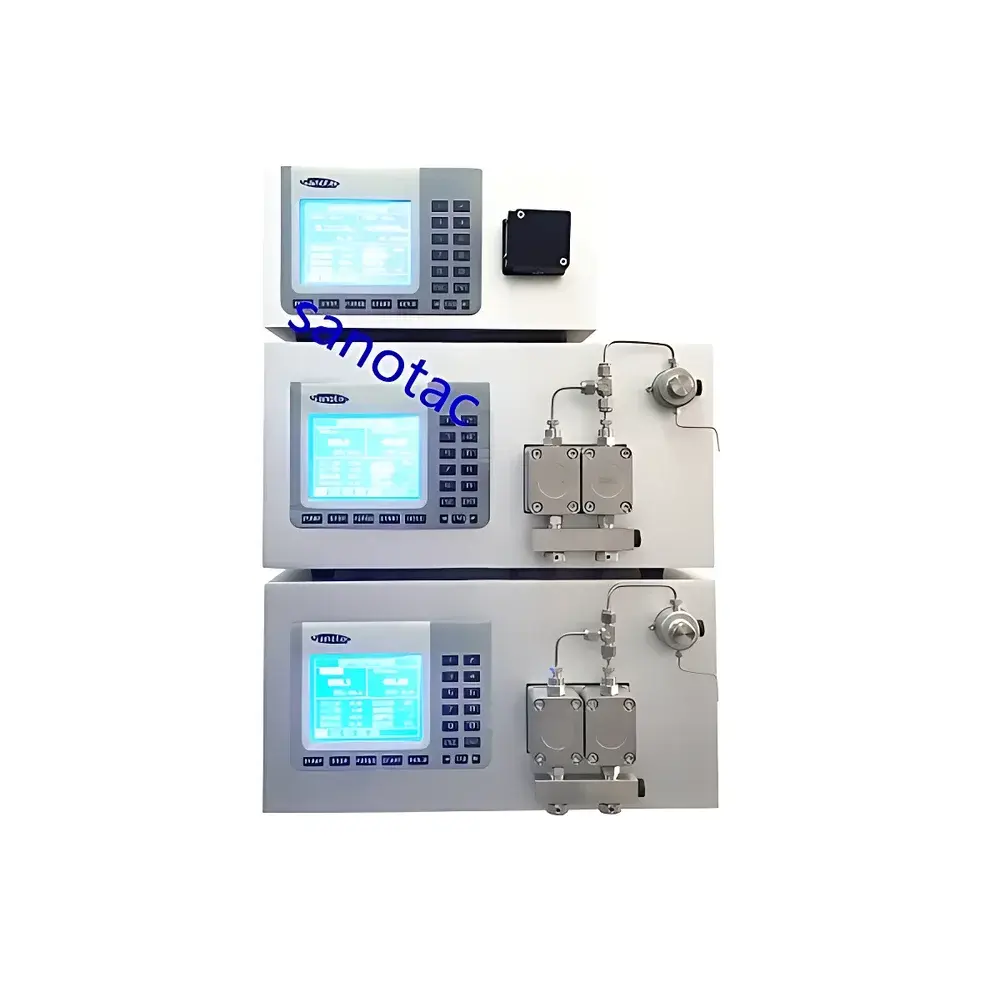
Sanotac Pilot-1000 Preparative High-Performance Liquid Chromatography System
| Brand | Sanotac |
|---|---|
| Origin | Shanghai, China |
| Manufacturer Type | Direct Manufacturer |
| Product Category | Domestic |
| Model | Pilot-1000 |
| Application Level | Industrial-Scale Preparative |
| Instrument Type | High-Pressure Preparative HPLC |
| Flow Rate Range | 0.01–1000.00 mL/min |
| Flow Accuracy | ±1% |
| Flow Precision (RSD) | ≤0.5% |
| Maximum Pressure | 10 MPa |
| Wavelength Range | 190–800 nm |
| Wavelength Accuracy | ±1 nm |
| Wavelength Repeatability | 0.2 nm |
| Baseline Noise | ±0.75×10⁻⁵ AU (254 nm, TC = 1 s) |
| Data Acquisition Rate | 10 Hz |
Overview
The Sanotac Pilot-1000 Preparative High-Performance Liquid Chromatography (Prep-HPLC) System is an engineered solution for scalable, reproducible purification of organic small molecules, natural products, peptides, and synthetic intermediates in industrial R&D and pilot-scale manufacturing environments. Based on high-pressure gradient liquid chromatography principles, the system delivers precise solvent delivery, real-time dual-wavelength UV-Vis detection, and fully automated fraction collection — all integrated within a modular architecture designed for method transfer from analytical to preparative scale. Unlike analytical HPLC systems optimized for detection sensitivity, the Pilot-1000 prioritizes robustness under sustained high-flow conditions, low pulse amplitude (<0.2 MPa), and long-term pressure stability up to 10 MPa. Its design supports both linear and step-gradient elution profiles, with in-run gradient modification capability — enabling rapid method optimization without system shutdown. The system operates across a broad flow range (0.01–1000.00 mL/min), making it suitable for milligram-to-gram-scale purification workflows while maintaining <0.5% RSD flow repeatability — critical for batch-to-batch consistency in compound isolation.
Key Features
- High-precision dual-piston reciprocating pump with cam-profile pulsation compensation and multi-point flow calibration across the full dynamic range
- Auto-cleaning pump head mechanism prevents salt crystallization and buffer residue buildup — extending service intervals and minimizing downtime
- Dual-lamp UV-Vis detector (deuterium + tungsten) with simultaneous dual-wavelength monitoring (190–800 nm), ±1 nm wavelength accuracy, and baseline noise of ±0.75×10⁻⁵ AU at 254 nm (1 s time constant)
- Modular fluidic path constructed from chemically inert materials: standard 316L stainless steel, optional PEEK, titanium, or Hastelloy components for aggressive solvents or alkaline mobile phases
- Integrated preparative autosampler with 10 mL default loop (customizable); supports both solid-phase loading and direct liquid injection
- Intelligent lamp and flow cell exchange system — tool-free replacement with automatic lamp life tracking and spectral validation
- Low-dead-volume mixing chamber with optimized laminar flow geometry, reducing band broadening and improving gradient fidelity
Sample Compatibility & Compliance
The Pilot-1000 accommodates a wide spectrum of sample matrices — including crude reaction mixtures, fermentation broths, plant extracts, and synthetic libraries — without requiring extensive pre-filtration. Its compatibility extends to all commercially available reversed-phase, normal-phase, ion-exchange, and size-exclusion columns (ID 10–50 mm, length up to 250 mm), as well as SPE cartridges and guard columns from third-party vendors. From a regulatory standpoint, the system conforms to international quality frameworks essential for pharmaceutical and biotech applications: data integrity is enforced through role-based user authentication, electronic signatures, audit trails with immutable timestamps, and full compliance with FDA 21 CFR Part 11 and CFDA GxP requirements. All instrument methods, chromatograms, and project metadata are stored in a relational database with version-controlled access — supporting GLP/GMP audits and traceability from raw data to final purified fraction.
Software & Data Management
Control and data acquisition are managed via a Windows-native workstation software platform (compatible with Windows 7/8/10). The interface features drag-and-drop method building, real-time chromatogram overlay, peak tracking with retention time alignment, and customizable fraction triggering logic (time-, peak-, threshold-, or UV-ratio-based). Project-level data organization ensures that every run is linked to its associated method, calibration records, and raw spectral files. Software logs include operator ID, timestamped parameter changes, system alerts, and hardware status snapshots — all retained for ≥10 years per configurable retention policy. Export options include ASCII, CSV, and CDF formats compatible with third-party analysis tools (e.g., Chromeleon, Empower, OpenLab). Remote monitoring via secure TCP/IP connection enables centralized lab management without compromising data sovereignty.
Applications
- Purification of synthetic drug candidates (API intermediates, chiral isomers, and metabolites) prior to structural elucidation (NMR, MS) and biological screening
- Isolation of bioactive natural compounds (alkaloids, flavonoids, terpenes) from complex botanical matrices
- Downstream processing of peptide synthesis mixtures — removal of deletion sequences and truncated variants
- Scale-up of analytical methods developed on UHPLC or HPLC platforms using identical column chemistries and gradient profiles
- Preparative separation of oligonucleotides and modified nucleosides under denaturing or native conditions
- Support for QC release testing where reference standards require in-house purification due to commercial unavailability
FAQ
What column dimensions and chemistries are supported?
The Pilot-1000 accepts columns with internal diameters from 10 mm to 50 mm and lengths up to 250 mm. It is compatible with C18, C8, phenyl-hexyl, amino, cyano, silica, diol, and specialized chiral stationary phases — including those from Waters, Phenomenex, YMC, and Agilent.
Can the system operate under GMP-compliant conditions?
Yes. The software enforces ALCOA+ data integrity principles: attributable, legible, contemporaneous, original, accurate, complete, consistent, enduring, and available. Full 21 CFR Part 11 compliance includes electronic signature validation, audit trail review functionality, and locked archive mode for finalized projects.
Is gradient delay volume compensated during method transfer?
The system incorporates programmable dwell volume correction in its gradient engine, allowing users to match retention times across different column geometries and flow rates — essential for seamless analytical-to-preparative scale-up.
What maintenance intervals are recommended for routine operation?
Pump seals require inspection every 6 months under continuous use; UV lamps are rated for ≥2000 hours and monitored automatically; flow cells should be cleaned quarterly with appropriate solvents based on mobile phase composition.
Does the system support integration with external detectors such as ELSD or MS?
Yes. Analog and digital I/O ports (0–10 V, RS-232, USB) enable synchronization with mass spectrometers, evaporative light-scattering detectors (ELSD), and refractive index (RI) detectors — facilitating hyphenated purification workflows.






