
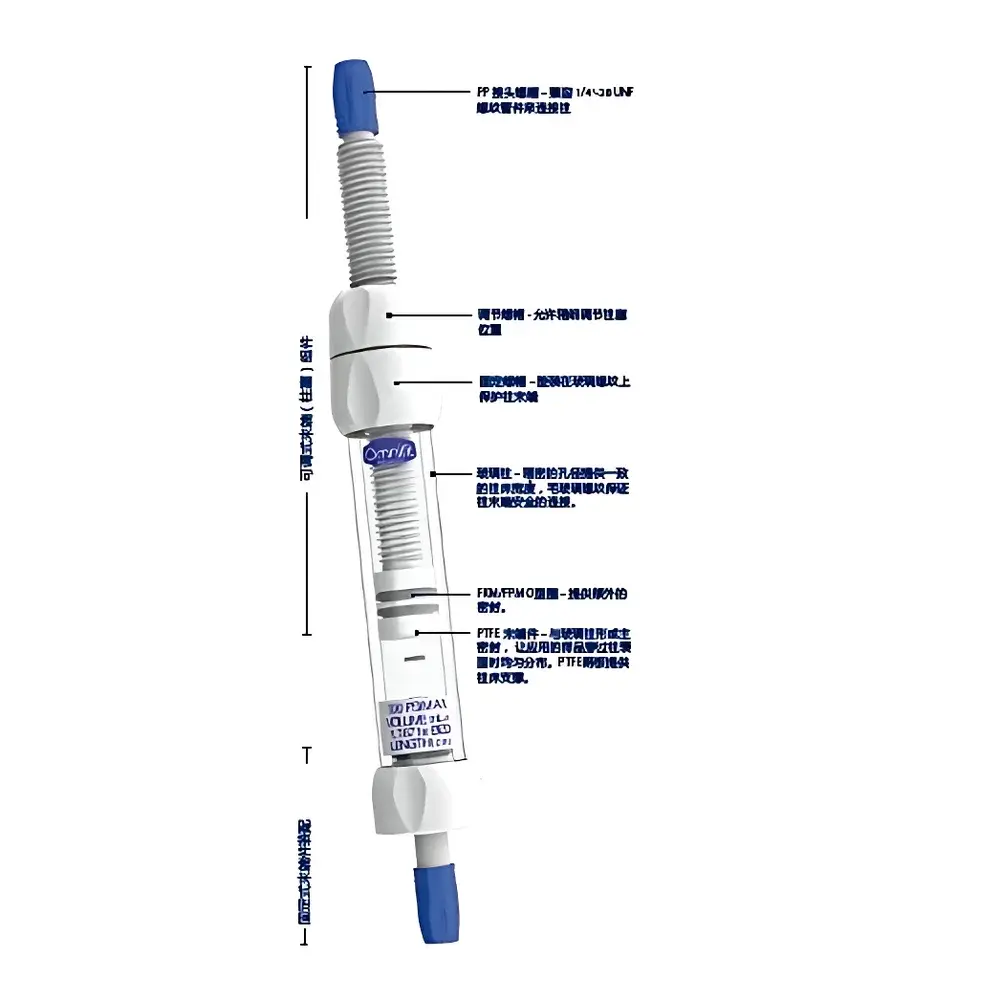
Omnifit EZ Columns Protein & Biomolecule Chromatography Column (Model 006EZ-10-25-AF)
| Origin | UK |
|---|---|
| Manufacturer Type | Authorized Distributor |
| Origin Category | Imported |
| Model | 006EZ-10-25-AF |
| Application Level | Laboratory Grade |
| Instrument Type | Medium-Low Pressure Preparative Liquid Chromatography |
| Max Operating Pressure | 900 psi (60 bar) |
| Column ID | 10 mm |
| Column Length | 250 mm |
| End Configuration | Axial Compression (One-End Adjustable) |
| Material | Borosilicate Glass Tube, PTFE End Fittings, PE Frits, FKM O-Rings, Acetal Adjustment Nuts, GF-Reinforced PP Hardware |
| Temperature Range | 4–40 °C |
| pH Stability | 1–14 |
| Chemical Compatibility | Aqueous buffers, acetonitrile, methanol, isopropanol, ethanol, THF, DMF, DMSO |
| Compliance | Designed for GLP-compliant workflows and integration with ISO/IEC 17025-accredited purification platforms |
Overview
The Omnifit EZ Columns series represents a benchmark in modular, user-serviceable chromatography hardware engineered for protein and biomolecule purification under medium-low pressure conditions. Manufactured in the United Kingdom by Omnifit (a brand of Porvair Sciences), these columns operate on the principle of axial compression—mechanically stabilizing packed beds to minimize channeling, improve resolution, and ensure reproducible elution profiles across repeated runs. Unlike fixed-bed columns, the EZ design incorporates precision-machined acetal adjustment nuts that allow fine-tuning of bed height and density without disassembly, preserving column integrity during method development or scale-up. The 006EZ-10-25-AF variant features a 10 mm internal diameter borosilicate glass tube and a 250 mm effective bed length, configured for one-end adjustable axial compression—ideal for optimizing packing density of soft agarose- or dextran-based resins (e.g., Sepharose, Capto, Toyopearl) used in affinity, ion exchange, and size exclusion chromatography. Its rated maximum pressure of 900 psi (60 bar) supports compatibility with common preparative LC systems including Cytiva AKTA avant, Bio-Rad NGC, and Sanotac Biolot platforms, while maintaining mechanical stability under gravity-fed or peristaltic pump-driven operation.
Key Features
- Modular axial compression architecture enabling precise, tool-free bed compaction—critical for maintaining homogeneity in low-rigidity media
- Borosilicate glass column body offering optical clarity for visual bed inspection and high thermal/mechanical stability (4–40 °C operating range)
- Chemically inert wetted path: PTFE end fittings, PE frits (10–25 µm pore size), FKM O-rings, and GF-reinforced PP hardware ensure broad solvent compatibility and low extractables
- Seven standard internal diameters (5–50 mm) and lengths up to 500 mm support scalability from analytical screening to pilot-scale purification (0.2–940 mL bed volume)
- Three end configurations: Fixed-Fixed (FF), One-End Adjustable (AF), and Two-End Adjustable (AA)—enabling method transfer across development, validation, and manufacturing stages
- Pre-assembled accessory kit includes dual-length PTFE tubing (2 m and 0.5 m, 1/16″ ID) with 1/4-28 UNF PP ferrules for rapid system integration
Sample Compatibility & Compliance
Omnifit EZ Columns are validated for use with biological macromolecules—including monoclonal antibodies, recombinant enzymes, viral vectors, and plasmid DNA—under physiologically relevant pH (1–14) and temperature (4–40 °C) conditions. The glass/PTFE/PE construction minimizes nonspecific binding and metal leaching, supporting USP , ISO 10993-5 cytotoxicity, and ICH Q5A/Q5D biocompatibility expectations. Columns comply with Good Manufacturing Practice (GMP) Annex 15 requirements for equipment qualification: each unit carries traceable batch documentation, and the modular design facilitates IQ/OQ execution per ASTM E2500 and EU GMP Annex 15. While not inherently 21 CFR Part 11 compliant (as a hardware-only component), the columns integrate seamlessly into audit-trail-enabled systems such as AKTA Unicorn and NGC Chromatography Software when deployed within validated purification workflows.
Software & Data Management
As a passive hardware component, the Omnifit EZ Column does not incorporate embedded electronics or firmware. However, its mechanical consistency directly contributes to data integrity in regulated environments: reproducible bed compression yields consistent retention times (<1.5% RSD over 50 injections), peak symmetry (Asymmetry factor 0.9–1.2), and resolution (Rs ≥ 1.5 for IgG monomer/dimer separation). When paired with Cytiva Unicorn or Bio-Rad Biolog software, column parameters—including ID, length, bed volume, and compression setting—are manually entered into method files to enable accurate flow rate calculation (e.g., linear velocity = flow rate / cross-sectional area) and system suitability assessment per USP . All physical specifications are documented in the OEM Certificate of Conformance (CoC), which is supplied with each shipment and archived for regulatory submission.
Applications
- Lab-scale purification of His-tagged proteins using Ni-NTA resin under imidazole gradient elution
- Buffer exchange and desalting of CRISPR-Cas9 ribonucleoprotein complexes via size exclusion chromatography (SEC)
- Polishing step in mAb downstream processing using cation exchange (CEX) on SP Sepharose FF
- Process development for AAV vector purification using AVB Sepharose or POROS™ CaptureSelect resins
- Method scouting for plasmid DNA purification using anion exchange (AEX) on Q Sepharose HP
- Continuous flow chromatography (CFC) implementation using twin-column setups with automated valve switching
FAQ
Can Omnifit EZ Columns be sterilized using autoclaving?
No. The borosilicate glass body is autoclavable, but PTFE, PE, FKM, and acetal components are not rated for repeated steam sterilization. Recommended sanitization methods include 0.5 M NaOH (≤30 min contact time) or 70% ethanol, followed by thorough equilibration.
What is the recommended maximum flow rate for the 006EZ-10-25-AF column?
For optimal resolution with soft gels (e.g., Sepharose CL-4B), maintain linear velocity ≤ 15 cm/h (≈ 1.2 mL/min at 10 mm ID). For rigid media (e.g., SOURCE 15), linear velocity may be increased to 300 cm/h (≈ 24 mL/min), provided system backpressure remains below 900 psi.
Is column regeneration possible after resin fouling?
Yes. The modular design permits full disassembly: glass tube, end pieces, frits, and O-rings can be cleaned separately using appropriate solvents. Replacement frits (Omnifit part #006FRT-10) and O-rings (006ORK-10) are available as service kits.
How does axial compression affect column efficiency compared to non-compressed columns?
Axial compression reduces bed void volume and radial heterogeneity, improving plate count (N) by 20–40% and reducing peak tailing (Asymmetry factor improvement from >1.5 to <1.1) in low-pressure applications where resin compressibility exceeds 10%.
Are custom dimensions or materials available for GMP manufacturing use?
Yes. Porvair Sciences offers OEM customization—including laser-etched serialization, alternative frit materials (e.g., stainless steel for high-pH stability), and ASME BPE-compliant fittings—subject to minimum order quantities and extended lead times.





