
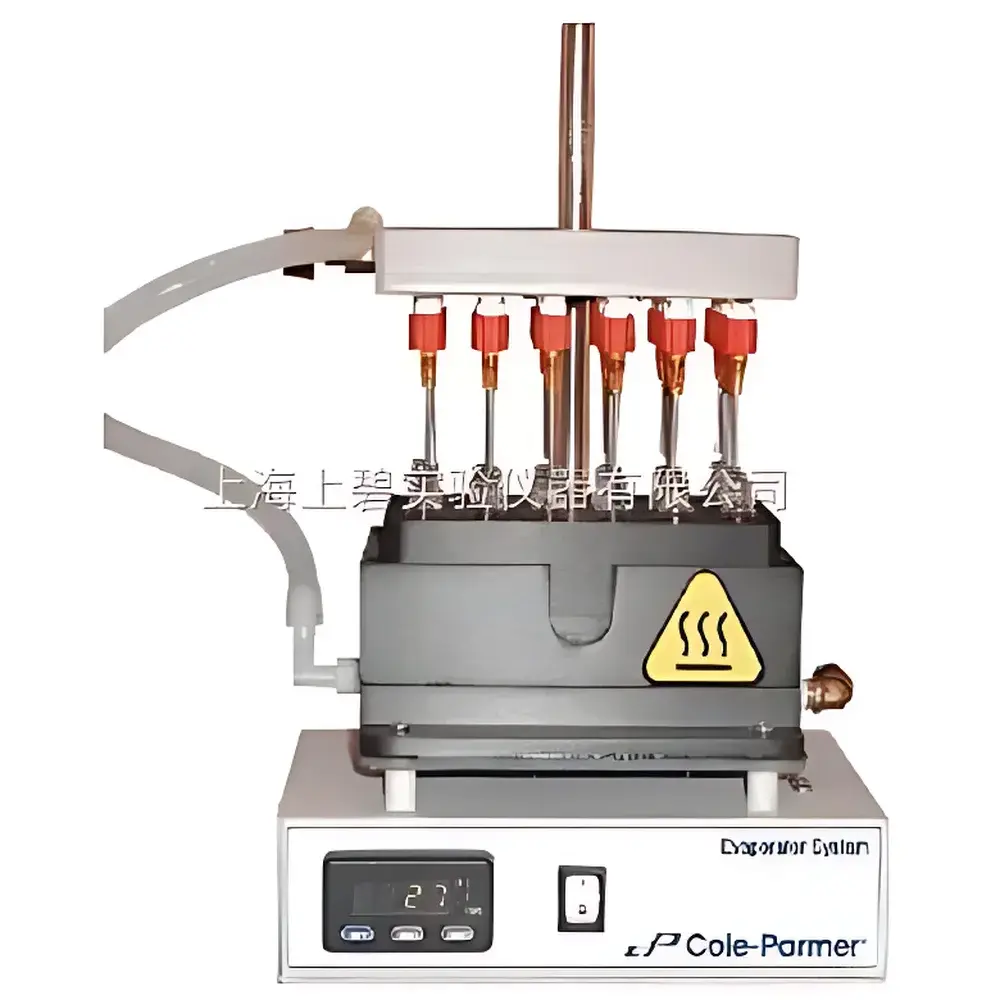
Cole-Parmer 28690-05 Nitrogen Evaporator System
| Brand | Cole-Parmer |
|---|---|
| Origin | USA |
| Model | 28690-05 |
| Heating Method | Dry-block heating |
| Temperature Range | Ambient to 100 °C |
| Gas Pressure Range | 1–20 psi |
| Gas Flow Rate | 40 L/min |
| Dimensions (L×W×H) | 19 × 14 × 13 cm |
| Sample Capacity | 8-position EPA vial holder |
| Needle Valve | 15-gauge, 3.8 cm length |
| Compliance | Designed for EPA Method 502/503/504/525-compliant sample preparation |
Overview
The Cole-Parmer 28690-05 Nitrogen Evaporator System is an engineered dry-block concentrator designed for reproducible, low-temperature solvent removal in regulated analytical laboratories. It operates on the principle of inert gas-assisted evaporation: nitrogen (or compressed air) is delivered via precision-engineered 15-gauge stainless-steel needles positioned directly above heated sample vessels, creating controlled laminar flow that accelerates solvent volatilization without thermal degradation of analytes. Unlike water-bath evaporators, its dry-block architecture eliminates cross-contamination risk, ensures uniform thermal distribution across all positions, and supports rapid temperature ramping and stabilization—critical for trace-level analysis in environmental, pharmaceutical, and forensic workflows.
Key Features
- Dry-block heating system with PID-controlled temperature regulation from ambient to 100 °C (±0.5 °C accuracy at setpoint), enabling precise thermal management for thermolabile compounds
- Eight-position modular configuration optimized for standard EPA-certified 40-mL glass vials (e.g., EPA Method 525.3), with individually adjustable 15-gauge stainless-steel gas delivery needles (3.8 cm length)
- Independent needle valve control per channel allows fine-tuned gas flow modulation—essential for balancing evaporation rate and analyte recovery in multi-analyte extractions
- Gas pressure range of 1–20 psi accommodates both low-flow gentle concentration (e.g., PCBs, PAHs) and high-throughput applications (e.g., pesticide residue screening)
- Compact footprint (19 × 14 × 13 cm) and low power consumption (<150 W) support integration into fume hoods or shared benchtop workspaces without compromising safety or ergonomics
- Chemically resistant aluminum housing and anodized block surface withstand repeated exposure to organic solvents including hexane, acetone, ethyl acetate, and dichloromethane
Sample Compatibility & Compliance
The 28690-05 is validated for use with EPA-approved glassware and conforms to method requirements for U.S. EPA Methods 502.2, 503.1, 504.1, and 525.3—particularly in the final concentration step prior to GC-ECD, GC-MS, or LC-MS/MS analysis. Its design supports GLP-compliant documentation when paired with laboratory information management systems (LIMS); temperature logs and gas pressure settings are manually recorded per batch to satisfy audit trails required under 40 CFR Part 136 and ISO/IEC 17025:2017 Clause 7.8. The absence of moving parts or liquid media reduces maintenance intervals and eliminates calibration drift associated with bath-level sensors or immersion probes.
Software & Data Management
This unit operates as a standalone hardware platform with no embedded microprocessor or digital interface; all operational parameters—including block temperature, inlet pressure, and needle valve position—are set manually and verified using external calibrated instrumentation (e.g., digital manometer, RTD thermometer). This analog architecture ensures deterministic behavior, avoids firmware-related validation burdens, and aligns with FDA 21 CFR Part 11 Annex 11 expectations for “simple instruments” where electronic records are not generated. Users maintain full traceability through paper-based or LIMS-linked run sheets documenting lot numbers, analyst ID, date/time, and method reference—supporting full GxP audit readiness without software qualification overhead.
Applications
- Concentration of aqueous and organic extracts from solid-phase extraction (SPE), liquid-liquid extraction (LLE), and QuEChERS workflows prior to instrumental analysis
- Final volume adjustment of environmental samples (groundwater, wastewater, soil leachates) per EPA SW-846 protocols
- Preparative cleanup in pharmaceutical QC labs for residual solvent removal from API intermediates (ICH Q3C-compliant)
- High-sensitivity trace metal analysis requiring ultra-low blank levels—dry-block design minimizes background contamination vs. water baths
- Forensic toxicology sample prep where consistent evaporation kinetics across replicates are essential for quantitative accuracy (e.g., blood alcohol or drug metabolite quantification)
FAQ
Is the 28690-05 compatible with non-EPA vial formats?
Yes—custom adapter plates can be fabricated for 12-mm or 16-mm round-bottom tubes; however, optimal gas flow dynamics and thermal transfer are guaranteed only with EPA-standard 40-mL vials.
Does this unit require external nitrogen supply regulation?
Yes—a dedicated nitrogen generator or cylinder with integrated pressure regulator (set to ≤20 psi) and particulate/moisture filter is mandatory to prevent needle clogging and ensure consistent flow.
Can it be used for volatile organic compound (VOC) analysis per EPA Method 502.2?
Yes, provided the system is operated inside a certified fume hood with appropriate exhaust velocity (≥100 fpm), and all glassware is pre-baked per Method 502.2 Section 8.2.
What maintenance is required for long-term reliability?
Quarterly inspection of needle tips for residue buildup, annual verification of block temperature uniformity using NIST-traceable thermocouples, and biannual cleaning of the aluminum housing with isopropanol.
Is calibration certificate included with purchase?
No—calibration is performed by the end user or third-party metrology lab per ISO/IEC 17025; Cole-Parmer provides dimensional and material compliance documentation only.



