
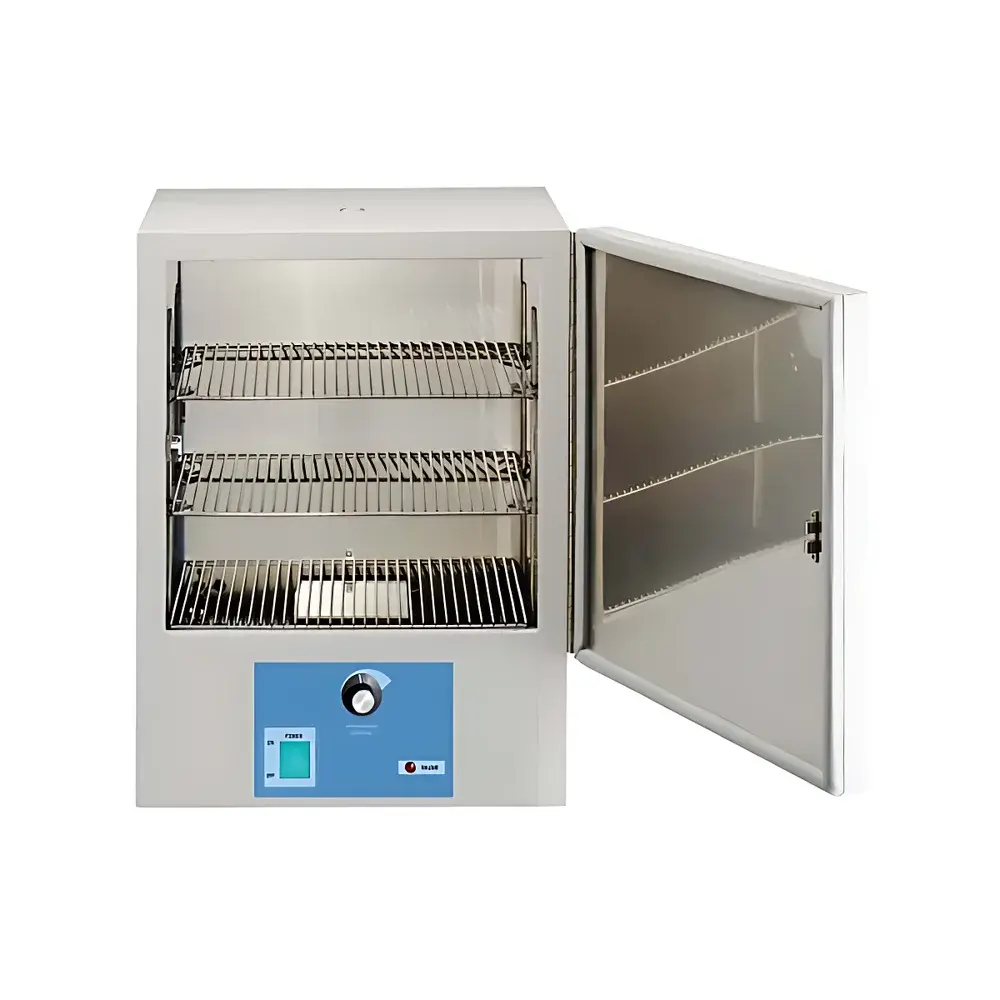
Cole-Parmer StableTemp Forced-Air Drying Oven Model 52100-05
| Brand | Cole-Parmer |
|---|---|
| Origin | USA |
| Model | 52100-05 |
| Temperature Range | Ambient to 275 °C |
| Temperature Uniformity | ±3 °C at 200 °C |
| Temperature Stability | ±3 °C |
| Internal Dimensions (W×D×H) | 41×41×29 cm |
| External Dimensions (W×D×H) | 47×63×35 cm |
| Chamber Material | Stainless steel (interior and exterior) |
| Heating Method | Forced-air convection |
| Display | Digital PID controller |
| Power Supply | 230 V, 50/60 Hz |
| Power Consumption | 1200 W |
| Net Weight | 39 kg |
| Standard Shelving | 3 adjustable stainless steel shelves (5 total positions) |
| Over-Temperature Protection | Audible alarm on deviation > preset limit |
| Data Retention | Last set temperature retained in non-volatile memory after power cycle |
Overview
The Cole-Parmer StableTemp Forced-Air Drying Oven Model 52100-05 is an engineered solution for precise thermal processing in regulated laboratory and quality control environments. Designed around a robust forced-air convection architecture, it ensures rapid heat transfer and high spatial temperature uniformity across the chamber volume—critical for applications requiring reproducible drying, curing, sterilization validation, or moisture loss determination. Unlike natural-convection ovens, this unit employs a calibrated axial fan and optimized internal airflow ducting to minimize thermal gradients, achieving ±3 °C uniformity at 200 °C (per ASTM E2207-22 methodology). The chamber operates from ambient temperature up to 275 °C, with digital PID control delivering stable setpoint maintenance under dynamic load conditions. Its stainless steel interior and exterior construction provides corrosion resistance, ease of decontamination, and long-term dimensional stability—essential for GLP-compliant workflows and repeated exposure to solvents or humidity.
Key Features
- Forced-air convection system with rear-mounted blower and perforated rear wall for laminar, top-to-bottom airflow distribution
- Digital PID temperature controller with intuitive keypad interface and real-time display of setpoint, actual chamber temperature, and elapsed time
- Non-volatile memory retains last-used temperature setting after power interruption—eliminates manual re-entry during routine operation
- Over-temperature safety circuit triggers audible alarm if chamber exceeds user-defined limit by >5 °C; heater remains active only within safe operational envelope
- Five-tier shelf support system with three pre-installed 304 stainless steel shelves (removable and repositionable); additional shelves (Cat. No. 52100-50) and retaining clips (Cat. No. 52100-53) available separately
- Front-access door with dual-layer tempered glass window and silicone gasket seal for visual monitoring without thermal disruption
- UL-listed electrical components and CE-marked construction compliant with IEC 61010-1:2010 for laboratory equipment safety
Sample Compatibility & Compliance
The 48 L chamber accommodates standard laboratory ware including Petri dishes, weighing boats, glass desiccators, metal sample trays, and polymer test coupons. It supports ISO 5725-based repeatability studies and ASTM D2244 colorimetric drying assessments. The oven meets requirements for residual solvent removal per USP , moisture content determination per AOAC 950.46, and accelerated aging per ICH Q1A(R2). Its temperature uniformity profile has been validated per ISO 17025-accredited protocols using NIST-traceable Class A PT100 probes at nine spatial locations. The unit does not include integrated data logging hardware but is compatible with external USB or Ethernet-connected thermocouple arrays for 21 CFR Part 11–compliant audit trails when paired with validated third-party software.
Software & Data Management
While the Model 52100-05 operates as a standalone instrument with no embedded PC interface, its analog output (0–5 V DC proportional to chamber temperature) enables integration into centralized building management systems or SCADA platforms via optional signal conditioners. For regulatory documentation, users may connect calibrated external loggers (e.g., Omega OM-DAQPRO-5300 series) to record time-stamped temperature profiles with timestamped metadata. All configuration changes—including setpoint adjustments and alarm thresholds—are manually entered and visually confirmed on the front-panel display; no password protection or electronic signature functionality is provided, aligning with its classification as a Class II general-purpose thermal device under FDA guidance.
Applications
- Gravimetric moisture analysis of pharmaceutical excipients and APIs per USP
- Curing of epoxy-coated substrates and powder-coated metal parts in materials R&D labs
- Drying of filter papers and crucibles prior to ash content determination (AOAC 923.03)
- Stabilization of hygroscopic reference standards before calibration procedures
- Pre-heating of test specimens for tensile, impact, or thermal expansion measurements (ASTM D638, D256, E831)
- Validation of dry-heat depyrogenation cycles for glass vials and stoppers (USP )
FAQ
Does this oven support programmable ramp-soak profiles?
No. The Model 52100-05 provides single-setpoint temperature control only. Multi-step thermal profiles require external programmable controllers.
Is the internal chamber volume verified per ISO 27835?
Chamber volume is calculated geometrically from nominal internal dimensions (41 × 41 × 29 cm) and is not certified to ISO 27835, which applies specifically to volumetric calibration of incubators.
Can the oven be used for sterilization?
It is not validated or rated for microbiological sterilization. Dry-heat sterilization requires sustained exposure at ≥160 °C for ≥2 hours per ISO 15883-1; users must perform their own cycle development and biological indicator testing.
Are replacement shelves autoclavable?
Yes. All stainless steel shelves (Cat. No. 52100-50) are constructed from 304 stainless steel and withstand repeated autoclaving at 121 °C, 15 psi for 20 minutes.
What is the maximum recommended continuous operating temperature?
275 °C is the absolute upper limit specified by Cole-Parmer. For extended service life and optimal sensor longevity, operation above 250 °C should be limited to ≤4 hours per cycle.



