
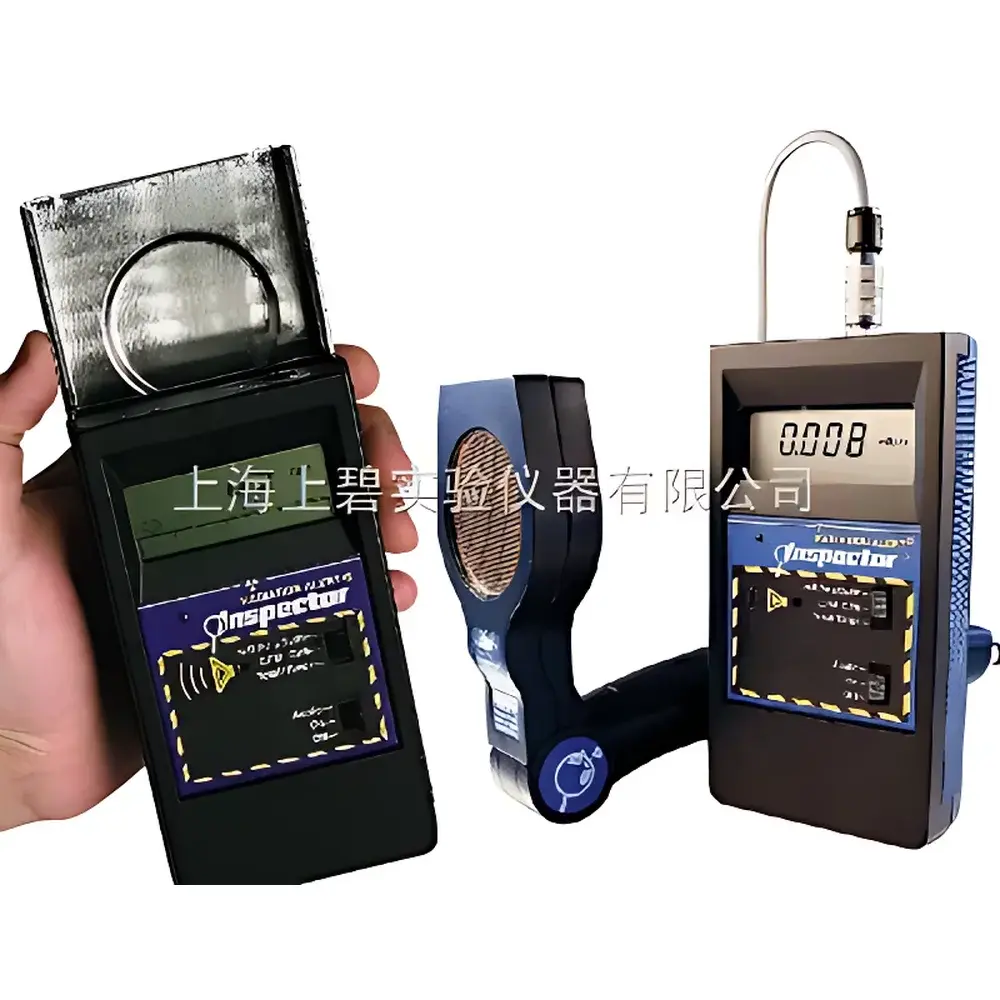
Seiger Instruments Inspector EXP Geiger-Müller Radiation Survey Meter
| Origin | USA |
|---|---|
| Manufacturer Type | Authorized Distributor |
| Origin Category | Imported |
| Model | EXP |
| Instrument Type | Online Environmental Radiation Monitor |
| Detection Method | Geiger-Müller Tube (GM) |
| Radiation Types Detected | α, β, γ, and X-rays |
| Display | 4-digit LCD |
| Measurement Modes | CPM, CPS, mR/hr, µSv/hr, Total Count |
| Timer Range | 1 minute to 24 hours |
| Minimum Detectable Energy | 20 keV (γ-rays) |
| Dose Rate Range | 0.001–100 mR/hr (0.1–1000 µSv/hr) |
| Count Rate Range | 0–5000 CPS (0–300,000 CPM) |
| Total Count Range | 1–9,999,000 |
| Accuracy | ±15% at ≤500 µSv/hr |
| Gamma Sensitivity | 3500 CPM/mR/hr (Cs-137 reference) |
| Alpha Efficiency (Am-241, 5.5 MeV) | 18% |
| Beta Efficiency (Sr-90) | 38% |
| Physical Dimensions (L×W×H) | 8 × 3 × 15 cm |
| Power Supply | 9 V alkaline battery |
Overview
The Seiger Instruments Inspector EXP Geiger-Müller Radiation Survey Meter is a portable, field-deployable environmental radiation monitoring instrument engineered for reliable detection and quantification of alpha (α), beta (β), gamma (γ), and X-ray radiation in air, water, surfaces, and materials. It operates on the fundamental principle of gas ionization within a halogen-quenched Geiger-Müller tube: incident radiation induces ion pairs in the tube’s fill gas, triggering discrete electrical pulses—each pulse corresponding to a single radiation interaction. These pulses are electronically processed and reported in user-selectable units including counts per minute (CPM), counts per second (CPS), exposure rate (mR/hr), ambient dose equivalent rate (µSv/hr), and cumulative total count. The EXP variant features an extended external GM probe connected via shielded coaxial cable, enabling safe standoff measurements during contamination surveys, thereby minimizing operator dose and enhancing operational flexibility in high-risk or hard-to-access locations.
Key Features
- External ruggedized GM probe with 1.5-meter shielded cable for remote, low-dose-rate measurements and surface contamination screening
- Four-digit LCD display with real-time switching between CPM, CPS, mR/hr, µSv/hr, and total count modes
- Programmable measurement timer (1 minute to 24 hours) for time-integrated data acquisition and statistical averaging
- Low-energy threshold of 20 keV for γ-rays, supporting sensitive detection of low-energy isotopes such as I-125 (minimum detectable activity: 0.02 µCi at contact)
- Calibrated gamma sensitivity of 3500 CPM/mR/hr referenced to Cs-137, ensuring traceable response across common environmental radionuclides
- Documented detection efficiencies: 18% for Am-241 (α), 38% for Sr-90 (β), and 32% for Bi-210 (β), verified under 4π geometry at contact
- Compact handheld main unit (8 × 3 × 15 cm) powered by a single 9 V alkaline battery with >200 hours of continuous operation
Sample Compatibility & Compliance
The Inspector EXP is routinely deployed for direct-contact and proximity-based assessment of heterogeneous sample matrices—including aqueous samples (groundwater, effluent), solid substrates (concrete, soil, granite, ceramic ware), personal protective equipment (gloves, lab coats), and structural surfaces (walls, floors, workbenches). Its design supports compliance with international radiation protection frameworks, including IAEA Safety Standards Series No. GSR Part 3 and national regulations aligned with NRC 10 CFR Part 20. While not certified for regulatory reporting under ISO/IEC 17025, the instrument meets functional performance criteria outlined in ANSI N42.32 (Portable Radiation Detection Instrumentation) and ASTM D3648 (Standard Practice for Measurement of Radioactivity). It is suitable for preliminary screening, ALARA verification, and routine health physics surveys in accordance with OSHA 1910.120 and EPA Method 901.1.
Software & Data Management
The Inspector EXP operates as a standalone analog-digital hybrid device with no embedded Bluetooth, USB, or cloud connectivity. All measurements are displayed and stored locally on the LCD screen only; no internal memory or data logging capability is provided. For audit-trail integrity, users are advised to record readings manually or integrate the device into structured survey protocols using external digital logbooks compliant with GLP/GMP documentation requirements. When used in regulated environments (e.g., nuclear medicine facilities or decommissioning sites), measurement records should include timestamp, location identifier, probe orientation, distance from source, and background subtraction methodology—practices consistent with FDA 21 CFR Part 11 expectations for handwritten entries supported by contemporaneous witness verification.
Applications
- Environmental site assessment: mapping radon progeny in soil gas, detecting Ra-226 in groundwater, characterizing legacy uranium mill tailings
- Industrial hygiene: monitoring surface contamination on PPE, tools, and transport containers in radiopharmaceutical manufacturing
- Academic and research labs: verifying shielding integrity, validating decay-corrected sample handling procedures, teaching radiation detection fundamentals
- Emergency response: rapid reconnaissance of suspected radiological dispersal devices (RDDs), post-incident contamination triage in municipal infrastructure
- Consumer product screening: evaluating radioactivity in building materials (granite countertops), vintage glassware (uranium-doped), and antique ceramics
- Decommissioning support: documenting residual activity levels on piping, valves, and reactor coolant system components prior to release
FAQ
Is the Inspector EXP suitable for quantitative radionuclide identification?
No. It is a gross-counting instrument without energy discrimination capability. Spectral analysis requires a scintillation detector or high-purity germanium (HPGe) system.
Can it measure radon gas concentration directly?
Not as a continuous gas-phase monitor. It detects radon progeny (e.g., Po-218, Bi-214) deposited on surfaces or filters; air sampling must be performed separately using alpha-track or electret ion chamber methods.
What is the recommended calibration interval?
Annual calibration against traceable Cs-137 and Co-60 sources is advised per ANSI N42.20 and facility radiation safety program requirements.
Does the external probe require separate power?
No. The probe is passive and receives bias voltage and signal transmission through the integrated coaxial cable from the main unit.
Is the device intrinsically safe for use in explosive atmospheres?
No. It is not rated for Class I, Division 1 hazardous locations and must not be operated in flammable vapor or dust environments.
Related Products







