
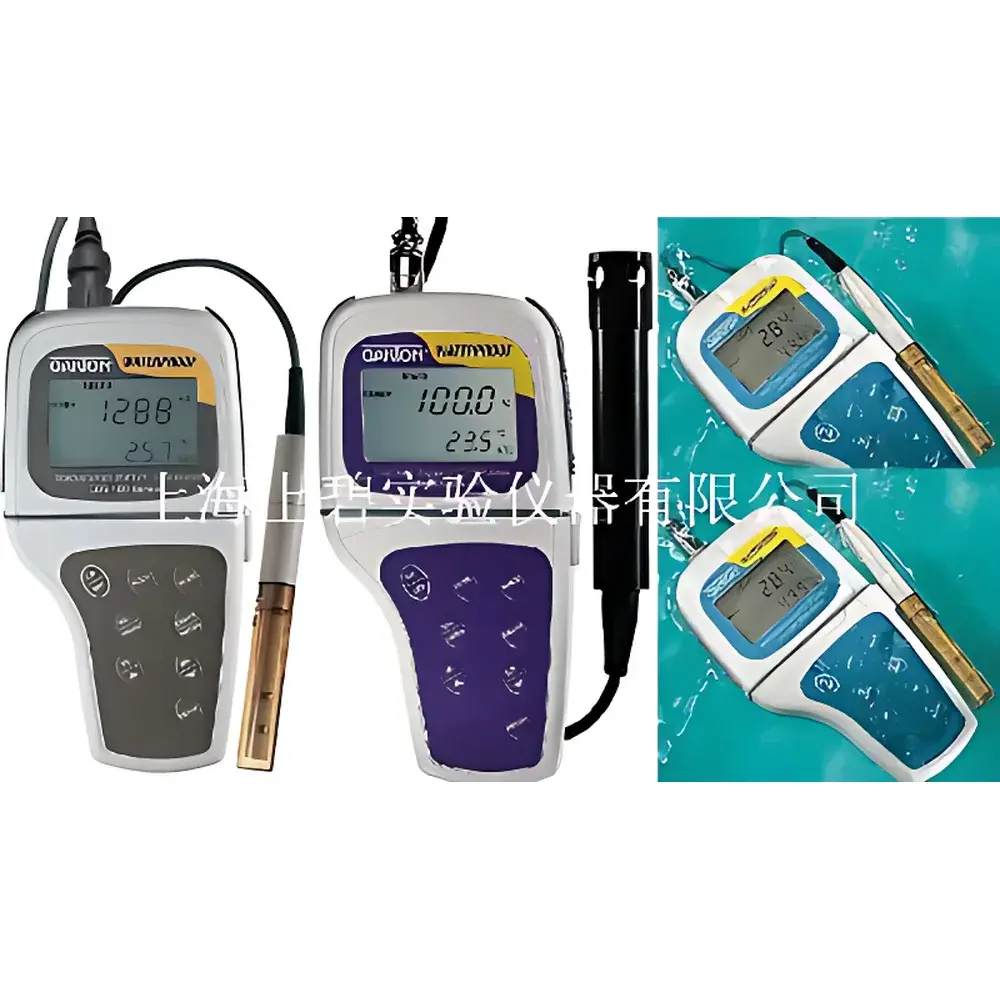
Oakton DO300 Dissolved Oxygen Meter with 15-Meter Immersion Probe (Model 35805-54)
| Origin | USA |
|---|---|
| Manufacturer Type | Authorized Distributor |
| Origin Category | Imported |
| Model | 35805-54 |
| Instrument Type | Laboratory Benchtop/Field-Portable |
| Measurement Principle | Galvanic Cell Electrochemical Probe |
| Dissolved Oxygen Range | 0.00–80.00 mg/L (ppm) |
| Accuracy | ±0.2 mg/L (at 25 °C, within 0–20 mg/L range) |
| Repeatability | ±0.05% of reading |
| Detection Limit | 0.00 mg/L ± 2% of full scale |
| Temperature Compensation | Automatic or manual (0–50 °C) |
| IP Rating | IP67 |
| Data Storage | 50 readings |
| Dimensions (W×H×D) | 8.9 × 18.6 × 4.4 cm |
| Probe Cable Length | 15 m |
Overview
The Oakton DO300 Dissolved Oxygen Meter (Model 35805-54) is a laboratory-grade, field-deployable electrochemical analyzer engineered for precise, reliable measurement of dissolved oxygen (DO) concentration in aqueous samples using a galvanic cell probe principle. Unlike polarographic sensors requiring polarization time and external voltage, the galvanic cell design operates autonomously—generating its own current proportional to oxygen partial pressure—enabling rapid response (<60 s to 90% step change), zero warm-up delay, and stable output across variable temperature and salinity conditions. This instrument is calibrated per ASTM D888–22 (Standard Test Methods for Dissolved Oxygen in Water) and supports compliance with EPA Method 360.1 and ISO 5814:2012 (Water quality — Determination of dissolved oxygen — Electrochemical probe method). The 15-meter immersion probe (35805-54) extends operational reach into deep wells, reservoirs, sediment-water interfaces, and process tanks where standard probes cannot access—without compromising signal integrity or calibration stability.
Key Features
- Galvanic cell DO sensor with integrated temperature compensation (ATC), eliminating manual correction errors and enabling real-time compensation from 0 °C to 50 °C
- High-resolution display (0.01 mg/L resolution) with dual-parameter readout: DO concentration (mg/L) and % saturation simultaneously
- IP67-rated housing ensures dust-tight operation and submersion resistance up to 1 m for 30 minutes—validated for humid laboratories, wastewater treatment plants, and outdoor monitoring stations
- 50-point internal memory with timestamped logging (date/time stamp enabled via optional PC interface), supporting GLP-compliant data traceability
- Two-point air-saturated water and zero-oxygen (sodium sulfite) calibration protocol with on-screen prompts and deviation alerts
- Dedicated probe port with keyed connector prevents cross-mating with pH or conductivity probes; gold-plated contacts ensure low-noise signal transmission over the full 15 m cable length
- No battery replacement required for probe operation—the galvanic cell is self-powered and rated for ≥12 months continuous use under typical field conditions
Sample Compatibility & Compliance
The DO300 with 35805-54 probe is validated for use across freshwater, seawater (up to 35 ppt salinity), wastewater effluents, activated sludge, and industrial process streams. It meets performance criteria outlined in US EPA Region 10 Field Manual (2021) for ambient water quality monitoring and satisfies the instrument qualification requirements of ISO/IEC 17025:2017 for testing laboratories. The galvanic sensor exhibits minimal interference from common ions (Cl⁻, NO₃⁻, SO₄²⁻) and is unaffected by hydrogen sulfide concentrations ≤1 mg/L. All firmware and calibration routines are compliant with FDA 21 CFR Part 11 when used with Oakton’s optional LogEasy software (v3.2+), providing electronic signature support, audit trail generation, and user-access controls.
Software & Data Management
Data export is supported via USB-C interface to Windows-based systems using Oakton LogEasy v3.2 software—a lightweight, validation-ready application that imports DO300 logs as CSV or PDF reports with embedded metadata (operator ID, calibration history, probe serial number, ambient pressure input). The software enforces ALCOA+ principles: Attributable, Legible, Contemporaneous, Original, Accurate—with automatic timestamping, edit tracking, and irreversible record locking after final review. For integration into LIMS environments, LogEasy provides ODBC-compliant database output compatible with LabWare, STARLIMS, and Thermo Fisher SampleManager. No cloud upload or telemetry is performed by default—ensuring full data sovereignty per GDPR and HIPAA-aligned institutional policies.
Applications
- Regulatory wastewater discharge monitoring (NPDES permit compliance)
- Biochemical oxygen demand (BOD₅) incubation tracking in environmental labs
- Aquaculture pond management and hypoxia risk assessment
- Drinking water distribution system residual oxygen profiling
- Bioreactor DO control validation during pharmaceutical upstream processing
- Groundwater redox potential mapping in site remediation projects
- Educational laboratory exercises in limnology, environmental chemistry, and analytical instrumentation
FAQ
Is the 35805-54 probe compatible with other Oakton meters besides the DO300?
Yes—mechanically and electrically compatible with the PH/DO300, PC300 (when equipped with DO module), and legacy DO200 series instruments. Firmware version 2.4 or higher is required for full feature support.
Does the galvanic probe require membrane replacement, and how often?
Yes—electrolyte-filled galvanic probes require periodic membrane and electrolyte replacement. Oakton recommends replacing the K-type membrane (Cat. No. 35640-01) and filling with 1 M KCl electrolyte (Cat. No. 35640-02) every 3–6 months under continuous use, or after exposure to suspended solids >50 mg/L.
Can barometric pressure be manually entered for altitude correction?
Yes—the DO300 supports manual barometric pressure input (in mmHg or kPa) during calibration setup, enabling accurate mg/L-to-% saturation conversion at elevations up to 3000 m above sea level.
What is the minimum sample flow rate required for accurate measurement?
For static measurements (e.g., in bottles or tanks), no flow is required. For in-line or open-channel applications, a minimum flow velocity of 5 cm/s across the probe tip is recommended to minimize boundary layer effects and ensure representative diffusion-limited current.







