
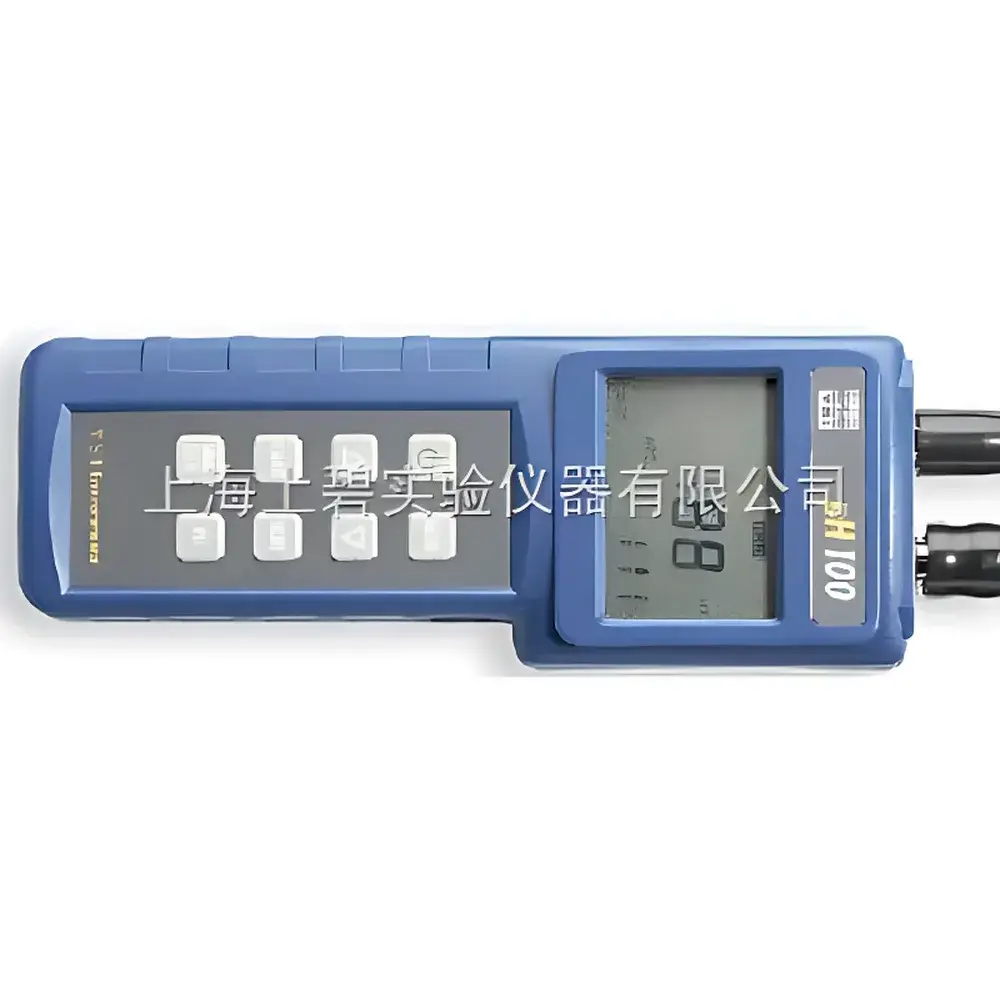
YSI Ecosense PH100 Portable pH/ORP/Temperature Meter
| Origin | USA |
|---|---|
| Manufacturer Type | Authorized Distributor |
| Origin Category | Imported |
| Model | PH100CC-01 |
| Instrument Type | Portable |
| Parameter Capability | Multi-parameter (pH, ORP, Temperature) |
| pH Accuracy | ±0.01 pH |
| pH Range | 0.00–14.00 |
| pH Resolution | 0.01 |
| ORP Range | −1999 to +1250 mV |
| ORP Resolution | 1 mV |
| Temperature Range | −10.0 to 120.0 °C |
| Temperature Resolution | 0.1 °C |
| Temperature Accuracy | ±0.5 °C |
| Calibration Buffers | Auto-recognized ASTM/ISO standard buffers (4.01, 6.86, 9.18 or 4.00, 7.00, 10.01) |
| Electrode Slope Acceptance | ±30% |
| Electrode Offset Tolerance | ±90 mV |
| Temp Compensation | Automatic or Manual (−10 to 120 °C) |
| Data Logging | Auto-store calibration records and measurement history |
| Enclosure Rating | IP65 |
| Power Source | One 9 V alkaline battery |
| Dimensions (L×W×H) | 18.6 × 7.0 × 3.7 cm |
| Weight | 350 g (with battery) |
Overview
The YSI Ecosense PH100 is a rugged, field-deployable portable meter engineered for high-reliability electrochemical measurements in environmental monitoring, wastewater treatment, aquaculture, and industrial process control. Built upon potentiometric principles, the instrument measures hydrogen ion activity (pH), redox potential (ORP), and temperature simultaneously using a single integrated sensor or interchangeable combination electrodes. Its design emphasizes operational robustness under variable ambient conditions—particularly where exposure to moisture, dust, or mechanical stress is routine. The PH100 operates on Nernst equation-based signal processing with digital temperature compensation, ensuring traceable accuracy across diverse sample matrices without requiring laboratory-grade environmental controls.
Key Features
- IP65-rated enclosure provides full protection against low-pressure water jets and dust ingress—validated for continuous outdoor use in humid or splash-prone environments.
- Auto-identification of electrode type and buffer solutions (4.01, 6.86, 9.18 or 4.00, 7.00, 10.01) eliminates manual setup errors and accelerates multi-point calibration workflows.
- Real-time electrode diagnostics display slope (%), offset (mV), and efficiency status—enabling proactive maintenance and verification of sensor health prior to critical measurements.
- Auto-hold function locks the display when measurement stability is achieved (±0.01 pH over 3 seconds), reducing operator interpretation variance during field sampling.
- Configurable temperature compensation: automatic (using built-in thermistor or external Pt100 probe) or manual entry—supporting compliance with ASTM D1293, ISO 10523, and EPA Method 150.1.
- Integrated data management: all calibration events—including date/time stamp, buffer IDs, slope/offset values, and user ID—are stored automatically in non-volatile memory for audit readiness.
Sample Compatibility & Compliance
The PH100 accommodates aqueous samples across a broad conductivity range (20 µS/cm to 2 S/cm) and is compatible with standard glass-body combination electrodes (e.g., YSI 100-1, 100-4). It meets functional requirements for GLP-compliant field data collection when paired with documented calibration procedures and controlled buffer traceability. While not certified for intrinsic safety in hazardous locations, its low-power architecture and sealed electronics align with IEC 61010-1 safety standards for portable measurement equipment. Calibration protocols conform to USP , ISO 7888, and ASTM E70 for pH instrumentation validation.
Software & Data Management
No proprietary software is required for basic operation; however, optional YSI ProComm™ firmware updates and configuration utilities support advanced settings (e.g., custom buffer tables, alarm thresholds, and logging intervals). All calibration metadata—including electrode serial numbers, buffer lot numbers, and environmental conditions at time of calibration—is embedded in internal logs. Export functionality via USB-to-serial adapter enables CSV-formatted transfer to LIMS or Excel for trend analysis. Audit trails comply with FDA 21 CFR Part 11 requirements when used in conjunction with validated electronic signature workflows.
Applications
- Environmental field surveys: stream, lake, and groundwater pH/ORP profiling per USGS NWIS protocols.
- Wastewater treatment plant monitoring: influent/effluent pH control, disinfection residual assessment via ORP.
- Aquaculture system management: real-time pond water quality tracking to maintain optimal species-specific pH windows.
- Food & beverage production: rinse water verification, cleaning-in-place (CIP) solution monitoring, and brine tank control.
- Educational laboratories: undergraduate electrochemistry experiments emphasizing Nernstian behavior, junction potentials, and temperature effects on electrode response.
FAQ
Does the PH100 support two-point or three-point calibration?
Yes—the instrument supports both two- and three-point calibration sequences using auto-recognized standard buffers. Slope and offset are calculated in real time and displayed post-calibration.
Can the PH100 be used with non-YSI electrodes?
It is compatible with any BNC-terminated pH/ORP/temperature combination electrode meeting standard output impedance (<250 MΩ) and millivolt range specifications (±1500 mV). However, auto-identification and diagnostic features are optimized for YSI-branded sensors.
What is the expected electrode lifetime under typical field use?
With proper storage (in KCl storage solution), regular cleaning, and avoidance of proteinaceous or sulfide-rich matrices, YSI 100-series electrodes typically deliver 6–12 months of stable performance before slope degradation exceeds ±30%.
Is the device compliant with GLP documentation requirements?
Yes—when operated with defined SOPs, calibrated buffers with valid certificates of analysis, and periodic verification using traceable reference standards, the PH100 satisfies core GLP data integrity expectations for field instruments.
How is temperature compensation applied during pH measurement?
The PH100 applies either automatic compensation (via integrated thermistor or external probe) or manual input. Compensation follows the standardized Nernst temperature coefficient (0.1984 mV/°C per pH unit at 25°C), dynamically adjusted across the full −10 to 120 °C range.





