
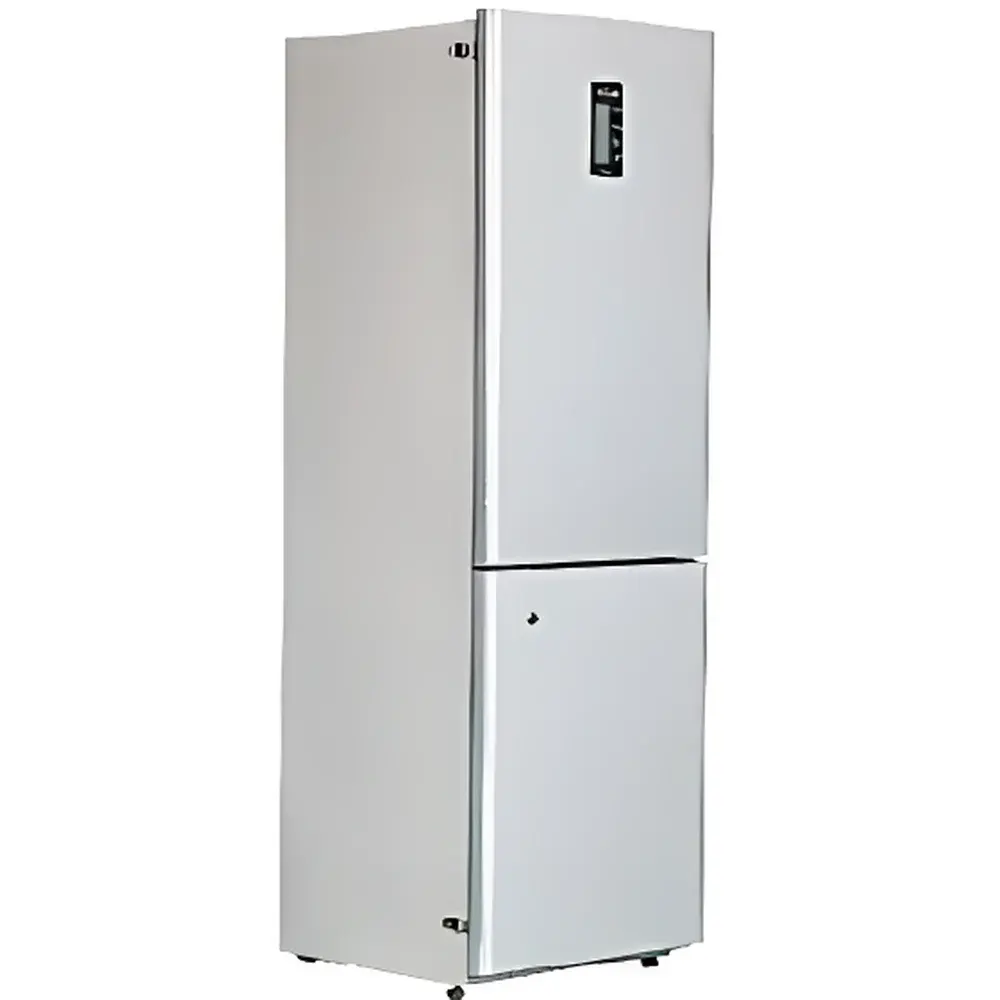
AUCMA YCD-265 Medical Refrigerator-Freezer
| Brand | AUCMA |
|---|---|
| Origin | Shanghai, China |
| Model | YCD-265 |
| Total Capacity | 265 L (160 L Refrigerated Compartment + 105 L Frozen Compartment) |
| Refrigerated Zone Temperature Range | +2 °C to +8 °C |
| Frozen Zone Temperature Range | –15 °C to –26 °C |
| External Dimensions (W×D×H) | 576 × 641 × 1687 mm |
| Internal Dimensions (Refrigerated) | 460 × 480 × 720 mm |
| Internal Dimensions (Frozen) | 405 × 460 × 692 mm |
| Power Supply | 220 V / 50 Hz |
| Rated Power Consumption | 90 W |
| Control System | Microprocessor-based dual-zone digital display |
| Cooling Method | Forced-air (refrigerated compartment), direct-coil (frozen compartment) |
| Refrigerant & Insulation | CFC-free refrigerant (R600a) and cyclopentane-blown polyurethane foam |
| Safety Features | Dual-mode alarm (audible buzzer + visual LED flash), door-open detection, sensor fault alert, high/low temperature deviation alarm, compressor delay protection, voltage fluctuation tolerance (±10 %) |
Overview
The AUCMA YCD-265 Medical Refrigerator-Freezer is a dual-compartment, upright laboratory-grade cold storage unit engineered for reliable, compliant storage of temperature-sensitive biological and pharmaceutical materials. Designed in accordance with ICH guidelines for stability testing and aligned with WHO Good Distribution Practice (GDP) recommendations for vaccine and blood product handling, the YCD-265 maintains two independent, precisely controlled thermal zones: a refrigerated compartment operating at +2 °C to +8 °C and a frozen compartment stabilized between –15 °C and –26 °C. Its forced-air circulation system in the refrigerated section ensures uniform temperature distribution (< ±0.8 °C spatial uniformity per ISO 14644-1 Class 5–compatible validation protocols), while the frozen zone employs optimized evaporator geometry and low-GWP refrigerant (R600a) for rapid pull-down and stable hold performance. The unit meets structural and safety requirements outlined in EN 61000-6-3 (EMC emissions) and EN 61000-6-2 (immunity), and its insulation architecture—using cyclopentane-blown polyurethane—achieves thermal conductivity ≤ 0.022 W/m·K, minimizing energy demand without compromising thermal integrity.
Key Features
- Microprocessor-based dual-zone temperature control with independent digital displays for refrigerated and frozen compartments
- Refrigerated compartment equipped with fan-assisted air circulation for enhanced temperature uniformity and reduced recovery time after door opening
- Dual-mode alarm system: audible buzzer + flashing LED indicator for high/low temperature excursions, sensor failure, and prolonged door-open events
- Compressor protection logic including programmable start-up delay (≥3 minutes) and minimum off-cycle interval (≥5 minutes) to prevent mechanical stress
- Wide-input voltage tolerance (198–242 V AC) ensuring operational continuity under unstable grid conditions common in field-deployed or resource-constrained facilities
- Ergonomic design with tempered double-glazed reflective glass door (anti-condensation coating) for clear sample visibility without thermal load penalty
- Interior configuration: three powder-coated steel wire shelves in refrigerated zone; four transparent ABS polymer drawers in frozen zone—each labeled and stackable for traceable inventory management
Sample Compatibility & Compliance
The YCD-265 supports storage of whole blood units, platelet concentrates (at +22 °C not applicable; this unit is not intended for room-temperature platelet storage), red blood cell suspensions, plasma derivatives, vaccines (including mRNA and viral vector formulations requiring strict +2 °C to +8 °C maintenance), antibiotics, monoclonal antibodies, and diagnostic reagents. It complies with national medical device regulatory frameworks in China (NMPA Class II registration), and its thermal performance aligns with ASTM F2631-22 Annex A for refrigerated medical cabinets. While not certified to UL 4750 or NSF/ANSI 456 (which apply to pharmacy-grade units), its construction, alarm logging capability (via optional external data logger interface), and temperature stability make it suitable for GLP-compliant environments where documented cold chain integrity is required—particularly in public health laboratories, regional CDC branches, hospital blood banks, and clinical trial biorepositories.
Software & Data Management
The YCD-265 operates as a standalone hardware platform with no embedded network connectivity or proprietary software suite. However, its analog alarm outputs (dry-contact relay signals) and RS-232 serial port (optional accessory) enable integration with third-party environmental monitoring systems (EMS) such as SensiLog, TempTale, or Vaisala viewLinc. When interfaced via RS-232, real-time temperature values from both zones—including timestamps and alarm status flags—can be streamed into validated CSV or Modbus RTU formats compatible with 21 CFR Part 11–compliant electronic lab notebooks (ELNs) and LIMS platforms. Users are advised to implement periodic manual calibration verification using NIST-traceable thermistors (e.g., Fluke 1523) at defined locations per IQ/OQ protocols prior to first use and at six-month intervals thereafter.
Applications
- Short-to-medium term storage of whole blood and packed RBCs in hospital transfusion services
- Stabilization of heat-labile vaccines (e.g., MMR, varicella, rotavirus) during distribution and daily clinic use
- Secure holding of clinical trial specimens pending shipment to central labs
- Backup cold storage for biobank accessioning workflows where ultra-low temperature redundancy is not required
- Field-deployable cold chain node in mobile health units or rural health stations lacking dedicated freezer infrastructure
FAQ
Is the YCD-265 certified for FDA 21 CFR Part 11 compliance?
No—the unit itself does not include audit trail, electronic signature, or user access control features required for Part 11 compliance. However, when integrated with a validated EMS platform that provides those functions, the combined system may support Part 11–aligned workflows.
Can the refrigerated compartment be disabled independently?
Yes—the control panel includes a dedicated toggle to deactivate the refrigerated zone while maintaining frozen zone operation, reducing energy consumption during seasonal demand shifts.
What is the recommended validation protocol for installation qualification (IQ)?
IQ should verify physical installation against manufacturer-specified clearances (≥10 cm rear/side ventilation gap), power supply specifications, and ambient operating conditions (10 °C–32 °C, ≤80 % RH non-condensing). Temperature mapping (OQ) requires ≥9 thermocouple probes per zone over 24 h under loaded conditions per ISO 14155:2020 Annex D.
Does the unit support remote monitoring via Ethernet or Wi-Fi?
No native Ethernet or Wi-Fi interface is provided. Remote capability requires external hardware gateways connected via RS-232 or dry-contact alarm outputs.
What is the expected service life under continuous operation?
With routine maintenance (condenser coil cleaning every 3 months, door gasket inspection quarterly), the compressor and control electronics are rated for ≥12 years of 24/7 operation per AUCMA’s internal MTBF modeling and field telemetry data from >5,000 installed units across Chinese provincial health systems.





