
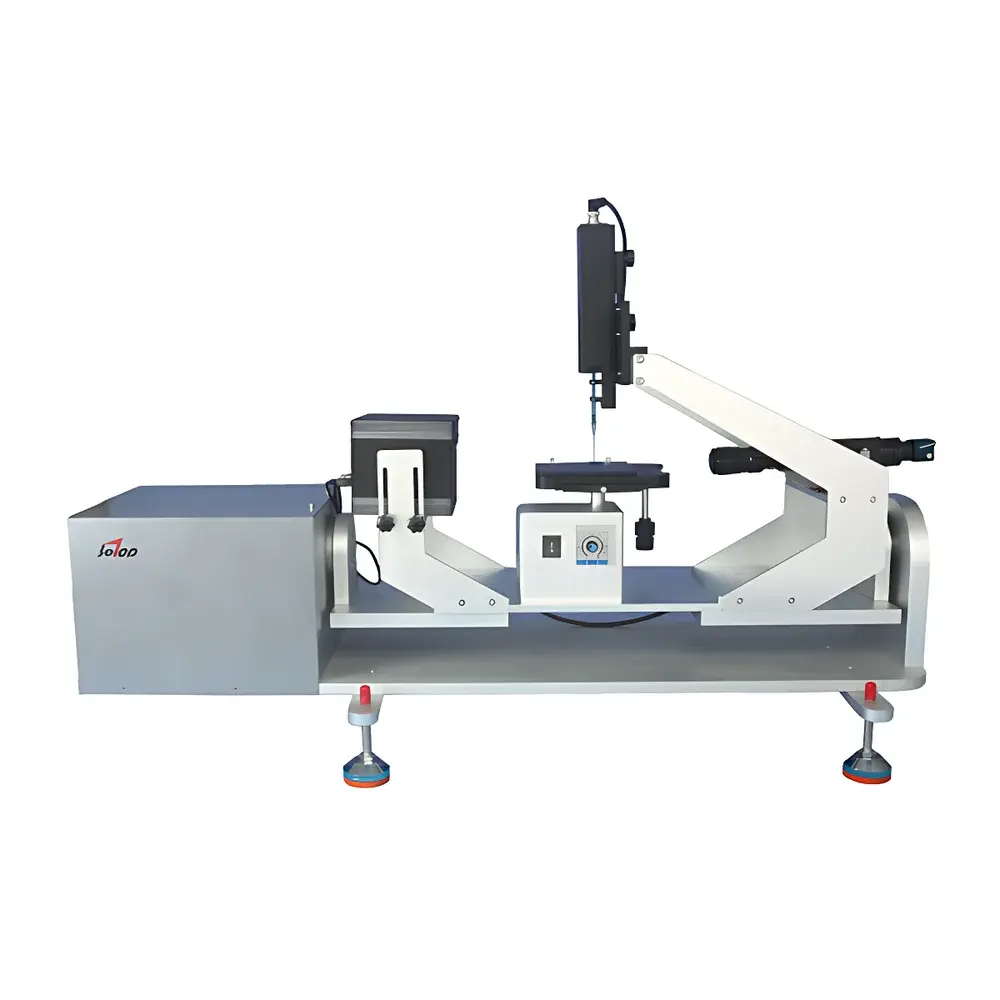
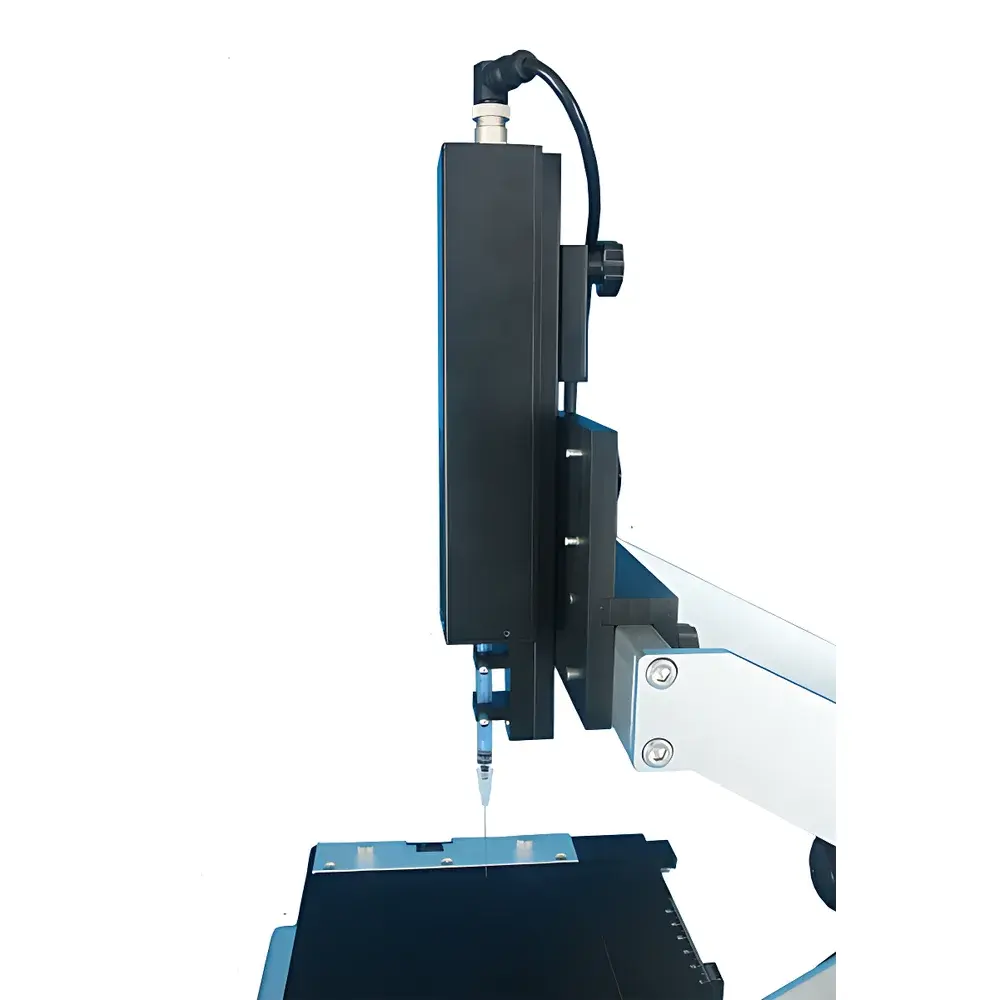
Betop Scientific DSA-X ROLL Automated Whole-Unit Tilting Optical Contact Angle Analyzer
| Brand | Betop Scientific |
|---|---|
| Origin | Guangdong, China |
| Manufacturer Type | OEM Manufacturer |
| Instrument Category | Domestic |
| Model | DSA-X ROLL |
| Instrument Type | Benchtop Video-Based Optical Contact Angle Meter |
| Contact Angle Measurement Range | 0–180° |
| Contact Angle Accuracy | ±0.1° |
| Contact Angle Resolution | ±0.01° |
| Tilt Angle Range | 0–90° |
| Tilt Angle Accuracy | ±0.01° |
| Surface/Interfacial Tension Range | 0–1000 mN/m |
| Surface/Interfacial Tension Accuracy | ±0.01 mN/m |
| Optical Magnification | 0.7×–4.5× (adjustable focus) |
| High-Speed Imaging | 210 fps @ 130 pixel resolution |
| Dispensing Precision | 0.01 µL |
| XYZ Sample Stage Travel | 100 mm × 100 mm × 50 mm (standard) |
| Fixed Stage Size | 100 mm × 100 mm |
| Max. Sample Dimensions | 300 mm × ∞ × 160 mm (W × D × H) |
| Max. Sample Weight Capacity | 5 kg |
| Lighting | LED Cold Light Source |
| Camera | High-Resolution Industrial CMOS Sensor |
| Analysis Methods | Static/Dynamic Contact Angle, Roll-Off Angle, Advancing/Receding Angle, Sessile Drop, Pendant Drop, Tilting Plate Method |
| Surface Energy Models | OWRK, Fowkes, Wu, van Oss-Chaudhury-Good |
| Optional Accessories | Vacuum Sample Holder (for thin films), Motorized Tilt Platform, Top-View Imaging Module (for concave surfaces) |
Overview
The Betop Scientific DSA-X ROLL is an automated whole-unit tilting optical contact angle analyzer engineered for high-precision, reproducible characterization of solid–liquid interfacial behavior under dynamic mechanical perturbation. Unlike conventional static contact angle systems, the DSA-X ROLL integrates synchronized motorized tilt actuation with high-speed video capture and real-time image analysis to quantify advancing, receding, roll-off, and hysteresis angles—critical parameters in evaluating surface heterogeneity, chemical anisotropy, and functional coating performance. Its core measurement principle relies on sessile drop and pendant drop imaging via a calibrated optical train (0.7×–4.5× zoom, adjustable focus), coupled with sub-pixel edge detection algorithms and six standardized fitting models (Circle, Ellipse, Young–Laplace, etc.) to extract contact geometry from high-contrast silhouettes illuminated by uniform LED cold light. The system’s rigid mechanical architecture—featuring high-torque stepper motors, low-backlash linear guides, and vibration-damped optical bench—ensures angular stability better than ±0.01° during tilt sequences up to 90°, enabling reliable quantification of dynamic wetting transitions across industrial and academic research workflows.
Key Features
- Fully automated tilt-and-capture sequence: motor-driven whole-unit inclination (0–90°) synchronized with high-speed image acquisition (up to 210 fps) to capture instantaneous rolling or sliding events.
- Precision microdispensing unit with 0.01 µL resolution and XYZ programmable positioning (100 mm × 100 mm × 50 mm travel range), supporting both top-down and side-view deposition protocols.
- Intelligent baseline auto-recognition and adaptive thresholding algorithms that minimize operator dependency and improve repeatability across diverse substrate morphologies—including rough, porous, or low-contrast surfaces.
- Multi-method surface energy calculation engine compliant with ISO 19403-2/-3 (2017) and ASTM D7490–13: OWRK, Fowkes, Wu harmonic mean, and van Oss–Chaudhury–Good acid–base approaches, with built-in reference liquid database (water, diiodomethane, ethylene glycol, formamide).
- GLP-ready software architecture featuring full audit trail, user access levels, electronic signature support, and 21 CFR Part 11–compatible data integrity controls for regulated QC environments.
- Modular hardware expansion: optional vacuum sample holder for ultra-thin polymer films, motorized dual-axis tilt platform for anisotropic surface mapping, and top-view imaging kit for concave or recessed geometries (e.g., microfluidic channels, etched wafers).
Sample Compatibility & Compliance
The DSA-X ROLL accommodates samples up to 300 mm wide × unlimited depth × 160 mm tall, with a standard 100 mm × 100 mm fixed stage and optional motorized XYZ translation. Its 5 kg load capacity supports rigid substrates (glass, silicon wafers, ceramic tiles, metal foils) as well as flexible materials (PET films, PDMS stamps, nonwovens) when used with vacuum fixation. Surface roughness does not impede measurement validity, provided the local curvature radius exceeds 10 µm—verified per ISO 27448:2009 guidelines for contact angle instrumentation. All optical components meet IEC 61000-4 EMC standards; mechanical design complies with ISO 14971:2019 risk management requirements for laboratory equipment. Calibration traceability is maintained through NIST-traceable goniometric standards and certified reference liquids (e.g., ultrapure water, 99.9% glycerol).
Software & Data Management
The proprietary BetopVision™ v4.2 software provides a unified interface for instrument control, real-time visualization, batch processing, and report generation. Raw image sequences (.tiff/.avi) and metadata (timestamp, tilt angle, dispensing volume, ambient T/RH) are stored in HDF5 format to ensure long-term readability and interoperability with MATLAB, Python (via h5py), and LabVIEW. Data export options include CSV (for statistical analysis), PDF (formatted test reports with embedded images and confidence intervals), and XML (for LIMS integration). Audit logs record every user action—including parameter modification, image reprocessing, and result approval—with immutable timestamps and digital signatures. Software validation documentation (IQ/OQ/PQ protocols) is available upon request for GMP/GLP-compliant deployment.
Applications
- Quality assurance of plasma-, corona-, or flame-treated polymer films—quantifying treatment uniformity via spatially resolved advancing/receding angle maps.
- Development and optimization of hydrophobic/hydrophilic coatings for medical devices, where roll-off angle and contact angle hysteresis directly correlate with biofouling resistance (per ISO 22196).
- Surface cleanliness verification in semiconductor packaging: detecting monolayer-level organic contamination via abnormal surface energy dispersion components.
- R&D of superhydrophobic textiles and self-cleaning façade materials—validating Cassie–Baxter state stability under controlled shear stress.
- Formulation screening of inkjet inks and conformal coatings—correlating dynamic contact angles with jetting reliability and film continuity.
- Regulatory submissions requiring surface energetics data (e.g., FDA 510(k) dossiers for coated implants, EU MDR Annex I essential requirements).
FAQ
What tilt accuracy is achievable during dynamic roll-off measurements?
The DSA-X ROLL achieves ±0.01° angular positioning repeatability over its full 0–90° range, verified using laser interferometry and certified angle blocks traceable to NPL standards.
Can the system measure contact angles on curved or textured surfaces?
Yes—through top-view imaging add-on and multi-angle tilt profiling, enabling robust analysis of cylindrical lenses, fiber bundles, and laser-ablated microstructures per ISO/TS 18443:2016.
Is the software compliant with FDA 21 CFR Part 11 for electronic records?
Yes—audit trail, role-based access control, electronic signatures, and data immutability are fully implemented and documented in the software validation package.
How is surface tension determined without a tensiometer?
Via pendant drop analysis using Young–Laplace curve fitting; accuracy is validated against Du Noüy ring and Wilhelmy plate reference methods per ISO 6295:2022.
What maintenance is required for long-term calibration stability?
Annual optical alignment verification and biannual camera sensor flat-field correction are recommended; no consumables or recalibration fees apply within the 24-month warranty period.



