
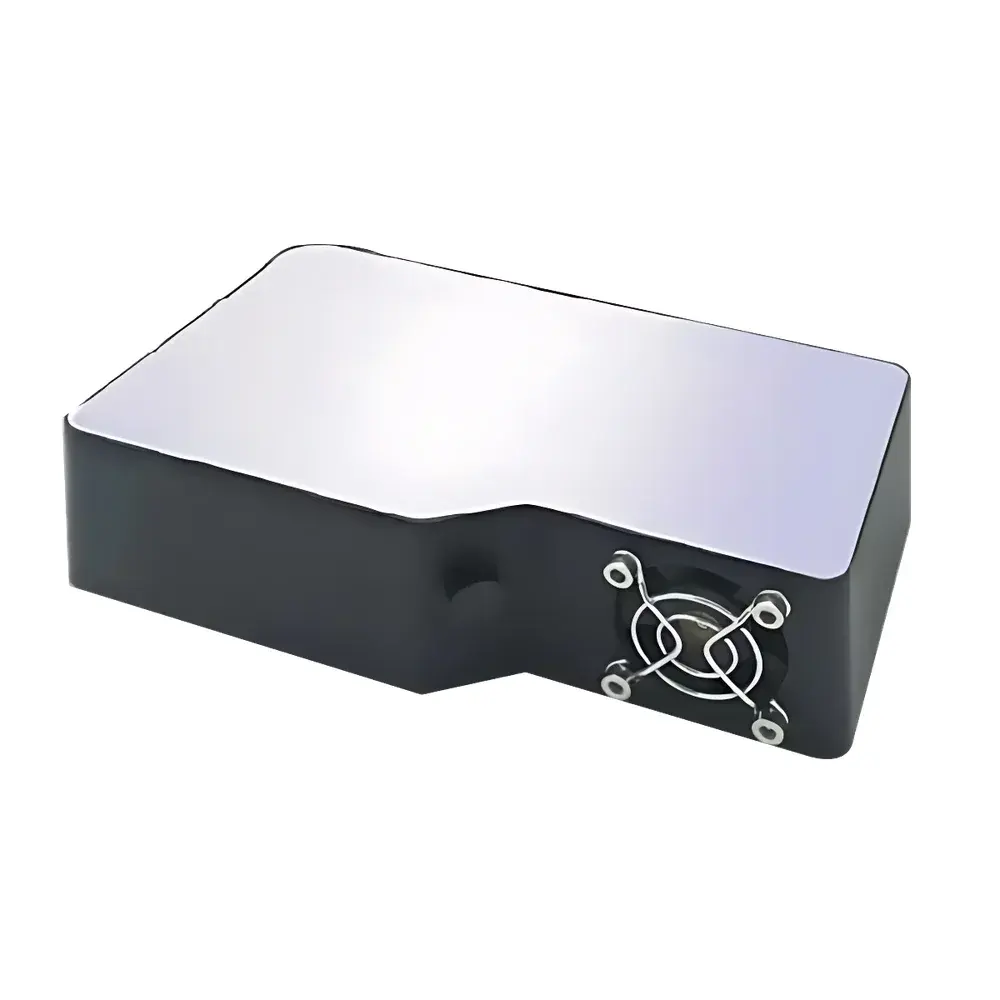
Laman Optics LM70 Fiber Optic Spectrometer
| Brand | Laman Optics |
|---|---|
| Origin | Guangdong, China |
| Model | LM70 |
| Spectral Range | 380–800 nm |
| Detector Type | CCD |
| Optical Resolution (FWHM) | 2 nm @ 50 µm slit width, 4 nm @ 100 µm slit width |
| Sensitivity | 75 photons/count @ 400 nm |
| Signal-to-Noise Ratio | >60 dB |
| Interface | USB 2.0 (bus-powered) |
| Fiber Connector | SMA905 |
| Software Features | Wavelength calibration, irradiance measurement, absorbance, transmittance, time-resolved spectral scanning |
Overview
The Laman Optics LM70 Fiber Optic Spectrometer is a compact, high-performance benchtop spectrometer engineered for precision visible-range spectral analysis. Based on a Czerny-Turner optical architecture with a plane holographic diffraction grating, the LM70 delivers stable dispersion and minimal aberration across its full 380–800 nm spectral window. Its integrated optical design eliminates moving parts and minimizes alignment sensitivity—critical for long-term measurement reproducibility in laboratory, industrial, and field-deployable applications. Unlike modular or OEM-grade units, the LM70 integrates detector control, analog-to-digital conversion, and firmware-level dark current compensation into a single embedded system. It operates exclusively via USB 2.0 bus power, eliminating external power supplies and reducing electromagnetic interference risks commonly associated with auxiliary adapters. The instrument is optimized for use with standard 400 µm or 600 µm core multimode fibers terminated with SMA905 connectors, enabling flexible light coupling from microscopes, integrating spheres, flow cells, or remote probe heads.
Key Features
- Plane holographic grating with fixed focal geometry ensures consistent wavelength accuracy and low stray light (<0.05% at 600 nm)
- High-quantum-efficiency linear CCD array with 2048 pixels and 14-bit digitization provides broad dynamic range and low read noise
- Configurable slit options (50 µm or 100 µm) allow trade-off between resolution and throughput—validated per NIST-traceable line source measurements
- Real-time onboard dark frame subtraction and pixel defect mapping enhance measurement fidelity during extended acquisition sequences
- Firmware-upgradable architecture supports future calibration refinements and protocol extensions without hardware modification
- Robust aluminum alloy housing with thermal mass stabilization minimizes drift during ambient temperature fluctuations (±0.5 nm/°C typical)
Sample Compatibility & Compliance
The LM70 is compatible with standard optical fiber delivery systems, including UV-VIS quartz fibers (200–1100 nm), liquid light guides, and collimated free-space input via optional adapter kits. It supports quantitative measurements traceable to NIST SRM 2031 (mercury-argon emission lines) and meets ISO/IEC 17025 requirements for spectral instrument verification when operated within defined environmental conditions (20–25 °C, <60% RH). While not certified for GMP or FDA 21 CFR Part 11 environments out-of-the-box, its software API enables integration with validated LIMS platforms supporting audit trail logging, user access control, and electronic signature workflows. All optical coatings comply with RoHS Directive 2011/65/EU and REACH Annex XIV restrictions.
Software & Data Management
The included SpectraView Pro software (v3.2+) provides a native Windows interface with support for .csv, .txt, and HDF5 export formats. Core functionalities include polynomial-based wavelength calibration (up to 5th order), radiometric correction using calibrated tungsten-halogen reference sources, kinetic spectral acquisition at up to 100 spectra/sec (buffered mode), and batch processing of time-series datasets. An open DLL-based SDK permits direct integration with LabVIEW, MATLAB, Python (via ctypes), and C# applications. Data files embed EXIF-style metadata—including integration time, gain setting, temperature sensor reading, and calibration timestamp—to support GLP-compliant documentation. Optional add-ons include chemometric preprocessing modules (baseline correction, Savitzky-Golay smoothing, PCA decomposition) licensed per seat.
Applications
The LM70 serves as a foundational tool across multiple technical domains requiring reliable, repeatable visible-spectrum characterization. In agricultural science, it enables rapid pigment profiling (chlorophyll a/b, anthocyanins) in leaf extracts and grain quality screening. In LED manufacturing, it supports binning by dominant wavelength, color rendering index (CRI), and chromaticity coordinate (CIE 1931 xy) calculation. Environmental labs deploy it for water quality monitoring (nitrate/nitrite absorbance at 220/275 nm, corrected for turbidity), while semiconductor process engineers use it for thin-film thickness verification via interference fringe analysis in the 450–750 nm range. Additional validated use cases include gemological identification (absorption band mapping in corundum and beryl), pharmaceutical excipient characterization (UV-Vis dissolution testing), and printed electronics inspection (ink spectral reflectance uniformity).
FAQ
Is the LM70 suitable for quantitative absorbance measurements in compliance with USP <857>?
Yes—when used with matched cuvette holders, NIST-traceable reference standards, and appropriate pathlength correction, the LM70 satisfies instrumental requirements for Class A UV-Vis spectrophotometers per USP <857> guidelines.
Can the resolution be improved beyond 2 nm with custom slits?
No—the 2 nm specification reflects the diffraction-limited performance at 50 µm slit width under optimal signal-to-noise conditions; narrower slits reduce throughput disproportionately and are not supported mechanically or thermally.
Does the device support triggering from external TTL signals?
Yes—pin 1 of the USB connector’s auxiliary header provides hardware trigger input (5 V CMOS compatible) for synchronized acquisition with pump lasers, shutter controllers, or motion stages.
What is the maximum recommended integration time before dark current dominates?
For optimal SNR, integration times above 10 s require active cooling or Peltier stabilization; the standard LM70 is rated for continuous operation up to 5 s without significant thermal drift.
Is spectral calibration data stored onboard or only in software?
A primary 3-point factory calibration (Hg-Ar lines at 435.8, 546.1, and 696.5 nm) is permanently stored in non-volatile memory; user-defined calibrations are saved externally in project files.





