
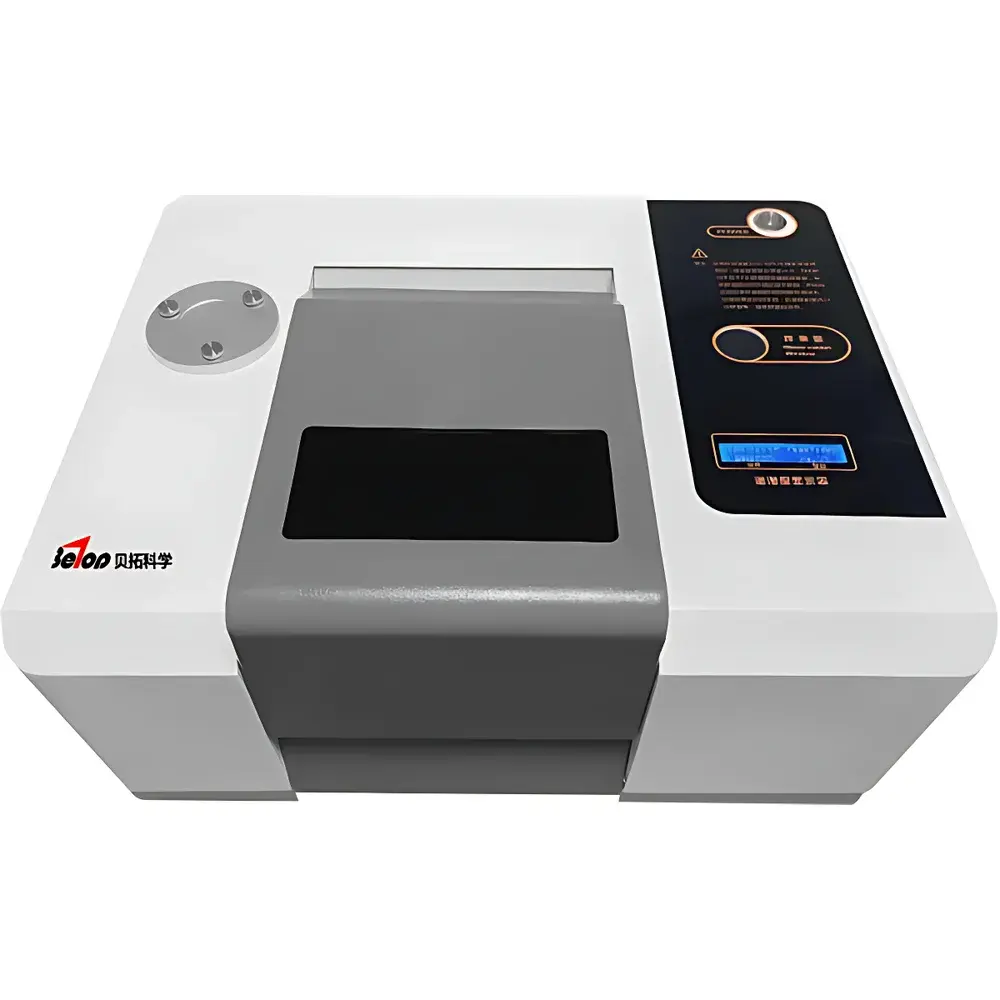

Betop Scientific Tensor Fourier Transform Infrared (FTIR) Spectrometer
| Brand | Betop Scientific |
|---|---|
| Origin | Guangdong, China |
| Manufacturer Type | OEM Manufacturer |
| Instrument Type | Laboratory FTIR Spectrometer |
| Wavenumber Range | 7800–350 cm⁻¹ |
| Resolution | Better than 1.0 cm⁻¹ |
| Signal-to-Noise Ratio | >15,000:1 (4 cm⁻¹, 1 min scan) / Optional >30,000:1 |
| Wavenumber Accuracy | Better than ±0.01 cm⁻¹ |
| Interferometer | DSP-Controlled Electromagnetic Michelson Interferometer |
| Beam Splitter Options | KBr/Ge, ZnSe, CaF₂ |
| Detector | DLATGS with Anti-Humidity Coating |
| Light Source | Long-Life Ceramic IR Source (Imported) |
| Data Interface | USB 2.0 (USB 3.0 Compatible) |
| A/D Conversion | 24-bit, 500 kHz |
Overview
The Betop Scientific Tensor Fourier Transform Infrared (FTIR) Spectrometer is a high-performance, research-grade laboratory instrument engineered for precision molecular identification and quantitative analysis across diverse scientific disciplines. Based on the Michelson interferometer architecture and governed by the principles of Fourier transformation, the Tensor delivers high-fidelity spectral data through rapid, phase-coherent interferogram acquisition and real-time digital signal processing. Its optical design adheres to core metrological requirements defined in ISO 17025-compliant laboratories and supports traceable wavenumber calibration per ASTM E1421 and USP . Designed for routine and advanced applications—from polymer characterization to pharmaceutical raw material verification—the Tensor integrates robust environmental control, thermal stability, and long-term measurement reproducibility essential for GLP and GMP-regulated environments.
Key Features
- DSP-controlled electromagnetic Michelson interferometer with continuous dynamic alignment—eliminates manual adjustment and ensures optimal energy throughput across the full spectral range.
- Imported three-dimensional gold-coated corner-cube retroreflectors: fixed mirror geometry guarantees permanent optical alignment and minimizes path-length drift under thermal or mechanical stress.
- Monolithic SPDT-machined optical mirrors ensure surface accuracy ≤λ/20 and reflectivity >98% across 7800–350 cm⁻¹, enhancing signal fidelity and inter-instrument spectral consistency.
- Hydrophobic anti-corrosion coatings on beam splitters, windows, and detectors significantly reduce KBr degradation from ambient moisture—critical for long-term reliability in non-dry-room labs.
- Modular beam splitter selection (KBr/Ge, ZnSe, CaF₂) enables optimized performance across mid-IR, far-IR, and high-humidity operational conditions.
- SuperTect digital electronics platform: 24-bit, 500 kHz A/D conversion with real-time USB 2.0/3.0 streaming—supports full-spectrum capture at ≥16 scans/sec without data loss or aliasing.
- Push-pull sample compartment door design minimizes atmospheric exchange during measurement, reducing CO₂ and H₂O vapor interference in baseline stability.
- Integrated industrial-grade temperature/humidity sensor with on-screen digital display and programmable humidity alarm—prevents deliquescence of hygroscopic optics and detector elements.
- Hermetically sealed optical cavity (Type I: partial sealing; Type II: full cavity sealing)—extends service intervals and maintains internal dryness without frequent desiccant replacement.
- Reusable 304 stainless steel desiccant cartridge—dryer replacement performed externally, eliminating chamber opening and contamination risk.
- Digital-stabilized 24 W SiC rod source (Type I: imported long-life ceramic source)—provides stable radiant output with <0.1% RMS intensity fluctuation over 10,000+ hours.
- High-stability He–Ne reference laser ensures sub-pixel interferogram sampling accuracy and supports wavenumber calibration traceable to NIST SRM standards.
Sample Compatibility & Compliance
The Tensor accommodates a broad range of sample forms via standardized accessory interfaces—including transmission cells (CaF₂, BaF₂), diamond ATR modules, diffuse reflectance accessories, specular reflection stages, and gas cells with path lengths from 0.1 to 10 m. All accessories conform to ISO 8573-1 purity class 4 for compressed air compatibility and meet mechanical interface specifications per ASTM E131 Annex A1. The system complies with electromagnetic compatibility (EMC) requirements per IEC 61326-1 and safety standards per IEC 61010-1. For regulated environments, software features include full 21 CFR Part 11 compliance support—audit trail logging, electronic signatures, user role-based access control, and immutable raw data storage in native .spa/.srs formats.
Software & Data Management
Operated via Betop’s proprietary TensorControl™ software suite (Windows 7–11 compatible), the platform delivers intuitive workflow navigation without requiring prior FTIR expertise. Core functions include real-time interferogram preview, automated background subtraction, atmospheric compensation (H₂O/CO₂ removal), baseline correction (Rubberband, Concave), peak integration, and second-derivative analysis. The embedded spectral library contains ~1,800 validated reference spectra; optional industry-specific libraries (>220,000 entries) cover pharmacopeial monographs (USP, EP, ChP), polymer databases (ASTM D3900), forensic chemical profiles, food additive standards, and inorganic mineral references. All spectra support JCAMP-DX export and cross-platform import (OMNIC, GRAMS/AI, Bio-Rad Win-IR). Full ELN functionality includes timestamped metadata tagging, customizable report templates (PDF/DOCX), and secure cloud-synced project archiving with SHA-256 checksum validation.
Applications
The Tensor serves as a primary analytical tool in quality control, R&D, and regulatory testing across multiple sectors. In polymer science, it quantifies SBS content in asphalt binders, identifies nylon 6/6,6 blends, and measures carbonyl index for oxidation aging assessment. In pharmaceutical manufacturing, it verifies excipient identity (e.g., lactose polymorphs), detects counterfeit APIs, and confirms packaging film integrity (PET vs. PVC barrier layers). For petrochemical QA, it determines fatty acid methyl ester (FAME) concentration in biodiesel, analyzes structural group composition in mineral oils (ASTM D2425), and detects non-compliant oxygenates in gasoline. Additional validated use cases include textile fiber classification (wool vs. acrylic), carbon/oxygen stoichiometry in silicon wafers (per SEMI F32), and Q-factor evaluation of synthetic quartz crystals used in frequency control devices.
FAQ
What is the maximum achievable resolution on the Tensor FTIR?
The instrument is factory-calibrated to deliver better than 1.0 cm⁻¹ nominal resolution; under optimized conditions (longer scan time, apodization, and narrow-band interferogram windowing), users routinely achieve ≤0.5 cm⁻¹ resolution for high-resolution gas-phase studies.
Does the Tensor support quantitative analysis with certified reference materials?
Yes—its wavenumber accuracy ( 0.9999 over OD 0–3.5) enable quantitative calibration using NIST-traceable standards such as SRM 1921b (polyethylene film) and GBW(E)130181 (polystyrene film).
Can the software perform automated peak matching against custom user-defined libraries?
Absolutely—TensorControl™ allows creation, annotation, and hierarchical organization of private spectral libraries; search algorithms support both correlation coefficient ranking and Euclidean distance scoring with adjustable tolerance thresholds.
Is remote operation and data monitoring supported?
The system supports TCP/IP-based remote control via Ethernet (optional), enabling instrument status monitoring, scheduled acquisitions, and real-time spectral preview from off-site locations—fully compatible with enterprise LIMS integration via HL7 or RESTful API extensions.
What maintenance is required for long-term performance stability?
Annual verification of wavenumber accuracy and photometric linearity is recommended per ISO/IEC 17025; no optical realignment is needed due to the passive interferometer design. Desiccant replacement frequency depends on ambient RH—typically every 6–12 months in controlled lab environments.
Related Products






