
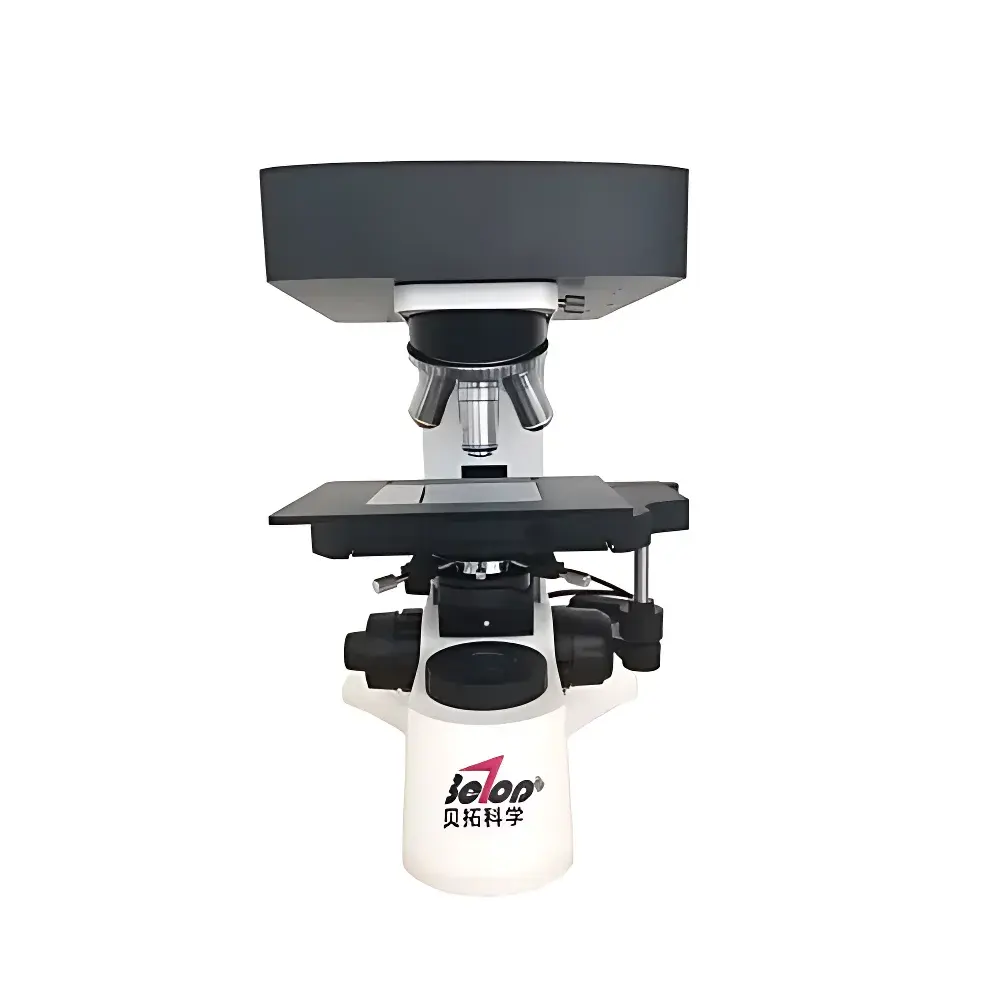
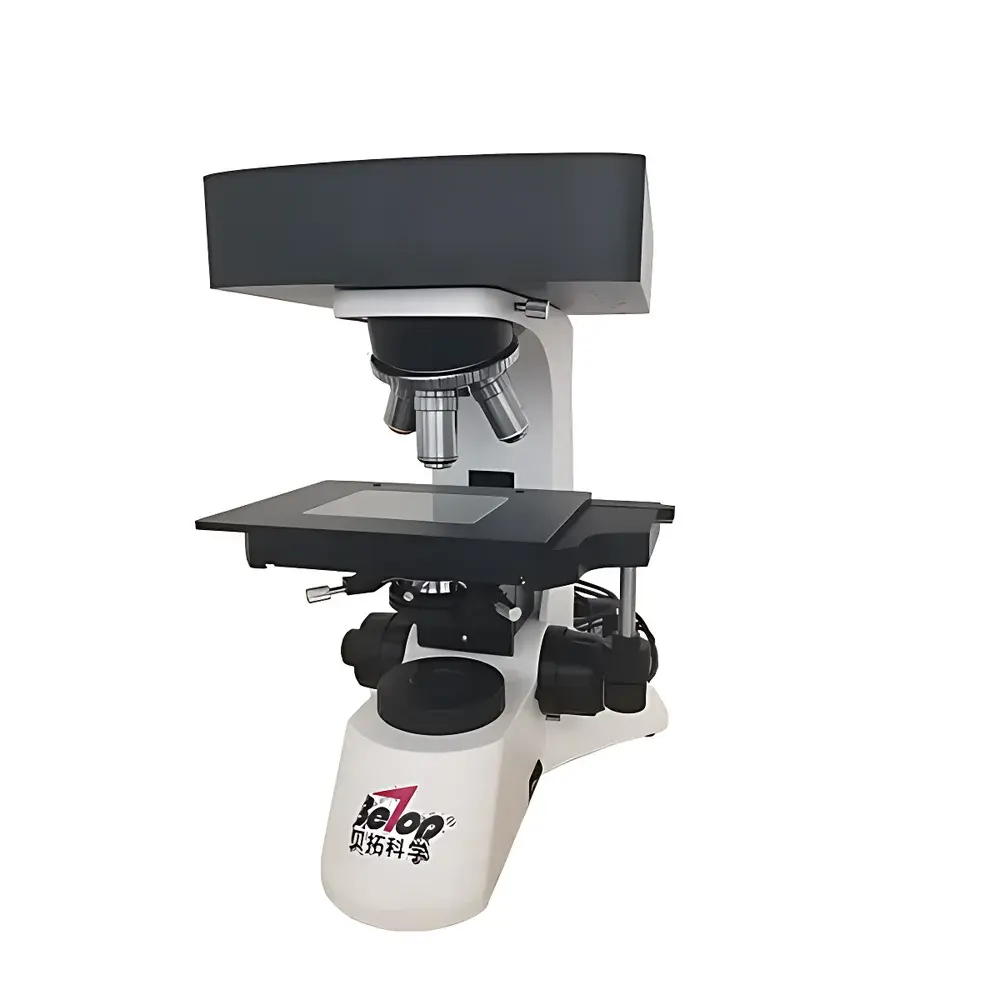
Betop Scientific TeachRam FIB Manual Micro-Raman Spectrometer
| Brand | Betop Scientific |
|---|---|
| Origin | Guangdong, China |
| Manufacturer Type | Direct Manufacturer |
| Product Category | Domestic |
| Model | TeachRam FIB Manual |
| Instrument Type | Confocal Micro-Raman Spectrometer |
| Excitation Wavelength | 785 nm (532 nm optional) |
| Spectral Range | 100–3000 cm⁻¹ |
| Spectral Resolution | 6 cm⁻¹ |
| Spatial Resolution | 50 µm |
| Minimum Wavenumber | 100 cm⁻¹ |
| Spectral Reproducibility | ≤1 cm⁻¹ |
Overview
The Betop Scientific TeachRam FIB Manual Micro-Raman Spectrometer is a compact, integrated confocal Raman system engineered for high-sensitivity vibrational spectroscopic analysis at the microscale. Based on spontaneous Raman scattering induced by monochromatic laser excitation (standard 785 nm, with 532 nm available as an optical module option), the instrument combines an upright research-grade microscope with a high-efficiency free-space optical path and a low-noise miniature spectrometer. Unlike fiber-coupled configurations—where coupling losses degrade signal-to-noise ratio—the TeachRam FIB employs direct spatial coupling between the microscope output and spectrometer entrance slit, preserving photon throughput and enabling reliable detection of weak Raman signals from sub-50 µm features. Its confocal architecture provides axial sectioning capability, enhancing depth selectivity in layered or heterogeneous samples. Designed for laboratory-based qualitative and semi-quantitative molecular identification, the system delivers reproducible wavenumber calibration and stable spectral acquisition under ambient conditions without active thermal stabilization.
Key Features
- Free-Space Optical Architecture: Eliminates fiber coupling losses; maintains >85% optical throughput from sample to detector via optimized collimation and slit coupling.
- Precision Wavenumber Calibration: Supports both single-point and multi-point calibration routines using standard reference materials (e.g., silicon at 520.7 cm⁻¹, cyclohexane, or polystyrene), ensuring long-term spectral accuracy within ±1 cm⁻¹ reproducibility.
- Real-Time Spectral Acquisition: Enables single-shot or time-resolved sequential acquisition modes; compatible with external triggers for synchronized measurements.
- Integrated Spectral Processing Suite: Includes real-time baseline correction (asymmetric least squares), Savitzky-Golay smoothing, Gaussian/Lorentzian peak fitting, intensity normalization, and spectral subtraction—accessible via intuitive GUI controls.
- Microscope-Coupled Imaging: Equipped with 10×, 50×, and 100× objective lenses (optional); supports brightfield and optional darkfield illumination for correlative morphological–spectral analysis.
- Modular Laser Options: Factory-configured 785 nm diode laser (≤50 mW output, TEM₀₀ mode); 532 nm DPSS laser available as a field-upgradeable module for enhanced resonance effects in specific chromophores.
Sample Compatibility & Compliance
The TeachRam FIB accommodates solid, powder, thin-film, and liquid samples mounted on standard glass slides or reflective substrates. Its open-stage design allows manual XYZ positioning with micrometer-adjustable translation (±10 mm range) and coarse focus control. Sample heating stages (up to 200 °C) and environmental cells (N₂ purged or vacuum-compatible) can be integrated externally. The system meets general laboratory safety requirements per IEC 61010-1 for Class 1 laser products when operated with the 785 nm source; optional 532 nm configuration complies with Class 3B requirements and mandates interlocked enclosures per ANSI Z136.1. While not pre-certified for regulated environments, its data integrity framework—including timestamped spectra, user audit logs, and exportable .csv/.spc formats—supports alignment with GLP documentation practices and internal QA/QC workflows.
Software & Data Management
The proprietary RamanView™ software (v3.x, Windows 10/11 compatible) provides full instrument control, spectral acquisition, and post-processing. All spectral metadata—including laser power, integration time, objective magnification, grating selection, and calibration parameters—are embedded in each spectrum file. Raw and processed data are exportable in ASCII (.txt), JCAMP-DX (.spa), or industry-standard .spc format. Software supports batch processing for library matching against built-in reference databases (e.g., RRUFF, ICDD, and custom user libraries). Audit trails record operator ID, acquisition timestamps, and parameter modifications—enabling traceability required for method validation under ISO/IEC 17025 or internal SOPs. No cloud dependency; all processing occurs locally.
Applications
This system serves academic and industrial laboratories requiring accessible, benchtop Raman characterization. Typical use cases include: phase identification in battery electrode materials (e.g., LiCoO₂ vs. LiMn₂O₄); stress/strain mapping in 2D materials (graphene, MoS₂); crystallinity assessment in pharmaceutical polymorphs (e.g., carbamazepine Forms I–III); counterfeit detection in gemstones and historical pigments; and rapid ethanol concentration verification (as demonstrated in 75% v/v aqueous ethanol reference spectra). Its portability and low-power consumption also support field-deployable forensic screening when paired with portable power supplies and ruggedized sample holders.
FAQ
Is the TeachRam FIB compliant with FDA 21 CFR Part 11?
No—RamanView™ does not include electronic signature, role-based access control, or automated audit trail archiving required for Part 11 compliance. It may be used in non-GxP environments or adapted via third-party LIMS integration.
Can I upgrade from 785 nm to 532 nm after purchase?
Yes—the 532 nm laser module is mechanically and optically compatible and can be installed by authorized service personnel with recalibration.
What is the typical measurement time per spectrum?
With 1 s integration time and 10× averaging, acquisition completes in <15 s for most organic samples under 30 mW 785 nm excitation; total cycle time includes stage movement and auto-focus if enabled.
Does the system support polarization-resolved measurements?
Not natively—the standard configuration lacks motorized polarizers or rotatable waveplates. Custom optical add-ons are available upon request.
Is spectral calibration traceable to NIST standards?
Calibration uses certified reference materials traceable to NIST SRM 2241 (silicon) and SRM 2242 (polystyrene); full calibration certificates are provided with each instrument shipment.



