
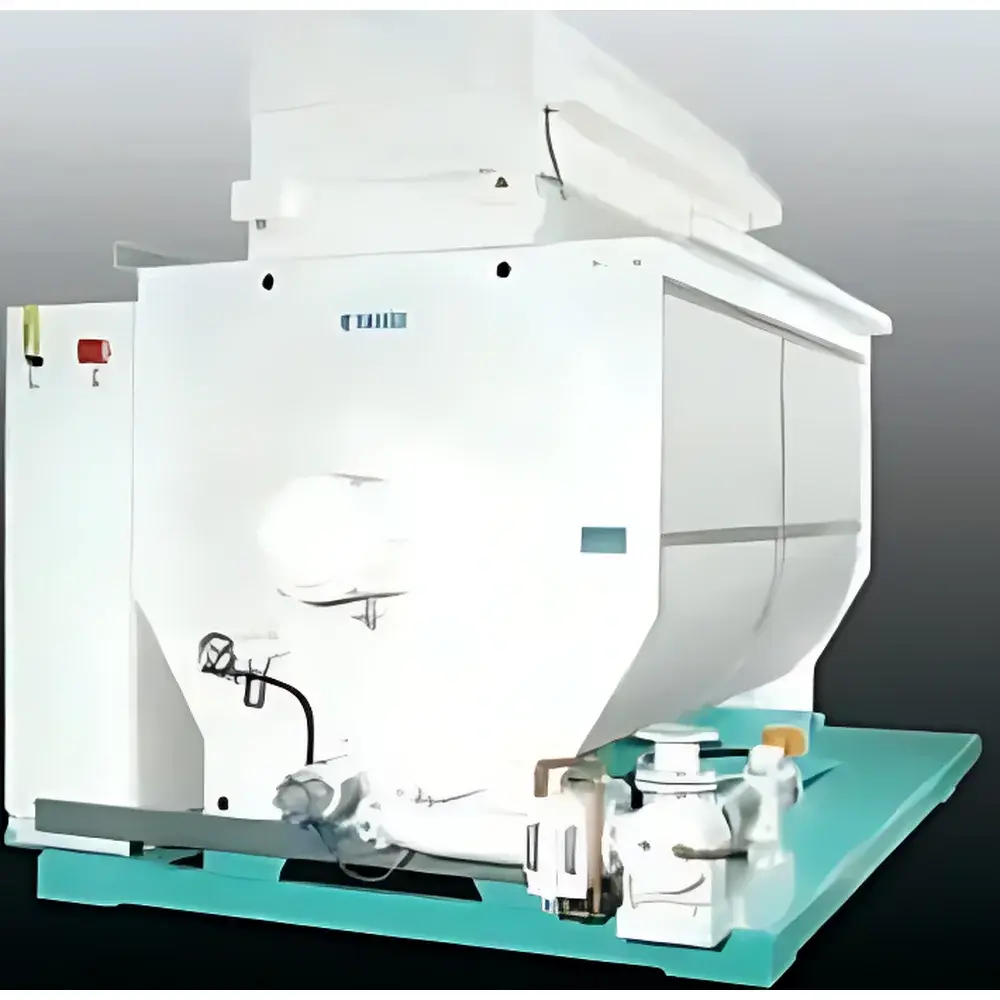
Bühler Frisse-ELK-0005V Single-Shaft Chocolate Conching and Refining Machine
| Brand | Bühler (Switzerland) |
|---|---|
| Origin | Switzerland |
| Model | Frisse-ELK-0005V |
| Configuration | Imported Equipment |
| Supplier Type | Authorized Distributor for China Region |
| Control System Options | Siemens S7 CPU or Allen-Bradley ControlLogix CPU |
| Drive Type | Variable-Frequency Motor (ELK-V) or Bidirectional Fixed-Speed Motor (ELK-P) |
| Discharge Capacity | Up to 20 t/h |
| Temperature Control | PID-regulated closed-loop water circulation with proportional valves and high-surface-area heat exchangers |
| Ventilation | Dual adjustable exhaust hoods (optional), standard louvered outlet with continuous airflow control |
| Compliance | Designed for GMP-compliant chocolate manufacturing environments |
Overview
The Bühler Frisse-ELK-0005V is a precision-engineered single-shaft conching and refining machine purpose-built for the industrial production of premium chocolate and cocoa-based compounds. It operates on a dual-mode mechanical principle—combining controlled axial transport, high-shear wedge-gap shearing, and dynamic thermal management—to simultaneously execute mixing, drying, kneading, flavor development, and final liquefaction within a single enclosed vessel. Unlike conventional roll refiners or multi-stage conches, the ELK-0005V integrates process physics at the tool–vessel interface: its proprietary three-dimensional ELK plough-shaped agitator generates tangential ejection during clockwise rotation (enhancing homogenization and surface renewal), while counterclockwise rotation draws viscous mass into a precisely engineered tapered shear gap between blade tip and stator wall—enabling adaptive shear stress modulation as viscosity evolves across refining stages. This geometry-driven process control ensures reproducible rheological transformation from dry cocoa nibs and sugar crystals through plastic mass to fluid chocolate with optimized particle size distribution (<25 µm median), reduced moisture content (<1.5 wt%), and maximized volatile retention for aromatic complexity.
Key Features
- Modular ELK plough agitator system with wear-resistant alloy construction and field-replaceable shear blades—designed for >10,000 operating hours under continuous duty.
- Bi-directional variable-speed drive (ELK-V variant): 0–60 rpm range with torque monitoring and real-time load feedback; enables precise energy input control per phase (dry conching vs. liquid conching).
- Dual independent ventilation modules (optional): Each equipped with EC centrifugal blowers and electric pre-heaters (±0.5 °C setpoint accuracy), supporting moisture removal, VOC management, and oxidative flavor tailoring per ISO 8587:2020 sensory guidelines.
- Tilted vessel design with pneumatically actuated discharge valve and integrated stainless-steel filtration box—ensures >99.8% residual-free emptying at up to 20 metric tons/hour, minimizing cross-batch contamination.
- Separate temperature control cabinet housing PID controllers, proportional cooling/heating valves, high-efficiency plate heat exchangers (>12 m² effective area), and low-thickness jacket walls (<8 mm) for rapid thermal response (±0.3 °C stability over 4–24 h cycles).
Sample Compatibility & Compliance
The Frisse-ELK-0005V accommodates raw materials including roasted cocoa nibs, granulated sugar, milk powder, lecithin, and vanilla extracts—processing batches from 500 kg to 2,500 kg with consistent microstructural outcomes. Its sealed architecture meets EHEDG Doc. Type A requirements for hygienic equipment design and supports validation protocols aligned with FDA 21 CFR Part 11 (electronic records/signatures), EU Annex 15 (qualification of manufacturing equipment), and ISO 22000:2018 food safety management systems. All wetted surfaces are electropolished AISI 316L stainless steel (Ra ≤ 0.4 µm), and gasket materials comply with USP Class VI biocompatibility standards.
Software & Data Management
The machine integrates either Siemens SIMATIC S7-1500 or Rockwell Automation ControlLogix 5580 PLC platforms, both supporting full audit trail functionality—including timestamped parameter changes, operator logins, alarm history (IEC 61511 compliant), and recipe version control. The HMI features a 15.6″ capacitive touchscreen running TIA Portal or FactoryTalk View SE, delivering intuitive graphical process visualization, drag-and-drop recipe editing, and offline simulation. All recipes store critical parameters: agitation direction/torque profile, ventilation flow rates (m³/h), jacket inlet/outlet temperatures, and real-time moisture trend estimation via embedded thermal mass balance algorithms. Data export conforms to CSV/OPC UA standards for integration into MES (e.g., Siemens Opcenter, Rockwell Plex) and LIMS platforms.
Applications
Primary use cases include dark/milk/white chocolate conching, compound coating formulation, nut paste refinement (hazelnut, almond), and functional cocoa mass stabilization for pharmaceutical excipients. The system supports R&D-scale process transfer via scalable kinetics modeling—enabling correlation between lab-scale (e.g., Bohlin CVO) rheometry data and full-production ELK-0005V torque/time profiles. It is routinely deployed in facilities certified to FSSC 22000, BRCGS Food Issue 9, and IFS Food v7, with documented validation packages available for IQ/OQ/PQ execution.
FAQ
What distinguishes the ELK plough agitator from conventional conche paddles?
Its asymmetrical 3D geometry creates simultaneous axial conveyance and localized high-shear zones—eliminating dead spots and enabling uniform energy dissipation across viscosity gradients.
Can the ELK-0005V operate under nitrogen purge for oxidation-sensitive formulations?
Yes—integrated gas inlet ports and pressure-regulated exhaust dampers support inert atmosphere operation with O₂ monitoring interfaces.
Is remote diagnostics supported?
Standard Ethernet/IP or PROFINET connectivity allows secure remote access via VPN-configured maintenance terminals for firmware updates and fault root-cause analysis.
What validation documentation is supplied?
Factory-issued FAT/SAT reports, material certifications (EN 10204 3.1), electrical safety compliance (CE, UL 61800-5-1), and optional GMP-compliant IQ/OQ protocol templates.
How is cleaning-in-place (CIP) performed?
The unit supports automated CIP cycles using programmable spray ball sequences, conductivity-based rinse endpoint detection, and thermal verification at 85 °C for ≥30 minutes per ASME BPE-2022 Section 6.





