
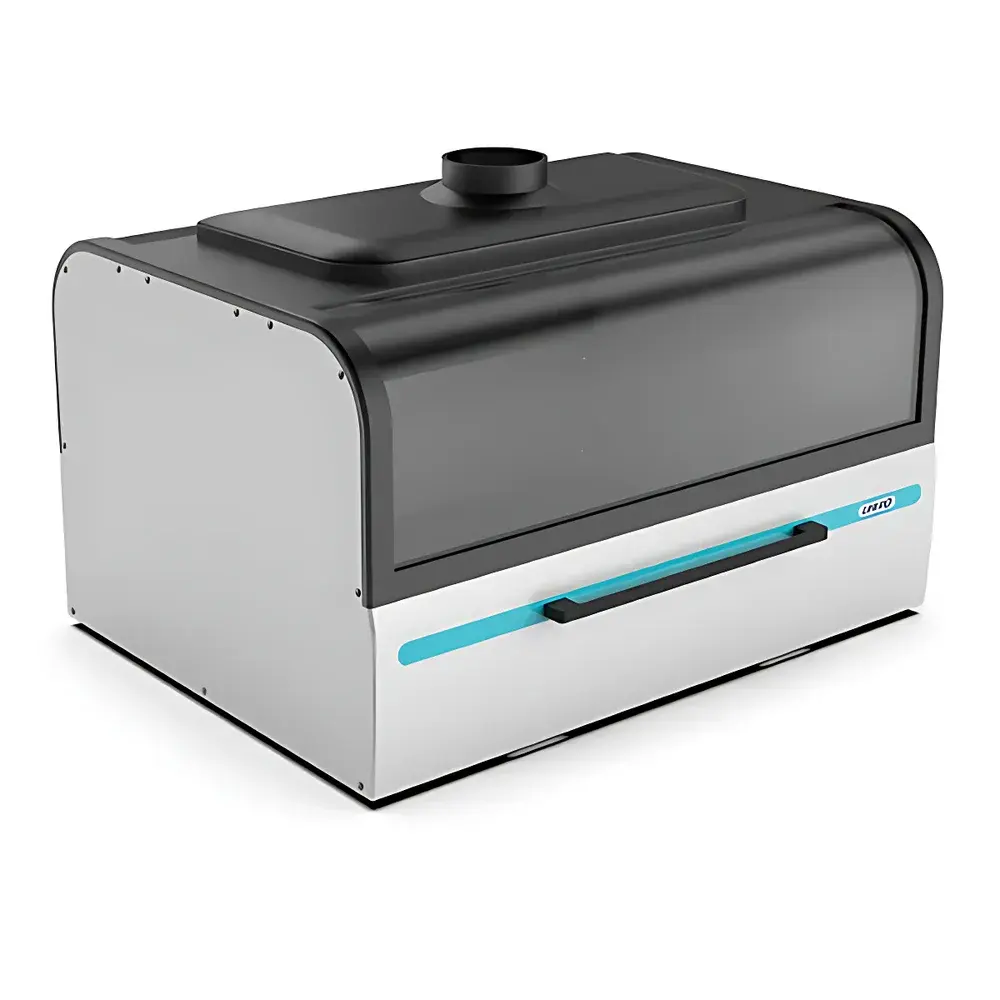
Lihero LFMC-2014 Multi-Channel Automated Water Quality Monitoring System
| Brand | Lihero |
|---|---|
| Origin | Hunan, China |
| Model | LFMC-2014 |
| Detection Modules | UV-Vis Spectrophotometry (Continuous Spectrum), Electrochemical Sensors, Gas-Phase Colorimetry (Purge-and-Colorimetric), Ion-Selective Electrodes (ISE) |
| Measurement Modes | Simultaneous, Sequential, and Continuous Monitoring |
| Parameter Coverage | ≥32 Parameters per EPA 1600/ISO 5667 & China’s Surface Water Environmental Quality Standard (GB 3838–2002) |
| Sample Introduction | Dual-Path Auto-Sampling with Standard Reference Verification |
| Automation Level | Fully Automated via Robotic Reagent Handler |
| Compliance Support | GLP/GMP-aligned Audit Trail, ISO/IEC 17025 Traceability Framework, USP <621> Chromatographic System Suitability Principles (adapted for wet chemistry platforms) |
Overview
The Lihero LFMC-2014 Multi-Channel Automated Water Quality Monitoring System is an integrated, laboratory-grade in-situ and fixed-station analytical platform engineered for continuous, unattended quantification of physicochemical and ionic water quality parameters. It operates on a modular multi-detection architecture—combining UV-Vis spectrophotometry with continuous spectral acquisition (190–1100 nm), potentiometric ion-selective electrode arrays, amperometric/voltammetric electrochemical transducers, and purge-and-colorimetric gas-phase detection for volatile analytes such as ammonia, cyanide, and phenol. Unlike single-method analyzers, the LFMC-2014 implements synchronized fluidic routing and time-resolved module activation under centralized PLC and embedded Linux control, enabling concurrent analysis across independent measurement channels without cross-contamination or temporal aliasing. Designed to meet long-term operational requirements of national surface water monitoring networks, it supports full compliance with GB 3838–2002 (China), ISO 5667 series (Water Quality Sampling), and ASTM D3370 (Standard Practices for Sampling Water). Its mechanical architecture integrates all core modules—including peristaltic pumping manifolds, precision syringe dosing units, temperature-controlled reaction cuvettes, and dual-path sample introduction—within a compact 600 × 500 × 1200 mm footprint, minimizing infrastructure dependency.
Key Features
- Modular multi-detection architecture supporting simultaneous deployment of UV-Vis spectrophotometry, electrochemical sensing, gas-phase colorimetry, and ISE-based ion quantification
- Robotic reagent handling system with programmable XYZ-axis mechanical arm for precise, low-dead-volume switching among >12 reagent reservoirs
- Dual independent sample intake paths with automatic standard verification cycles at user-defined intervals (e.g., every 6 or 12 hours)
- Embedded process logging subsystem recording instrument status, valve actuation sequences, sensor calibration events, reagent consumption, and thermal stability metrics
- Real-time fault diagnostics including reagent depletion alerts, flow path occlusion detection, electrode drift compensation flags, and photometric baseline deviation thresholds
- Self-contained environmental control: Peltier-cooled optical bench (±0.1°C stability), humidity-regulated electronics enclosure, and vibration-damped mounting interface
Sample Compatibility & Compliance
The LFMC-2014 accepts raw, filtered (≤5 µm), or centrifuged surface water, groundwater, and treated effluent samples without pretreatment for most target analytes. It accommodates matrix variations through adaptive blank subtraction, multi-point calibration curve fitting (linear, quadratic, or log-log), and built-in interference correction algorithms—for example, turbidity compensation in colorimetric ammonia assays and ionic strength normalization in fluoride ISE measurements. All measurement protocols are structured to align with ISO/IEC 17025:2017 requirements for method validation, including documented linearity ranges, limit of detection (LOD) estimation per IUPAC recommendations, repeatability (n=6, RSD ≤3.5%), and intermediate precision assessment. Data integrity conforms to principles outlined in FDA 21 CFR Part 11 for electronic records—enabling audit-trail-enabled user authentication, immutable timestamped event logs, and role-based access control for configuration changes.
Software & Data Management
The system runs Lihero AquaControl v4.2 firmware—a deterministic real-time OS with dual-mode operation: local touchscreen HMI (7″ capacitive display) and remote supervisory control via encrypted HTTPS REST API. Raw spectral data (ASCII-exportable .csv), electrode potential time-series (.tdms), and colorimetric kinetic curves are stored locally on industrial-grade SSD with RAID-1 redundancy and synchronized hourly to secure cloud repositories using TLS 1.3. The software suite includes automated QC flagging (e.g., out-of-control Westgard rules applied to daily standard checks), customizable reporting templates compliant with China’s Ministry of Ecology and Environment (MEE) Format No. 12, and export-ready CSV/Excel outputs mapped to ISO 13843 metadata standards. All calibration histories, maintenance logs, and version-controlled method files are retained for ≥36 months to satisfy GLP archival mandates.
Applications
- Fixed-site monitoring of rivers, lakes, reservoirs, and drinking water intakes per China’s National Surface Water Quality Automatic Monitoring Network Technical Specifications (HJ 915–2017)
- Regulatory compliance reporting for municipal wastewater discharge (GB 18918–2002) and industrial effluent (GB 8978–1996)
- Early-warning detection of accidental contamination events via real-time multivariate anomaly scoring across correlated parameter sets (e.g., NO₃⁻ + Cl⁻ + conductivity)
- Long-term trend analysis of eutrophication indicators (TP, TN, NH₄⁺, PO₄³⁻, Chl-a surrogate via absorbance ratios) with seasonal baseline modeling
- Method development and validation support for regional environmental labs seeking CNAS accreditation under ISO/IEC 17025
FAQ
What water quality parameters does the LFMC-2014 measure by default?
It measures up to 32 parameters including pH, conductivity, dissolved oxygen, turbidity, CODMn, NH₃-N, NO₂⁻-N, NO₃⁻-N, TP, TN, SiO₂, F⁻, Cl⁻, SO₄²⁻, Fe²⁺/Fe³⁺, Mn²⁺, Cr⁶⁺, As³⁺, Cd²⁺, Pb²⁺, Cu²⁺, Zn²⁺, Ni²⁺, Cr³⁺, Hg²⁺, phenol, cyanide, ammonia (gas-phase), total phosphorus (acid hydrolysis), chloride (potentiometric), sulfate (turbidimetric), fluoride (ISE), and chromaticity (APHA units).
Is remote firmware update supported?
Yes—via authenticated OTA (Over-the-Air) updates using signed firmware packages verified through ECDSA-256 digital signatures; rollback capability ensures system recoverability.
How often must the robotic arm be serviced?
The stepper-motor-driven arm requires no scheduled lubrication; preventive maintenance is limited to biannual visual inspection and end-effector wear verification—average mean time between failures exceeds 15,000 operational hours.
Can the system interface with SCADA or third-party LIMS?
Yes—through Modbus TCP (function codes 03/04/16), OPC UA (compliant with IEC 62541), and HTTP POST/JSON webhooks configured for HL7 or ASTM E1384 message schemas.
What is the minimum sample volume required per analysis cycle?
Per channel: 1.2–3.5 mL depending on assay protocol; total system consumption averages 28 mL per full 32-parameter sequence, including rinsing and blanking steps.
Related Products







