
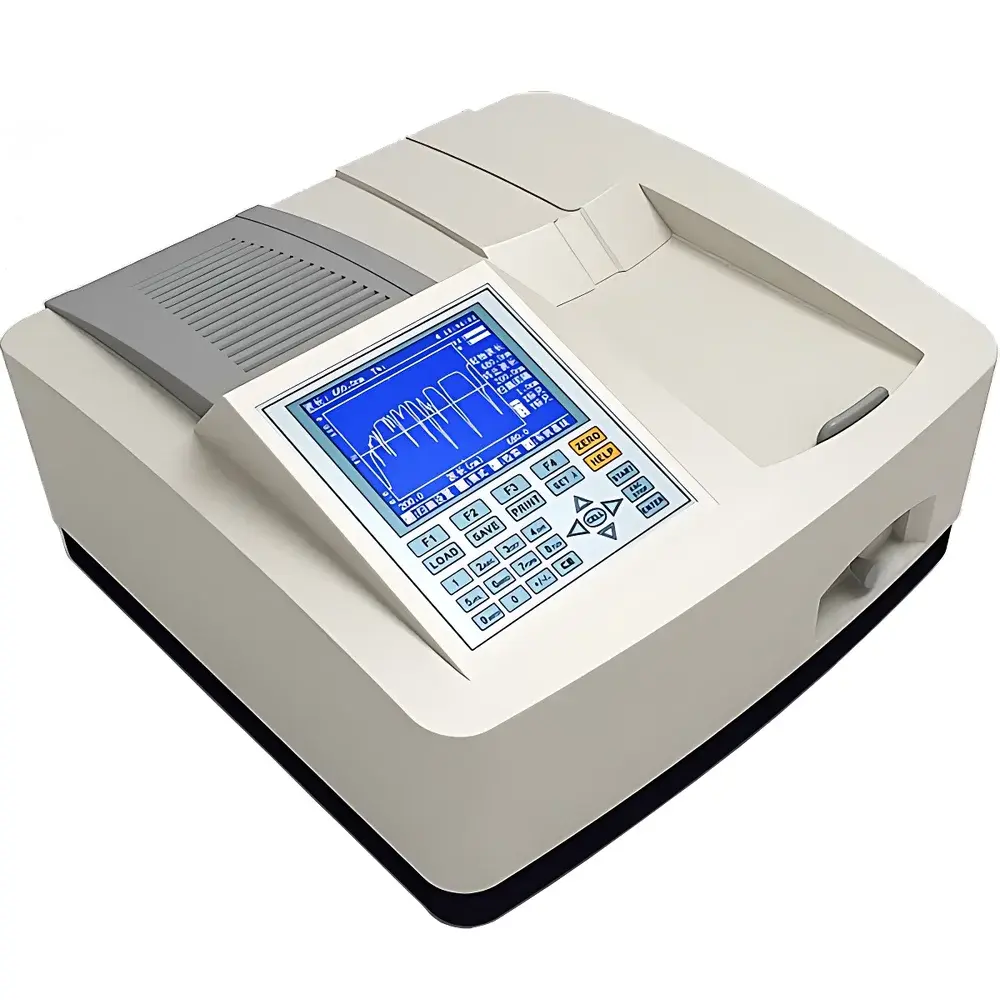
Betop Scientific Lamda-260RN and Lamda-260DN UV-Vis Spectrophotometers
| Brand | Betop Scientific |
|---|---|
| Origin | Guangdong, China |
| Manufacturer Type | Direct Manufacturer |
| Model | Lamda-260RN / Lamda-260DN |
| Detector Type | Photodiode Array (PDA) |
| Wavelength Range | 190–1100 nm |
| Automation Level | Automatic Wavelength Scanning |
| Spectral Bandwidth | 1.8 nm (Lamda-260RN), 2.0 nm (Lamda-260DN) |
| Wavelength Accuracy | ±0.5 nm |
| Wavelength Repeatability | ≤0.2 nm |
| Stray Light | ≤0.05% T at 220 nm and 360 nm |
Overview
The Betop Scientific Lamda-260RN and Lamda-260DN are precision-engineered UV-Vis spectrophotometers designed for routine quality control, academic research, and method development in regulated and non-regulated laboratory environments. Both models operate on fundamental photometric principles—measuring absorbance (A), transmittance (%T), and radiant energy (E) based on the Beer–Lambert law—but differ critically in optical architecture to address distinct operational requirements. The Lamda-260DN employs a true double-beam configuration, splitting the incident light into sample and reference paths via a rotating mirror or beam splitter, enabling real-time compensation for source drift, detector instability, and solvent baseline fluctuations. In contrast, the Lamda-260RN implements a pseudo-double-beam (or ratio-monitoring) design: a single-beam optical train with rapid alternating measurement of sample and reference signals using time-shared detection—offering enhanced stability over conventional single-beam systems while minimizing mechanical complexity and cost. This architectural distinction makes the Lamda-260DN particularly suitable for extended kinetic assays, high-precision quantitative work, and applications requiring strict baseline fidelity, whereas the Lamda-260RN delivers robust performance for general-purpose analysis where cost-efficiency and ease of maintenance are prioritized.
Key Features
- Photodiode array (PDA) detection enables full-spectrum acquisition without moving parts, ensuring high-speed scanning (up to 3,000 nm/min) and excellent signal-to-noise ratio across the 190–1100 nm range
- Wavelength accuracy of ±0.5 nm and repeatability better than 0.2 nm support compliance with ASTM E275, ISO 6425, and pharmacopeial methods (e.g., USP )
- Stray light ≤0.05% T at 220 nm and 360 nm meets ICH Q2(R2) sensitivity thresholds for low-absorbance measurements in impurity profiling and dissolution testing
- Large-capacity sample compartment accommodates cuvettes from 5 mm to 100 mm pathlength, plus optional accessories including temperature-controlled holders, fiber-optic probes, and solid-sample reflectance stages
- Integrated 7-inch TFT LCD with graphical interface and tactile membrane keypad ensures intuitive navigation without external computing hardware
- Long-life deuterium lamp with flange-mount design allows field replacement without optical realignment—reducing downtime and service dependency
- Non-volatile memory retains spectral data, calibration files, and user methods even after power loss; supports direct thermal printing and USB export to PC
Sample Compatibility & Compliance
The Lamda-260 series is validated for use with standard quartz, fused silica, and high-quality optical glass cuvettes. It supports liquid-phase quantification of organic compounds, nucleic acids (DNA/RNA), proteins (via Bradford, Lowry, or A280/A260 ratios), pharmaceutical actives, food colorants, and environmental analytes (e.g., nitrate, phosphate). Instrument design adheres to IEC 61010-1 safety standards for laboratory electrical equipment. Data integrity features—including audit-trail-enabled method storage, timestamped result logging, and user-access levels—facilitate alignment with GLP and GMP documentation practices. While not pre-certified for 21 CFR Part 11, the system architecture permits integration with compliant LIMS or third-party electronic lab notebook (ELN) platforms when deployed with appropriate procedural controls.
Software & Data Management
Optional PC-based scanning software provides expanded functionality: multi-curve overlay, derivative spectroscopy, peak identification, baseline correction algorithms (e.g., polynomial and rubber-band), and customizable report generation compliant with ISO/IEC 17025 reporting requirements. Raw absorbance data is exported in CSV and JCAMP-DX formats for interoperability with chemometrics tools (e.g., MATLAB, Unscrambler) and statistical process control (SPC) systems. All instrument firmware supports firmware update via USB, with version history and checksum verification to ensure traceable configuration management.
Applications
- Quantitative analysis of active pharmaceutical ingredients (APIs) per USP monographs
- Kinetic monitoring of enzyme-catalyzed reactions and polymerization processes
- Quality assurance of raw materials in food and beverage production (e.g., caffeine, anthocyanins, preservatives)
- Environmental water testing for heavy metals (via complexometric derivatization) and nutrient load assessment
- Academic teaching labs for fundamental spectroscopy experiments and method validation exercises
- Biotechnology workflows including oligonucleotide purity assessment and protein concentration normalization prior to SDS-PAGE or HPLC
FAQ
What is the difference between the Lamda-260RN and Lamda-260DN optical designs?
The Lamda-260DN uses a true double-beam optical path with simultaneous sample/reference measurement, while the Lamda-260RN employs a time-shared single-beam design with rapid reference/signal alternation—offering improved stability over basic single-beam instruments at lower mechanical complexity.
Does the instrument support compliance with pharmacopeial standards?
Yes—the wavelength accuracy, stray light performance, and photometric linearity meet minimum requirements specified in USP , EP 2.2.25, and JP 2.03 for UV-Vis method execution.
Can the PDA detector be used for kinetic studies?
Yes—full spectral acquisition rates up to 3,000 nm/min enable time-resolved spectral mapping, supporting reaction progress analysis and rate constant derivation when combined with the built-in time-scan mode.
Is the software compatible with Windows 11 and macOS?
The official Betop PC software is validated for Windows 10 and 11 (64-bit); macOS compatibility requires virtualization or cross-platform data exchange via CSV/JCAMP-DX.
What maintenance is required to sustain wavelength accuracy?
Annual verification using NIST-traceable holmium oxide and didymium filters is recommended; no user-adjustable wavelength calibration is provided—factory calibration remains stable under normal operating conditions for ≥12 months.





