
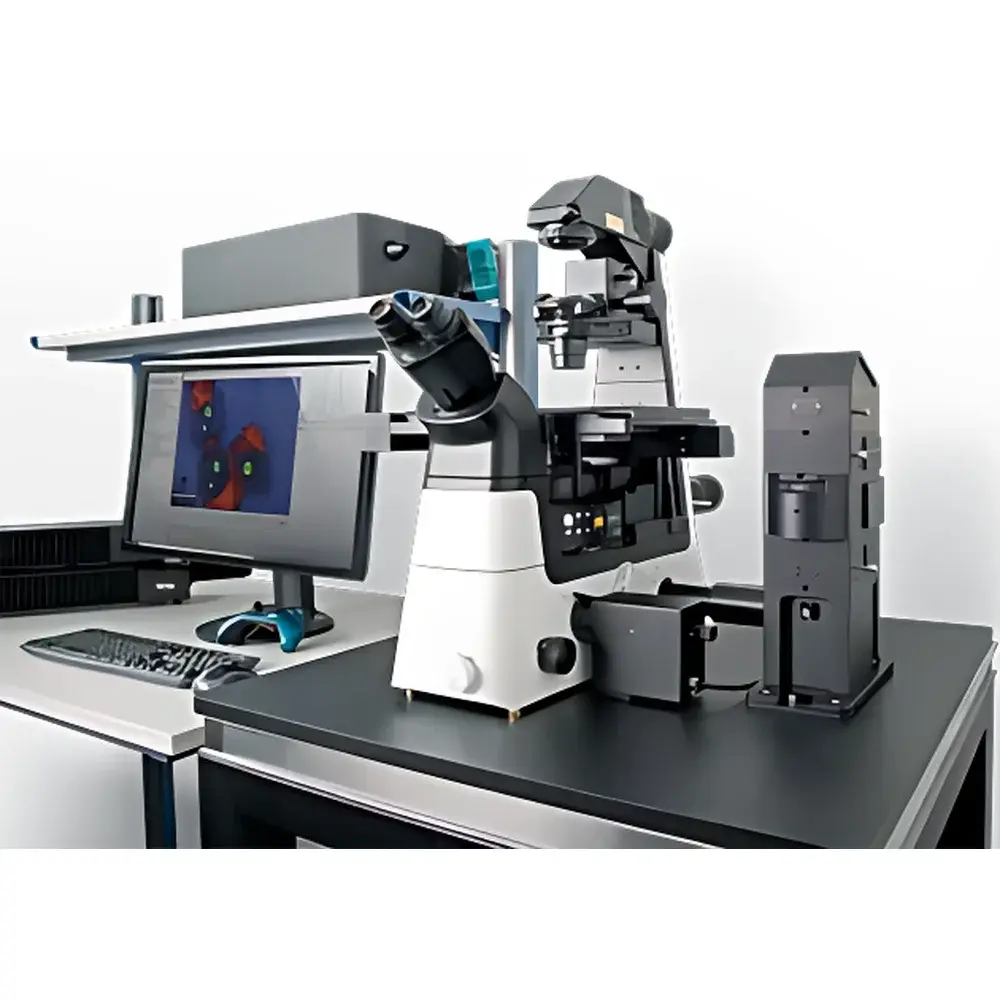
WITec Alpha300 RI Inverted Confocal Raman Imaging Spectrometer
| Brand | WITec |
|---|---|
| Origin | Germany |
| Model | Alpha300 RI |
| Instrument Type | Confocal Raman Microscope |
| Spectral Range | 90–9000 cm⁻¹ |
| Spectral Resolution | ≤0.2 cm⁻¹ |
| Spatial Resolution | Lateral 350 nm, Axial 800 nm |
| Minimum Wavenumber | 10 cm⁻¹ |
| Spectral Reproducibility | ≤±0.02 cm⁻¹ |
Overview
The WITec Alpha300 RI is an inverted confocal Raman imaging spectrometer engineered for high-fidelity, label-free chemical mapping of complex and delicate samples in life sciences, materials research, and geoscience applications. Unlike conventional upright Raman microscopes, the Alpha300 RI employs an inverted optical architecture—where excitation and collection pathways are reversed—enabling bottom-side illumination and detection through transparent substrates such as glass-bottom Petri dishes, microfluidic chambers, or thick tissue sections. This design preserves the full functionality of WITec’s proven Alpha300 R platform while introducing critical advantages for aqueous, hydrated, or oversized specimens that cannot be accommodated in standard upright configurations. The system operates on the principle of confocal Raman scattering: a monochromatic laser is focused into the sample; inelastically scattered photons (Raman shifts) are collected via the same objective, spectrally dispersed by a fiber-coupled Ultra-High-Throughput Spectrometer (UHTS), and detected with a back-illuminated CCD. The resulting hyperspectral data cubes (x, y, z, λ) support quantitative 3D chemical imaging with sub-diffraction spatial resolution and exceptional wavenumber stability.
Key Features
- Inverted beam path optimized for immersion-based and liquid-phase measurements—ideal for live-cell studies, microfluidics, and thick biological tissues.
- Motorized XYZ stage with 110 mm × 70 mm travel range and sub-micron repeatability, supporting large-area mapping and multi-position experiments.
- Research-grade inverted microscope base with 6-position objective turret, Köhler illumination, and modular contrast methods including brightfield, DIC, phase contrast, and Nomarski.
- Fiber-coupled UHTS spectrometer delivering up to 70% optical throughput across UV–Vis–NIR spectral bands, enabling high-sensitivity acquisition even at low laser powers.
- Full compatibility with fluorescence microscopy: integrated DAPI/Hoechst filter sets, motorized filter wheels, and optional time-resolved FLIM upgrade paths.
- Automated focus stabilization and real-time drift correction ensure long-duration acquisitions remain spatially registered across spectral stacks.
- No sample fixation, sectioning, or staining required—preserving native biochemical integrity and enabling longitudinal monitoring of dynamic processes.
Sample Compatibility & Compliance
The Alpha300 RI accommodates diverse sample formats—including standard microscope slides, Terasaki plates, 35/65 mm culture dishes, hemocytometers, and custom flow cells—without mechanical reconfiguration. Its inverted geometry eliminates the need for coverslip inversion or water-dipping objectives, reducing optical aberrations and improving signal-to-noise in aqueous environments. The system complies with ISO/IEC 17025 requirements for analytical instrument validation and supports GLP/GMP workflows through audit-trail-enabled software logging (WITec Project Suite v5+). All spectral calibrations are traceable to NIST-certified standards, and wavenumber reproducibility (≤±0.02 cm⁻¹) meets ASTM E1840 specifications for Raman instrument performance verification.
Software & Data Management
Control, acquisition, and analysis are unified within WITec’s Project Suite—a modular, scriptable platform compliant with FDA 21 CFR Part 11 for electronic records and signatures. The software enables real-time spectral stitching, multivariate curve resolution (MCR), PCA clustering, false-color chemical mapping, and depth-profiling visualization. Hyperspectral datasets are stored in open-format HDF5 containers with embedded metadata (laser power, integration time, objective NA, grating configuration), ensuring FAIR (Findable, Accessible, Interoperable, Reusable) data principles. Batch processing pipelines support automated quality control checks, peak fitting (Lorentzian/Gaussian deconvolution), and export to third-party tools (MATLAB, Python via h5py, OriginLab).
Applications
- Live-cell biochemistry: Simultaneous Raman–fluorescence correlative imaging of DAPI-stained nuclei and unstained cytoplasmic components (e.g., lipid droplets, protein aggregates) in adherent cultures.
- Plant cell wall analysis: 3D chemical tomography of banana pulp revealing starch granule distribution (C–O–C stretch at ~1150 cm⁻¹, green) versus cellulose/hemicellulose matrix (C–O–H bend at ~1370 cm⁻¹, red).
- Geochemical mineral identification: In situ mapping of polymorphic phases (e.g., quartz vs. cristobalite) in thin sections without vacuum or conductive coating.
- Pharmaceutical solid-state characterization: Polymorph distribution and crystallinity gradients in tablet cross-sections using 10 cm⁻¹ low-wavenumber capability.
- Microplastics identification: Automated spectral library matching of PE, PP, PET, and PS particles directly in environmental water filters.
FAQ
Can the Alpha300 RI perform true confocal Raman imaging with optical sectioning?
Yes—the system uses a pinhole-aligned confocal detection scheme with adjustable aperture size, enabling axial rejection of out-of-focus light and generation of optically sectioned 3D datasets with verified 800 nm axial resolution.
Is the UHTS spectrometer upgradeable to different spectral ranges?
Yes—UHTS modules are available for UV (200–400 nm), visible (400–700 nm), and NIR (700–1000 nm) excitation, each with optimized gratings and detector coatings to maximize throughput and stray-light suppression.
Does the system support time-resolved measurements?
The Alpha300 RI platform is compatible with single-photon counting modules and TCSPC electronics for fluorescence lifetime imaging (FLIM) and time-gated Raman, subject to optional hardware integration.
What laser wavelengths are supported natively?
Standard configurations include 488 nm, 532 nm, and 633 nm lasers; UV (355 nm) and NIR (785 nm, 1064 nm) options are available with appropriate UHTS and filter upgrades.
How is spectral calibration maintained during extended acquisitions?
Real-time internal reference tracking (using neon or argon emission lines) compensates for thermal drift and mechanical relaxation, ensuring ≤±0.02 cm⁻¹ reproducibility over multi-hour sessions.






