
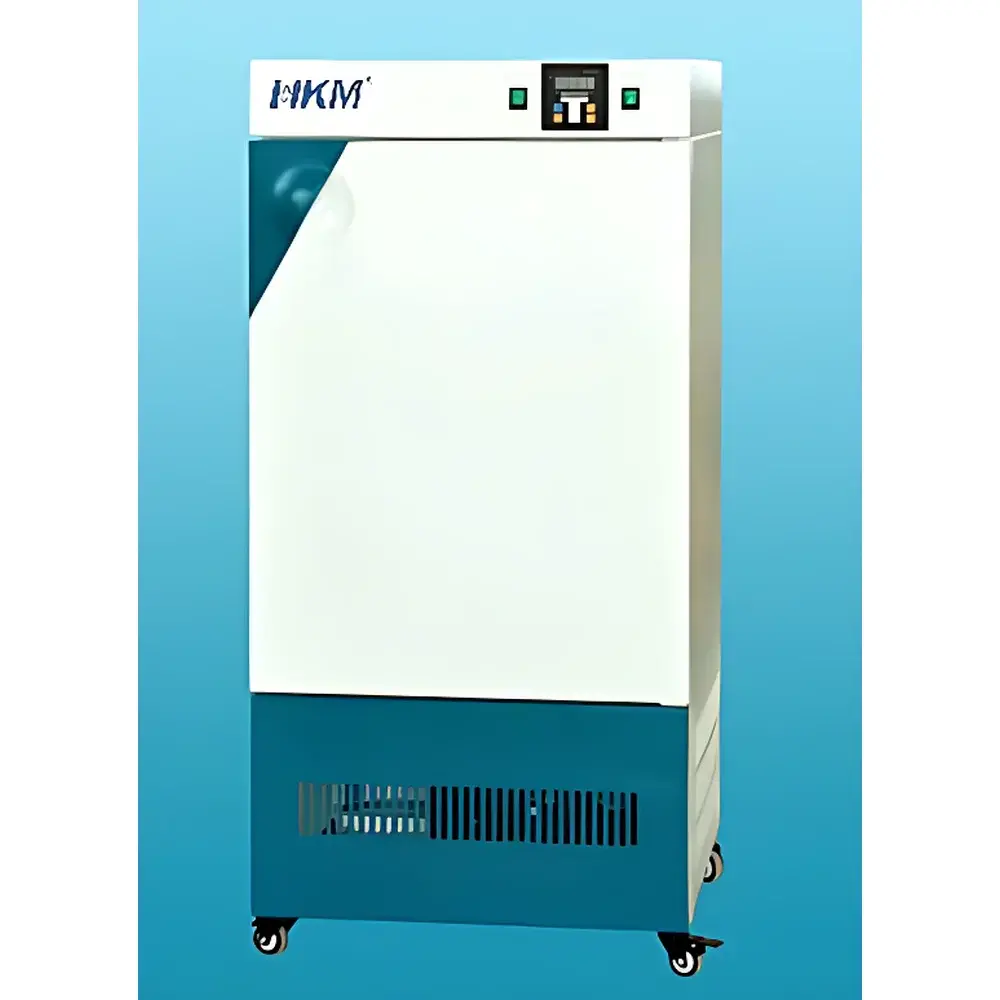
HKM SHP Series Biochemical Incubators (SHP-080, SHP-150, SHP-250, SHP-350)
| Brand | HKM |
|---|---|
| Origin | Guangdong, China |
| Model(s) | SHP-080, SHP-150, SHP-250, SHP-350 |
| Temperature Range | 5–50 °C |
| Temperature Uniformity | ±0.5 °C |
| Power Consumption | 600–1450 W |
| Internal Chamber Dimensions | 400 × 400 × 500 mm to 600 × 550 × 1000 mm |
| Voltage/Frequency | 220 V / 50 Hz |
| Interior Material | Mirror-finish stainless steel |
| Door | Double-layered, outer steel + inner tempered glass |
| Cooling System | Modular compressor-based refrigeration with high/low pressure protection and compressor delay start |
| Fan Motor | Imported German motor with low-noise impeller |
| Control System | Microprocessor-based PID controller with dual digital display (setpoint & actual temperature) |
| Shelf Adjustability | Yes |
Overview
The HKM SHP Series Biochemical Incubators are precision-engineered environmental chambers designed for stable, reproducible temperature-controlled cultivation of microorganisms—including bacteria, yeasts, molds, and cell lines—as well as for biochemical assays, BOD analysis, seed germination studies, and short-term sample storage in life science laboratories. Operating on a forced-air convection principle with optimized airflow distribution, these incubators maintain uniform thermal conditions across the entire working chamber. The temperature control architecture employs a closed-loop PID algorithm, continuously adjusting heating and cooling outputs to counteract external disturbances and load variations—ensuring long-term stability critical for sensitive biological processes. Unlike ambient-only or basic heating-only units, the SHP series integrates active refrigeration, enabling operation down to 5 °C, thereby supporting both mesophilic culture maintenance and low-temperature metabolic studies.
Key Features
- Mirror-finish stainless-steel interior with rounded corners minimizes surface area for microbial adhesion and facilitates rapid, residue-free cleaning—essential for GLP-compliant workflows and cross-contamination prevention.
- Dual digital LED display shows both setpoint and real-time internal temperature simultaneously, with intuitive keypad navigation and password-protected parameter locking to prevent accidental modification during extended experiments.
- Double-wall insulated construction with high-density polyurethane foam (≥60 mm thickness) ensures low thermal leakage and energy-efficient operation; the inner door is made of tempered safety glass, allowing visual monitoring without thermal disturbance to the chamber environment.
- Modular refrigeration system includes a hermetically sealed compressor with built-in high/low pressure cut-off switches, phase failure protection, and programmable compressor delay start to extend service life and reduce mechanical stress.
- Imported German DC brushless fan motor and aerodynamically profiled impeller deliver consistent laminar airflow at <45 dB(A), minimizing vibration transfer to cultured samples while maintaining ±0.5 °C temperature uniformity throughout the workspace.
Sample Compatibility & Compliance
The SHP incubators accommodate standard microbiological vessels—including Petri dishes, test tubes, flasks, multi-well plates, and culture bags—across all four model variants. Adjustable stainless-steel shelves (up to 4 levels per unit) support flexible configuration for heterogeneous sample loads. The chamber geometry has been validated for ISO 14644-1 Class 7 cleanroom-compatible placement, and materials comply with RoHS Directive 2011/65/EU. While not certified for IEC 61010-1 Class II medical device use, the design meets general laboratory equipment safety requirements under EN 61010-1:2010 and supports adherence to USP , CLSI M22-A3, and ISO 22000 food microbiology testing protocols when integrated into validated laboratory systems.
Software & Data Management
These standalone incubators operate without proprietary software dependencies. All operational parameters—including temperature setpoint, run duration, and alarm thresholds—are configured locally via the front-panel interface. Event logging (e.g., door-open duration, over-temperature alerts, compressor cycling) is stored in non-volatile memory for up to 30 days and can be reviewed directly on-screen. For laboratories requiring electronic record retention compliant with FDA 21 CFR Part 11, optional RS-485 Modbus RTU or USB-to-serial interfaces enable integration with third-party SCADA or LIMS platforms for automated data capture, audit trail generation, and remote status monitoring.
Applications
- Biochemical oxygen demand (BOD5) determination per ASTM D5210 and ISO 5815-1
- Microbial enumeration and identification workflows in clinical, pharmaceutical, and food safety labs
- Fungal spore germination and mycelial growth studies under controlled thermal regimes
- Short-term storage of reconstituted enzymes, antibodies, and lyophilized standards at defined temperatures
- Plant tissue culture initiation and callus proliferation in agricultural biotechnology research
- Environmental simulation for ecotoxicology assessments involving aquatic organisms
FAQ
What is the minimum operating temperature of the SHP series?
The incubators are rated for continuous operation from 5 °C to 50 °C, with full refrigeration capacity maintained across this range.
Are calibration certificates provided with shipment?
Factory calibration reports (traceable to NIST-equivalent national standards) are included; UKAS or ISO/IEC 17025-accredited calibration services are available upon request.
Can the incubator be used for CO₂-sensitive cultures?
No—this is a temperature-only incubator without gas mixing, humidification, or CO₂ control capabilities.
Is there a humidity control option?
Humidity regulation is not supported in the base SHP configuration; users requiring >60% RH should consider the HKM SHH series humidified incubators.
What is the expected mean time between failures (MTBF) for the refrigeration module?
Based on accelerated life testing and field data, the compressor-based cooling system demonstrates an MTBF exceeding 25,000 hours under typical lab usage conditions (8 h/day, 5 days/week).





