
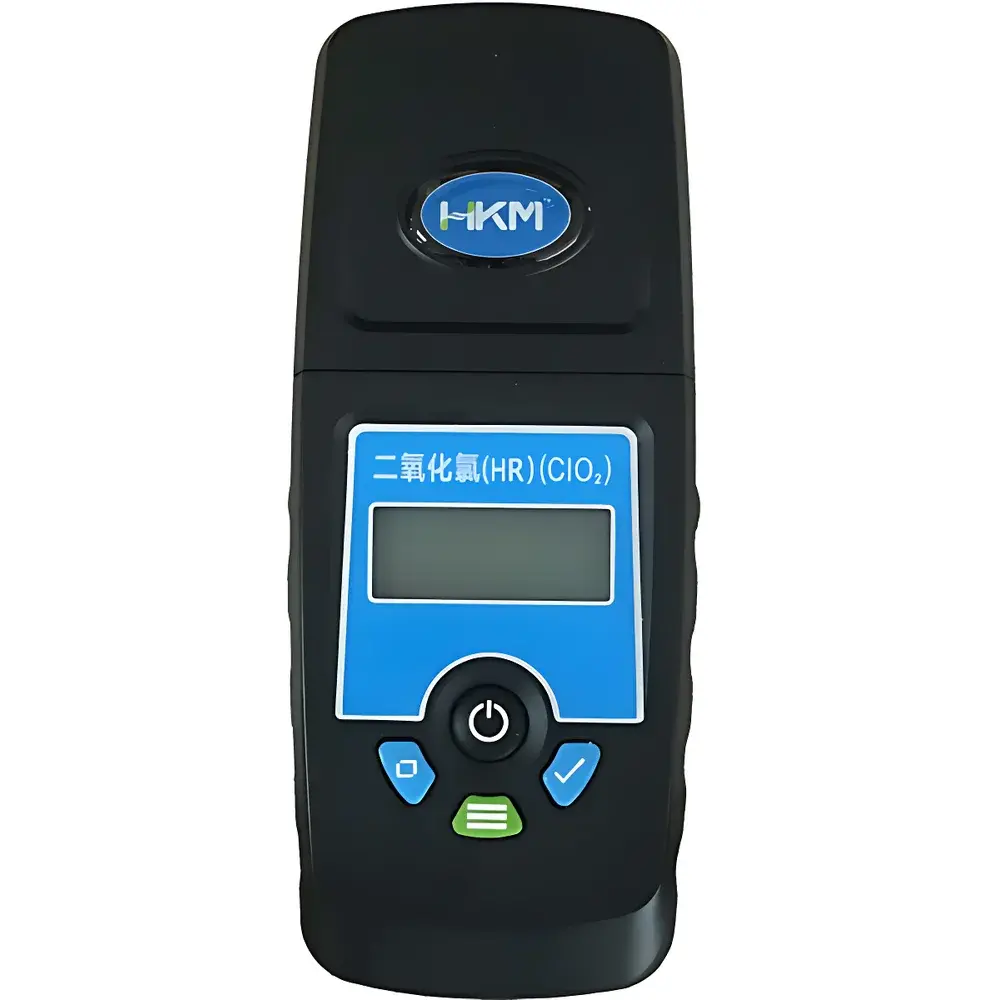
HKM S-202 Portable Residual Chlorine Analyzer (DPD Spectrophotometric Method)
| Brand | HKM |
|---|---|
| Origin | Guangdong, China |
| Model | S-202 |
| Instrument Type | Portable |
| Measurement Principle | DPD Spectrophotometry |
| Measured Parameter | Free Residual Chlorine |
| Range | 0–10 mg/L |
| Accuracy | ±5% |
| Repeatability | ±5% |
| Resolution | 1 mg/L |
| Detection Limit | 1 mg/L |
| Power | Alkaline batteries (≥40 h operation per set) |
Overview
The HKM S-202 Portable Residual Chlorine Analyzer is a field-deployable spectrophotometric instrument engineered for rapid, on-site quantification of free residual chlorine in drinking water, swimming pools, wastewater effluents, and distribution system samples. It operates on the standardized N,N-diethyl-p-phenylenediamine (DPD) colorimetric method—recognized by ISO 7393-2:2018, APHA Standard Methods 4500-Cl G, and EPA Method 334.0. In this method, free chlorine oxidizes DPD to form a stable magenta-colored quinoneimine dye, the absorbance of which is measured at 515 nm using an integrated solid-state photodiode detector and LED light source. The instrument’s optical path is calibrated against NIST-traceable standards, ensuring metrological consistency across measurement cycles. Designed for routine compliance monitoring rather than research-grade trace analysis, the S-202 delivers robust performance under variable ambient lighting and temperature conditions (10–40 °C), with no requirement for external calibration verification between daily use sessions.
Key Features
- Direct digital readout in mg/L on a high-contrast LCD display—eliminates subjective interpretation inherent in visual comparator methods or test strips
- Integrated cuvette holder with fixed 10-mm optical path length, optimized for DPD reaction kinetics and minimizing inter-sample carryover
- Pre-programmed calibration curve stored in non-volatile memory; no manual slope/intercept entry required
- Compact, rugged ABS housing (165 × 85 × 45 mm) with IP65-rated enclosure for dust and splash resistance during field transport and operation
- Low-power LED light source (515 ± 5 nm bandwidth) with <1% spectral drift over 10,000 hours—ensuring long-term photometric stability
- Battery-powered operation using two AA alkaline cells; typical service life exceeds 40 hours under intermittent usage (100 measurements/day)
- Onboard data logging for up to 200 measurement records, timestamped and retrievable via USB interface (optional cable)
Sample Compatibility & Compliance
The S-202 is validated for use with clarified, low-turbidity aqueous samples (turbidity <5 NTU). It supports standard 10-mL glass or disposable plastic cuvettes conforming to ISO 3696 Grade 3 water specifications. Interference mitigation includes built-in compensation for monochloramine (up to 2 mg/L as Cl₂) and moderate levels of manganese (≤0.1 mg/L); samples with higher interferent concentrations require pretreatment per APHA guidelines. The analyzer meets functional requirements of ISO/IEC 17025:2017 for field instruments used in accredited environmental testing laboratories. While not certified to IEC 61000-6-3 (EMC) or UL 61010-1, its electromagnetic emissions fall within Class B limits for industrial environments per CISPR 11. Documentation package includes factory calibration certificate, DPD reagent lot traceability, and conformity statement aligned with China’s JJG 973-2018 verification regulation for residual chlorine analyzers.
Software & Data Management
Data export is supported via USB 2.0 connection to Windows-based PCs running HKM DataLink v2.1 software (included). This application enables batch export to CSV or Excel formats, generation of QC summary reports (including %RSD, bias vs. reference values), and automatic date/time stamping per measurement. Audit trail functionality logs operator ID (user-defined), instrument serial number, calibration status, and battery voltage at time of measurement—supporting GLP-aligned recordkeeping. The firmware does not support 21 CFR Part 11 electronic signatures; however, exported datasets include embedded metadata sufficient for retrospective validation in non-GxP contexts such as municipal utility reporting or educational laboratory instruction.
Applications
- Routine disinfectant residual verification at water treatment plant final effluent points
- Swimming pool and spa facility compliance checks per WHO Guidelines for Safe Recreational Water Environments
- Field validation of point-of-use (POU) chlorination systems in rural or emergency response settings
- Quality assurance sampling during pipe rehabilitation or flushing operations
- Student laboratory exercises in environmental chemistry and public health curricula
- Third-party verification audits for ISO 22000 or HACCP-based food processing water systems
FAQ
Does the S-202 measure total chlorine or only free chlorine?
The S-202 is configured exclusively for free residual chlorine determination using the DPD Method 1 protocol. Total chlorine requires Method 4 (addition of potassium iodide), which is not supported by this model’s firmware or reagent formulation.
What is the shelf life of the included DPD reagent packets?
Unopened DPD reagent sachets maintain stability for 36 months when stored at 2–25 °C in original aluminum-laminated packaging, per HKM Certificate of Analysis (Lot-specific).
Can the instrument be recalibrated in the field without sending it to a service center?
Yes—users may perform a one-point verification using a certified 2.0 mg/L chlorine standard solution (NIST-traceable). Full multi-point calibration requires HKM-certified service personnel and proprietary calibration kits.
Is the device suitable for seawater or brackish water analysis?
No. High chloride ion concentration (>5,000 mg/L) induces significant positive interference in DPD-based assays. For saline matrices, amperometric or membrane electrode methods are recommended.
Related Products







