
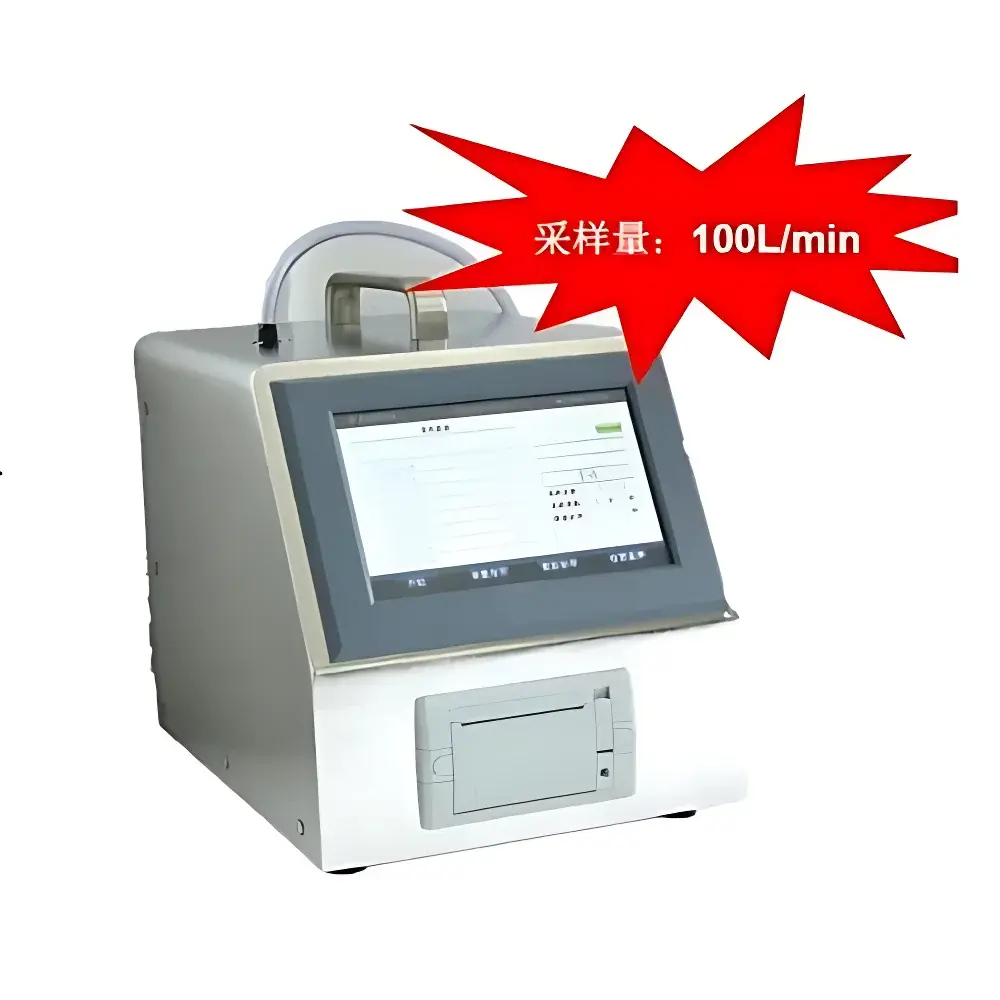
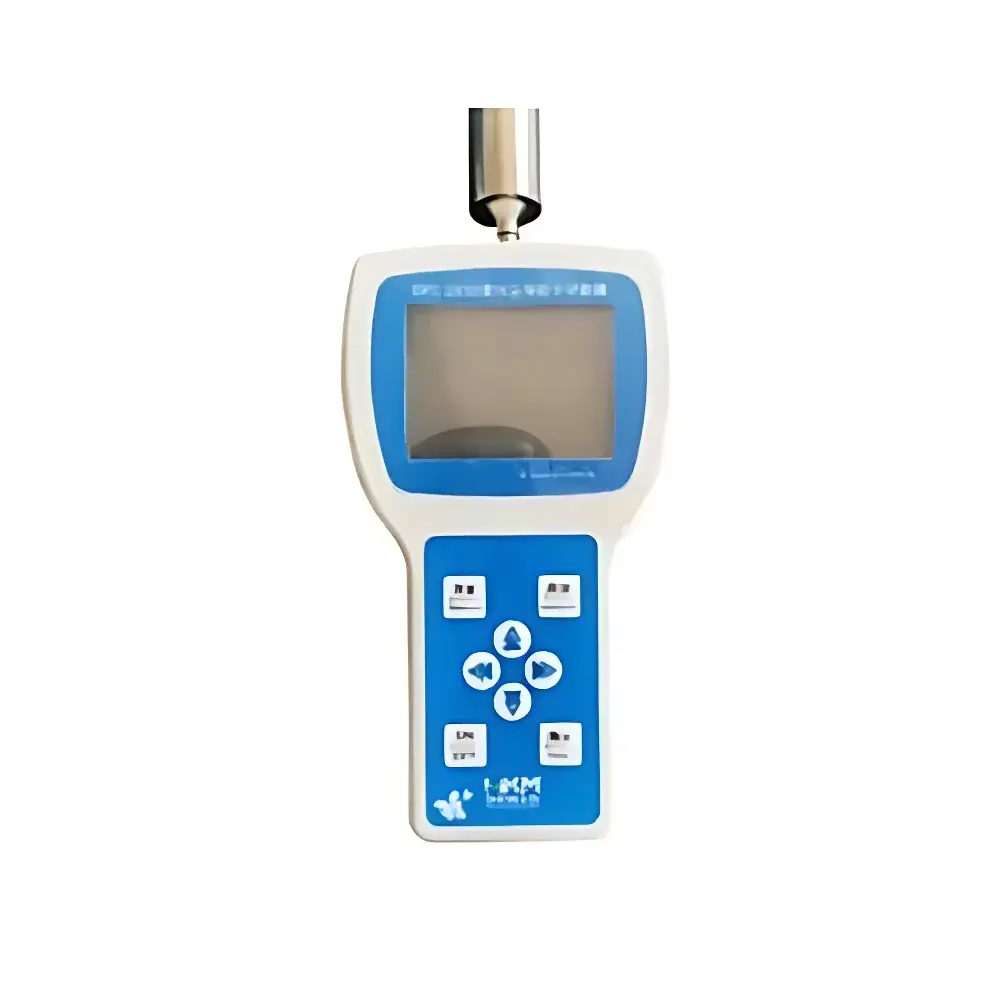
HKM DPC-2830 High-Flow Airborne Particle Counter
| Brand | HKM |
|---|---|
| Model | DPC-2830 |
| Application | Laboratory-grade airborne particle counting |
| Flow Rate | 28.3 L/min |
| Flow Accuracy | ≤±5% |
| Timing Accuracy | ≤±1 s per 6-min sampling |
| Repeatability | ≤±10% FS |
| Size Distribution Error | ≤±30% |
| Indication Error | ≤±30% FS |
| Particle Size Channels | 0.3, 0.5, 1.0, 3.0, 5.0, 10.0 µm |
| Light Source | Semiconductor laser (≥30,000 h lifetime) |
| Self-Cleaning Time | ≤10 min |
| Communication Interfaces | RS-232 (9600 bps), Mini-USB, optional Ethernet |
| Data Storage | Internal high-capacity memory with UCL (95% confidence level) calculation |
| Power | Rechargeable Li-ion battery (optional external AC adapter) |
| Filter for Zero Count | Included |
| Optional Accessories | External printer, sampling tripod, temperature/humidity/pressure differential modules |
Overview
The HKM DPC-2830 is a laboratory-class, high-flow airborne particle counter engineered for precise quantification of suspended particulate matter in cleanroom and controlled environment applications. It operates on the principle of light scattering—where particles drawn through a calibrated laminar airflow intersect a focused semiconductor laser beam, generating scattered photons detected by a high-sensitivity photodetector. Signal amplitude is correlated to particle size via Mie scattering theory, while pulse count yields concentration per unit volume. With a nominal flow rate of 28.3 L/min (1 ft³/min), the DPC-2830 satisfies ISO 14644-1, ISO 21501-4, and JIS B 9921 requirements for cleanroom certification and routine monitoring. Its design targets environments where regulatory compliance, audit readiness, and traceable metrology are mandatory—including pharmaceutical manufacturing facilities operating under cGMP (21 CFR Part 211), medical device cleanrooms aligned with ISO 13485, and semiconductor fabrication areas requiring ISO Class 3–8 verification.
Key Features
- Real-time multi-channel particle counting across six user-selectable size thresholds (0.3, 0.5, 1.0, 3.0, 5.0, and 10.0 µm), enabling simultaneous classification per ISO 14644-1 and EU GMP Annex 1 grading protocols.
- On-device calculation of Upper Confidence Limit (UCL) at 95% confidence level—fully compliant with ISO 14644-1:2015 Annex D statistical requirements for cleanroom certification reports.
- Automatic volumetric conversion between metric (particles/m³) and imperial (particles/ft³) units, eliminating manual recalculations during cross-border facility audits.
- Integrated rechargeable lithium-ion battery supporting ≥4 hours of continuous operation; low-battery indicator ensures uninterrupted sampling during extended qualification runs.
- RS-232 serial interface (9600 bps), Mini-USB port, and optional Ethernet module enable seamless integration into centralized environmental monitoring systems (EMS) and LIMS platforms.
- Self-cleaning cycle (<10 min) minimizes carryover risk between sequential sampling locations—critical for multi-point ISO classification surveys.
Sample Compatibility & Compliance
The DPC-2830 is validated for use with standard 0.2 µm-rated zero-count filters and compatible with isokinetic sampling probes for duct or ceiling-mounted installations. It meets optical calibration traceability requirements per ISO 21501-4:2018 using NIST-traceable polystyrene latex (PSL) reference particles. Device firmware supports GLP/GMP-compliant data integrity practices, including operator login, time-stamped event logs, and immutable audit trails when paired with HKM’s certified data management software. All measurement outputs conform to FDA 21 CFR Part 11 electronic record and signature requirements when configured with user authentication and electronic signature workflows.
Software & Data Management
The included HKM ParticleView™ software provides full bidirectional communication: real-time streaming, historical retrieval, report generation (PDF/CSV), and automated UCL computation per ISO 14644-1 Annex D. Raw datasets retain full metadata—including date/time stamps, location tags, operator ID, flow rate verification logs, and instrument serial number—ensuring full ALCOA+ (Attributable, Legible, Contemporaneous, Original, Accurate, Complete, Consistent, Enduring, Available) compliance. Data export supports direct import into industry-standard platforms such as DeltaV, PI System, or TrackWise for enterprise-level quality analytics and CAPA linkage.
Applications
- Pharmaceutical aseptic processing suites: monitoring Grade A/B/C/D zones during media fills, equipment qualification, and routine surveillance.
- Semiconductor front-end fabs: verifying ISO Class 3–5 environments for photolithography and etch tool enclosures.
- Medical device packaging lines: validating cleanroom performance prior to sterile barrier system assembly.
- Aerospace component testing labs: assessing particulate shedding from composite machining and precision optics handling areas.
- HEPA/ULPA filter integrity validation: performing upstream/downstream challenge tests per IEST-RP-CC001.4 and EN 1822.
- University and national lab cleanrooms: supporting nanomaterial synthesis, quantum computing infrastructure, and biological containment research.
FAQ
What standards does the DPC-2830 comply with for cleanroom certification?
It adheres to ISO 14644-1:2015 (cleanroom classification), ISO 21501-4:2018 (instrument calibration), and JIS B 9921 (Japanese industrial standard for particle counters).
Can the device be used for continuous unattended monitoring?
Yes—when connected to AC power and integrated via Ethernet or RS-232 into an EMS, it supports scheduled sampling, alarm-triggered logging, and remote status polling.
Is calibration certificate included with purchase?
A factory calibration report traceable to NIST PSL standards is supplied; UKAS-accredited third-party calibration services are available upon request.
How is data integrity ensured during transfer from instrument to software?
All communications employ checksum-verified protocols; software enforces write-once-read-many (WORM) archiving and generates SHA-256 hash signatures for each exported dataset.
Does the DPC-2830 support external environmental sensors?
Optional add-on modules enable concurrent acquisition of temperature, relative humidity, differential pressure, and air velocity—synchronized with particle counts for comprehensive ISO 14644-2 compliance reporting.







