
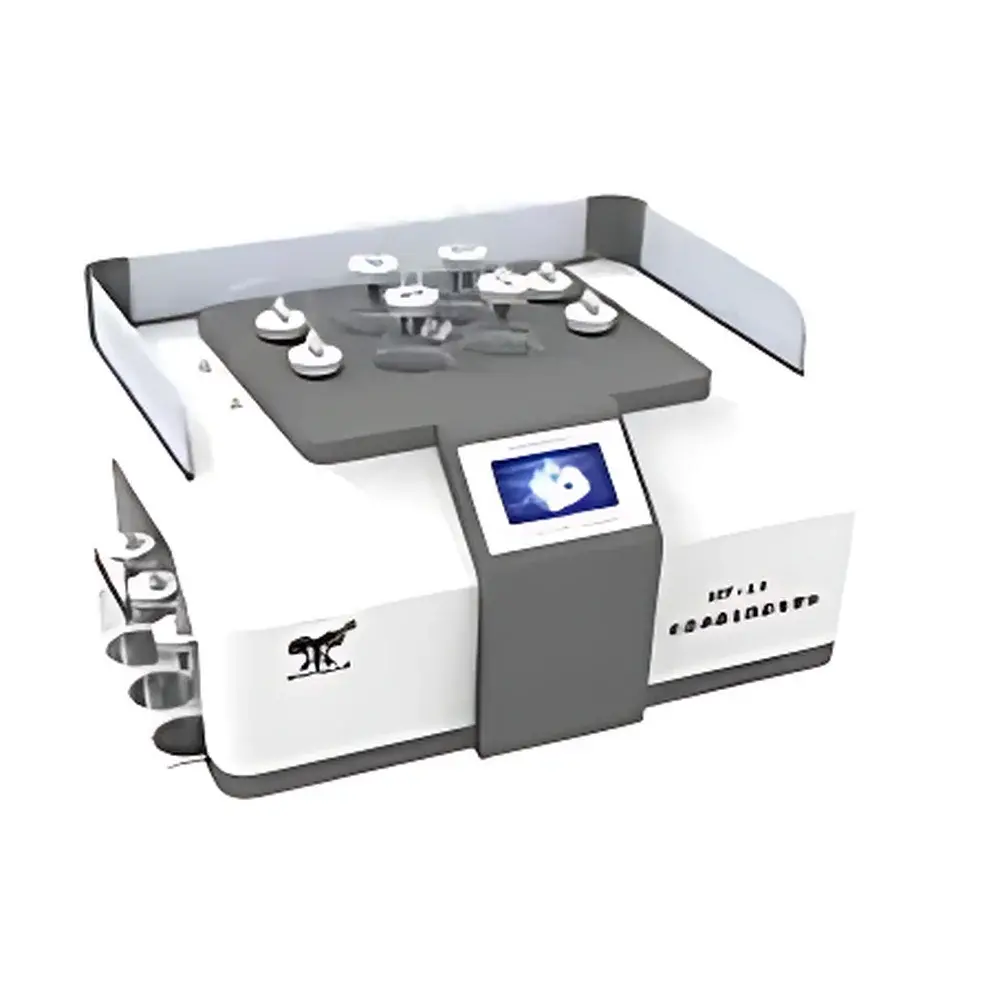

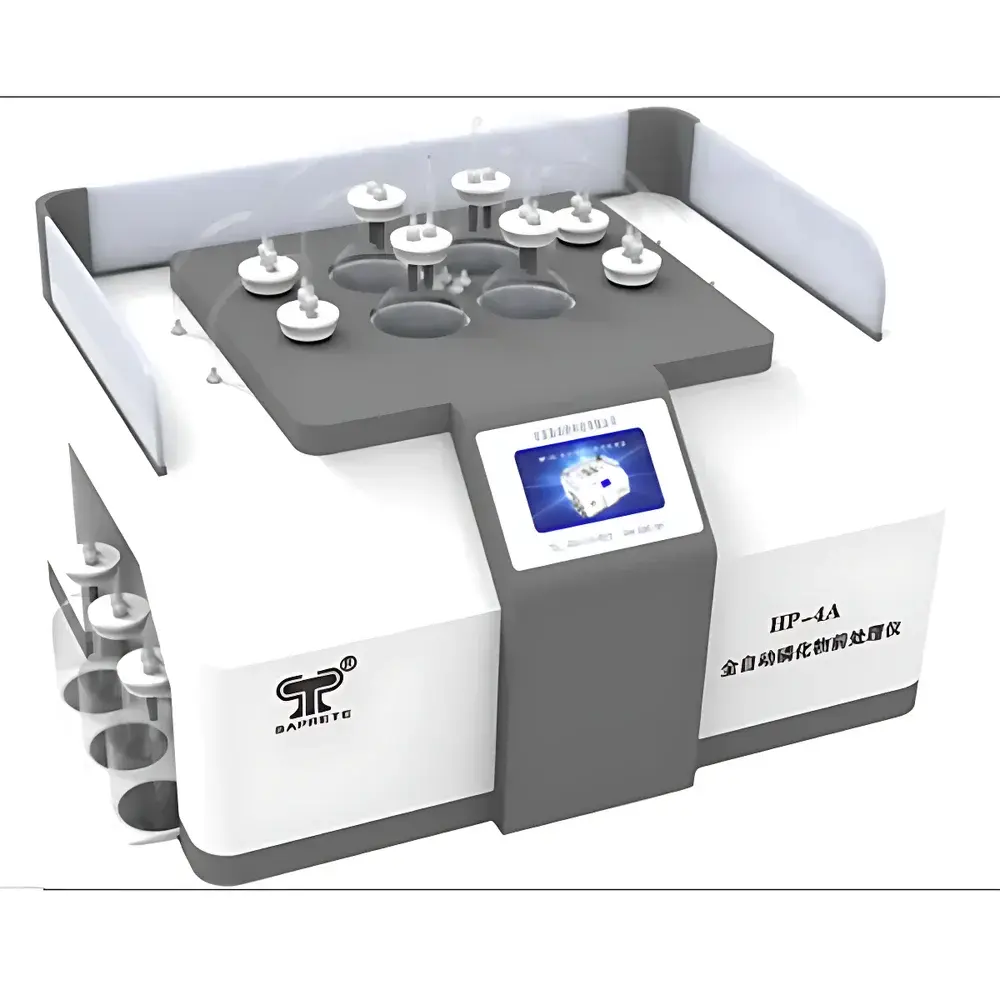
Saprete HP-4A Automated Phosphine Distillation and Absorption System for Grain and Oil Testing
| Brand | Saprete |
|---|---|
| Origin | Beijing, China |
| Manufacturer | Saprete Instrument Co., Ltd. |
| Type | Domestic |
| Model | HP-4A |
| Power Supply | 220 V AC |
| Compliance | Designed per GB/T 25222–2010 |
Overview
The Saprete HP-4A Automated Phosphine Distillation and Absorption System is a dedicated sample preparation instrument engineered for the quantitative determination of phosphine (PH₃) residues in grain and oil commodities. It operates on the principle of acid-induced hydrolysis of metal phosphides (e.g., aluminum or calcium phosphide) present in stored grains, followed by controlled distillation of liberated phosphine gas into an absorbent solution—typically silver nitrate or copper sulfate—where it forms a colored complex measurable by UV-Vis spectrophotometry. This system implements a closed-loop, fully automated workflow aligned with the methodology specified in GB/T 25222–2010, “Determination of Phosphide Residues in Cereals – Spectrophotometric Method.” Unlike manual or semi-automated setups, the HP-4A eliminates operator-dependent variability in acid addition, heating ramp, distillation timing, and gas flow regulation—critical parameters affecting recovery accuracy and method reproducibility.
Key Features
- Fully automated acid dosing: Precise, programmable delivery of hydrochloric or sulfuric acid to reaction vessels, minimizing exposure risk and ensuring stoichiometric consistency across batches.
- Integrated temperature-controlled distillation: PID-regulated heating blocks maintain optimal hydrolysis temperature (typically 60–80 °C) with ±0.5 °C stability, preventing premature PH₃ loss or thermal decomposition.
- Dynamic gas flow management: Mass-flow-controlled carrier gas (N₂ or air) ensures consistent purge velocity (adjustable 50–500 mL/min), enabling quantitative transfer of volatile phosphine to the absorption trap.
- Sealed reaction and absorption manifold: All wetted parts constructed from borosilicate glass and PTFE-lined fittings to resist acid corrosion and adsorptive losses; leak-tight design validated at ≤0.5 mL/min under 10 kPa differential pressure.
- End-of-run notification: Audible and visual alarm signals upon completion of distillation-absorption cycle, supporting unattended operation during multi-sample runs.
- Modular sample carousel: Accommodates up to 6 standard 100-mL digestion tubes; compatible with optional 24-position upgrade kits for high-throughput labs.
Sample Compatibility & Compliance
The HP-4A is validated for use with raw and processed cereal grains (wheat, rice, maize, barley), oilseeds (soybean, rapeseed), and milled products—including flour and bran—within moisture content ranges of 8–15% (w/w). It supports both solid-phase and slurry-based sample introduction, with recommended particle size ≤2 mm to ensure uniform acid penetration. The system meets essential safety and metrological requirements for regulated food testing environments: compliant with GB/T 25222–2010 analytical validation criteria (recovery ≥85%, RSD ≤8% for n=6); designed to support GLP documentation workflows; and compatible with ISO/IEC 17025-accredited laboratories through traceable calibration logs and audit-ready operational records.
Software & Data Management
The embedded control interface provides intuitive touchscreen navigation with preloaded method templates for common grain matrices. Each run generates a timestamped log file (.csv) containing acid volume delivered, distillation duration, peak absorption time, and final absorbance value—exportable via USB or Ethernet. Optional integration with LIMS platforms is supported through ASCII-based serial output (RS-232) or Modbus TCP protocol. All user actions—including method edits, parameter overrides, and maintenance events—are recorded with operator ID and digital signature, satisfying basic data integrity expectations under FDA 21 CFR Part 11 when deployed with supplementary access controls and electronic record policies.
Applications
- Regulatory monitoring of phosphine fumigant residues in imported/exported cereals per national phytosanitary protocols.
- QC/QA screening in grain storage facilities and milling plants to verify post-fumigation clearance intervals.
- Method development and validation studies for alternative detection techniques (e.g., GC-PFPD, IC-MS).
- Research on phosphide degradation kinetics under varying humidity and temperature conditions in silo environments.
- Supporting residue surveillance programs aligned with Codex Alimentarius Maximum Residue Limits (MRLs) for phosphine.
FAQ
Does the HP-4A require external gas cylinders for operation?
Yes—it requires a regulated supply of inert carrier gas (nitrogen or compressed air) at 0.2–0.4 MPa, typically sourced from a laboratory-grade cylinder or central air system.
Can the system be used for non-grain matrices such as dried fruits or spices?
While not validated per GB/T 25222–2010 for these matrices, method adaptation is feasible with matrix-specific optimization of acid concentration, distillation time, and absorption volume; users must perform in-house validation per ISO 17025 Clause 5.4.2.
Is routine calibration required for the acid dosing module?
Yes—gravimetric verification of delivered acid volume should be performed quarterly using certified volumetric flasks; calibration certificates are generated automatically and stored with run logs.
What maintenance intervals are recommended for the glassware and seals?
Reaction tubes and absorption traps should be inspected visually after every 20 runs; PTFE gaskets require replacement every 100 cycles or sooner if compression set exceeds 15%.
Does Saprete provide application support for method transfer to third-party spectrophotometers?
Yes—application notes and SOP templates are included, covering integration with common UV-Vis systems (e.g., Shimadzu UV-1900i, Agilent Cary 60) including wavelength alignment (λ = 470 nm) and baseline correction protocols.
Related Products






