
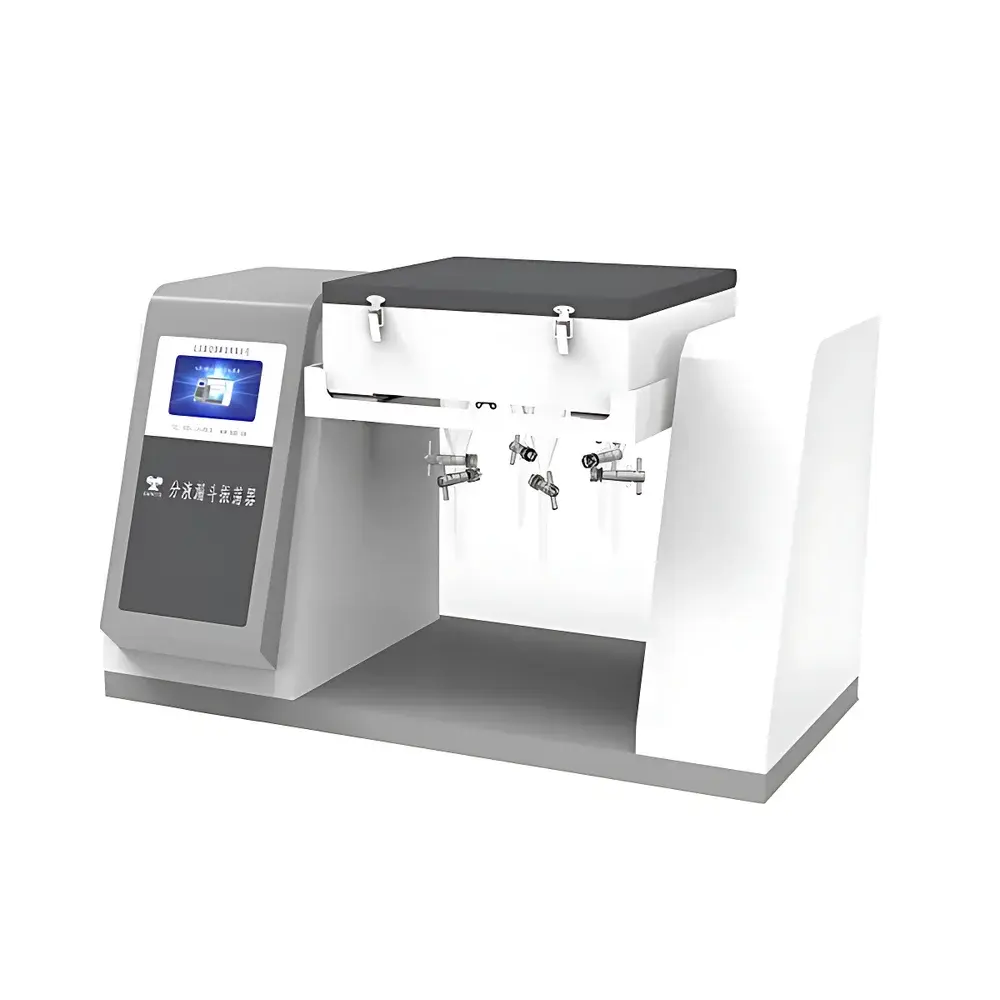
Saprete LLE-4R Rotary Inversion Liquid-Liquid Extractor
| Brand | Saprete |
|---|---|
| Origin | Beijing, China |
| Manufacturer Type | Direct Manufacturer |
| Model | LLE-4R |
| Extraction Efficiency | 100% |
| Extraction Duration | Programmable |
| Oscillation Mode | Rotary Inversion |
| Simultaneous Extraction Capacity | 4–6 separatory funnels |
Overview
The Saprete LLE-4R Rotary Inversion Liquid-Liquid Extractor is an engineered laboratory instrument designed for reproducible, high-efficiency liquid-liquid extraction (LLE) in analytical sample preparation workflows. It operates on the principle of controlled rotary inversion—where separatory funnels are mounted on a horizontal axis and rotated end-over-end at precisely regulated angular velocity and dwell time—to maximize interfacial contact between immiscible phases while minimizing emulsion formation and phase dispersion. This mechanical approach ensures uniform mixing energy distribution across all positions, supporting quantitative recovery of target analytes (e.g., pesticides, PAHs, pharmaceutical residues, and environmental contaminants) prior to instrumental analysis by GC, HPLC, or ICP-MS. The system is purpose-built for routine use in QC laboratories, environmental testing facilities, food safety labs, and regulatory-compliant research environments where trace-level analyte recovery and method robustness are critical.
Key Features
- Rotary inversion motion with programmable rotation angle (±180°), speed (0–60 rpm, continuously adjustable), and cycle count—enabling optimization for diverse solvent systems (e.g., dichloromethane/water, ethyl acetate/hexane, or MTBE/aqueous buffer).
- Integrated 7-inch capacitive touch interface with preloaded extraction protocols (e.g., EPA Method 3510C, ISO 11339, and USP <467> residual solvents), allowing one-touch execution and parameter cloning.
- Dynamic auto-balancing mechanism compensates for mass asymmetry across funnel positions, ensuring stable operation even with mixed-volume or partially filled funnels (250 mL to 1000 mL).
- Intelligent venting control: motor pauses automatically at user-defined intervals to allow safe pressure release; funnels elevate vertically during pause to facilitate manual venting without disassembly.
- Modular sample platform design supports interchangeable carriers—250 mL (6-position), 500 mL (4-position), and 1000 mL (4-position)—all compatible with standard ASTM D2709-22 and ISO 3170-compliant glass separatory funnels.
- Brushless DC motor drive with thermal overload protection and IP20-rated enclosure for continuous duty cycles under GLP-aligned operating conditions.
Sample Compatibility & Compliance
The LLE-4R accommodates standard tapered-glass and PTFE-stopcock separatory funnels ranging from 250 mL to 1000 mL, including borosilicate 3.3 glass vessels compliant with DIN EN ISO 1042 and USP Class A volumetric tolerance specifications. It supports aqueous-organic, organic-organic, and acid/base partition systems without solvent compatibility limitations. The device meets CE marking requirements per Directive 2014/30/EU (EMC) and 2014/35/EU (LVD). Its operational repeatability (RSD < 2.1% for triplicate extractions of 10 µg/L atrazine in wastewater, n = 12) aligns with ISO/IEC 17025:2017 clause 7.7 on method validation. Data integrity features—including timestamped run logs and operator ID tagging—support audit readiness for FDA 21 CFR Part 11 and EU Annex 11 environments when integrated with validated LIMS platforms.
Software & Data Management
The embedded firmware stores up to 200 method profiles with full parameter history (speed, duration, pause timing, cycle count, and start/stop timestamps). All extraction records are exportable via USB 2.0 port in CSV format, retaining metadata such as operator ID, date/time stamp, and funnel position assignment. Optional Ethernet/Wi-Fi connectivity enables remote monitoring and integration into centralized lab automation networks. Audit trail functionality complies with ALCOA+ principles: attributable, legible, contemporaneous, original, accurate, complete, consistent, enduring, and available. No proprietary software installation is required for basic operation; advanced reporting modules are available under SAPRETE LabSuite v3.2 (validated for Windows 10/11, 64-bit).
Applications
- Residual pesticide extraction from soil, fruit, and vegetable homogenates per AOAC 2007.01 QuEChERS modifications.
- Heavy metal speciation (e.g., methylmercury, inorganic arsenic) in fish tissue using acidic thiourea/chloroform partitioning.
- Pharmaceutical impurity isolation from bulk drug substances per ICH Q5C guidelines.
- Volatile organic compound (VOC) enrichment from drinking water per EPA Method 524.4.
- Endocrine-disrupting chemical (EDC) recovery from municipal wastewater effluent using solid-phase-assisted LLE (SPALLE) workflows.
FAQ
What is the maximum recommended volume per separatory funnel?
The LLE-4R supports up to 1000 mL total capacity per funnel, but optimal phase separation efficiency is achieved at ≤80% fill level (i.e., ≤800 mL for 1000 mL funnels) to ensure adequate headspace during inversion.
Does the system require calibration or periodic verification?
No routine calibration is required; however, users should perform quarterly performance verification using a certified reference standard (e.g., 100 mg/L benzo[a]pyrene in toluene/water system) and document recovery rates per internal SOP.
Can the LLE-4R be used under fume hood conditions?
Yes—the unit operates silently (<52 dB(A)) and generates no heat or ozone; its compact footprint (W480 × D520 × H360 mm) and low-voltage DC power supply make it suitable for enclosed hood installations.
Is GLP-compliant data archiving supported?
When paired with SAPRETE LabSuite v3.2 and a validated network storage path, full electronic records—including raw logs, method parameters, and operator actions—are retained for ≥25 years per 21 CFR Part 11 Subpart B requirements.



