
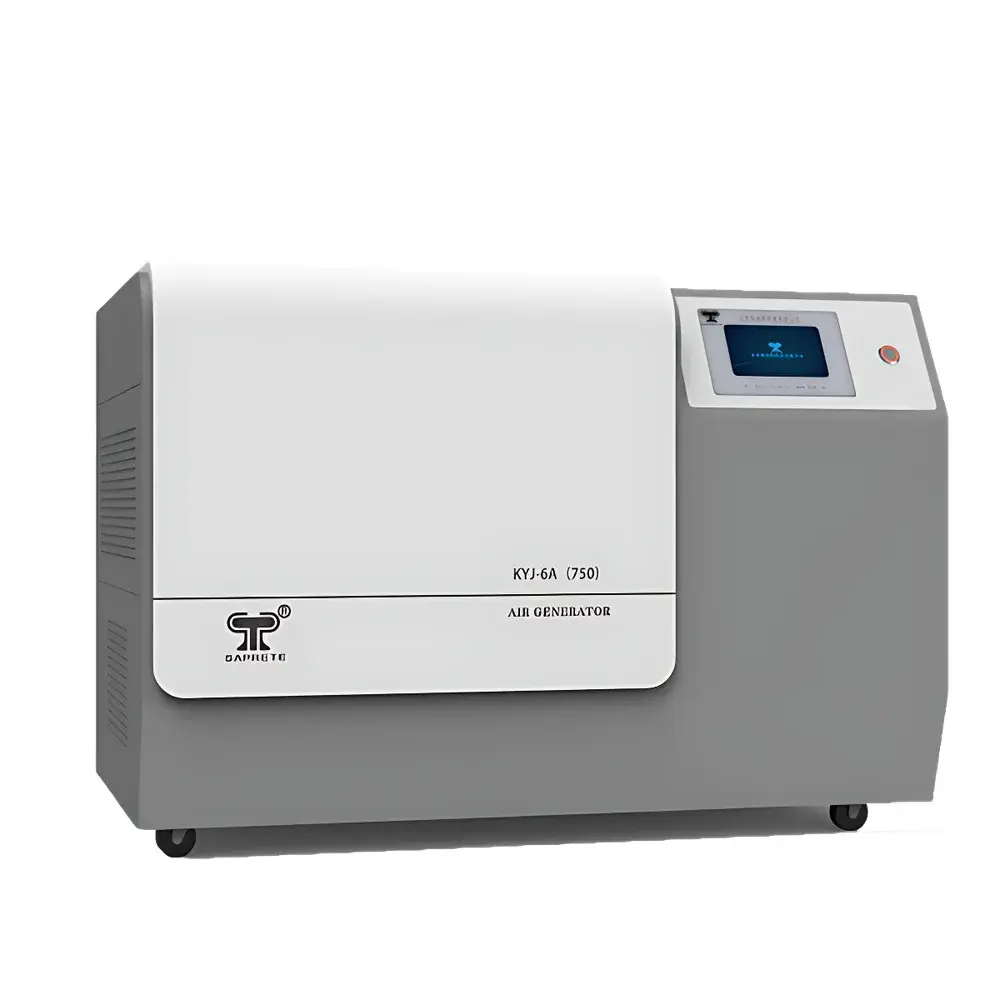
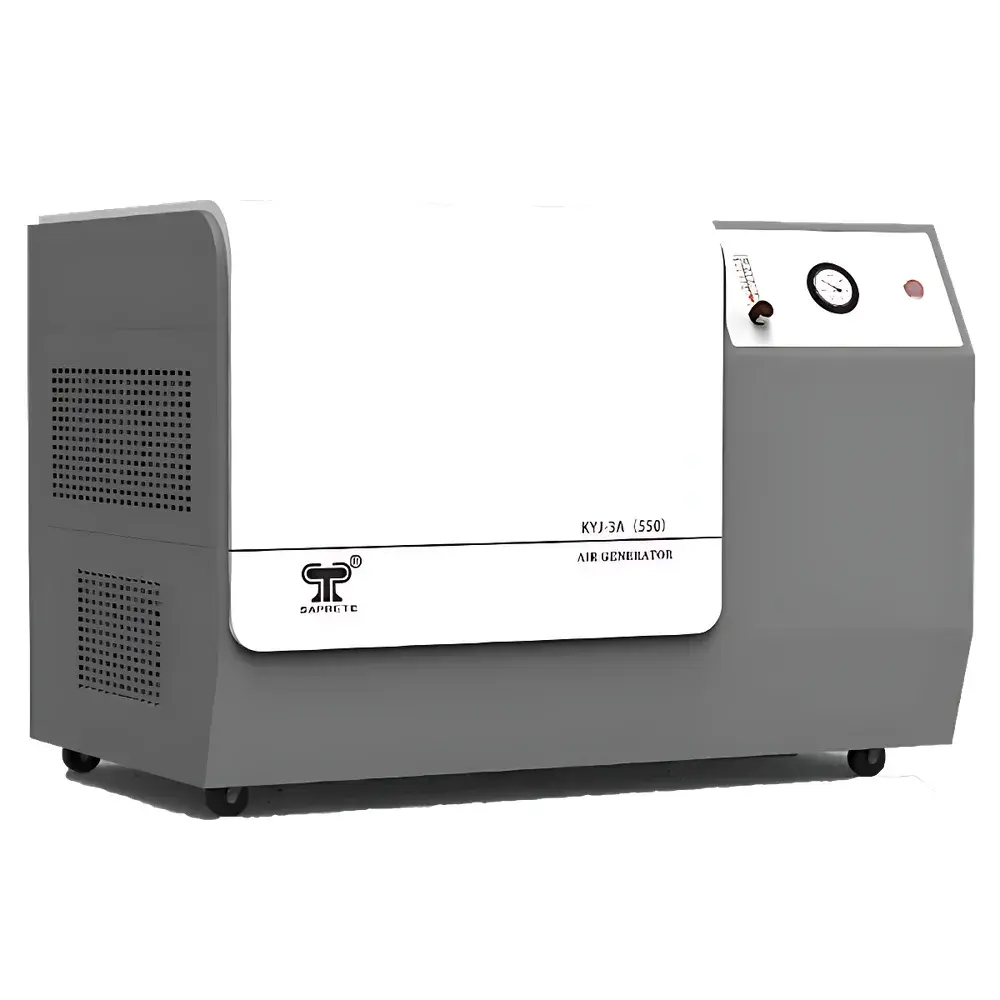
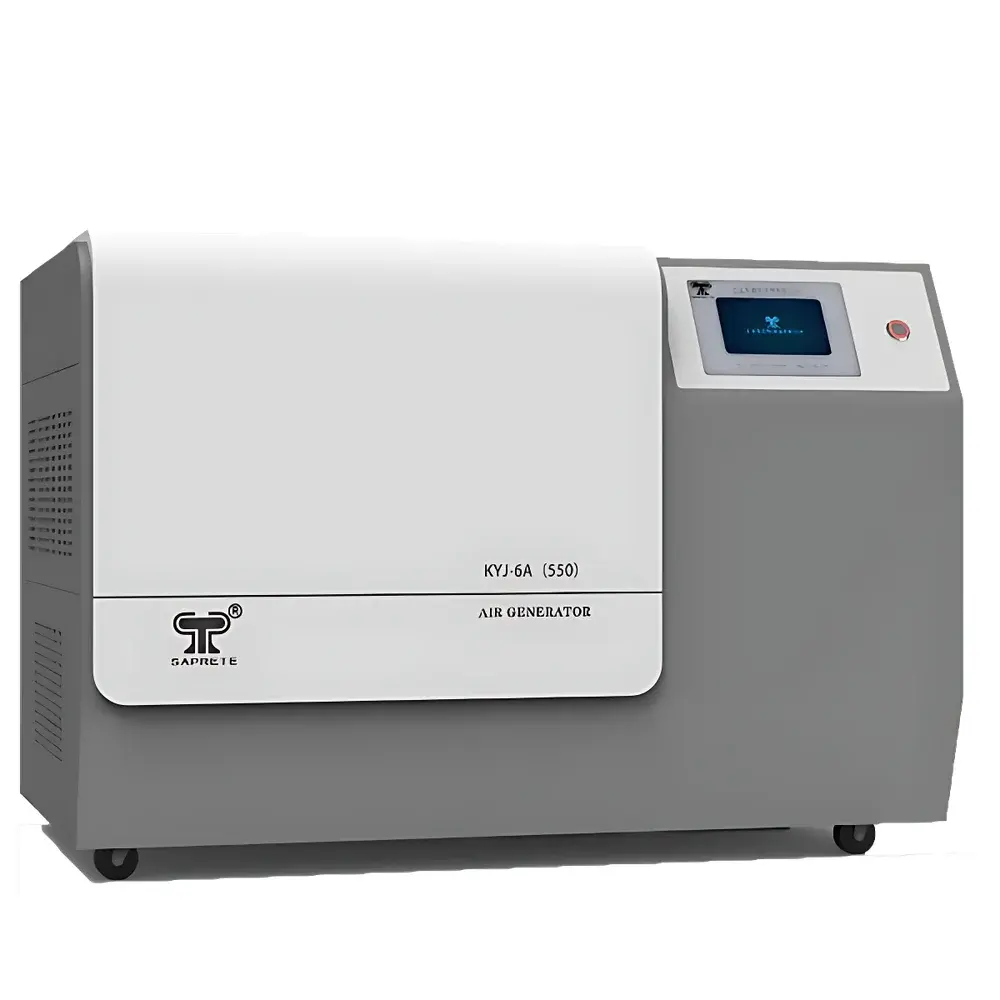
Saprete KYJ-6A750 Fully Automatic Air Generator
| Brand | Saprete |
|---|---|
| Origin | Beijing, China |
| Manufacturer Type | Direct Manufacturer |
| Model | KYJ-6A750 |
| Hydrocarbon Removal Principle | High-Temperature Catalytic Cracking |
| Output Flow Rate | 0–80 L/min |
| Output Pressure | 0–0.7 MPa |
| Dew Point | −40 °C |
| Filtration Stages | 3-Stage Integrated Filtration (Particulate, Coalescing, Catalytic) |
| Display | Real-Time Digital Pressure & Flow Monitoring |
| Cooling | Convection-Based Thermal Management |
| Safety | Over-Pressure Protection Circuit |
| Housing | Industrial-Grade Steel Enclosure |
Overview
The Saprete KYJ-6A750 Fully Automatic Air Generator is an engineered solution for laboratories requiring continuous, high-purity compressed air as a carrier or auxiliary gas in analytical instrumentation workflows. It operates on a multi-stage purification principle: ambient air is drawn through a primary external particulate filter, then subjected to coalescing filtration to remove bulk moisture and oil aerosols, followed by high-temperature catalytic cracking (≥350 °C) to decompose residual hydrocarbons—including methane, ethane, and volatile organic compounds—into CO₂ and H₂O, which are subsequently adsorbed downstream. Final polishing employs desiccant-based drying to achieve a certified dew point of −40 °C at rated flow, ensuring compatibility with sensitive detection systems such as GC-FID, GC-MS, and headspace samplers. Unlike oil-lubricated compressors or bottled air, the KYJ-6A750 eliminates batch-to-batch variability, cylinder handling risks, and hydrocarbon carryover—critical for trace-level organic analysis where background interference compromises method specificity and detection limits.
Key Features
- Stable output pressure regulation across 0–0.7 MPa, maintained within ±0.02 MPa under dynamic load conditions
- Digitally controlled flow adjustment from 0 to 80 L/min, with real-time LED display of both pressure (MPa) and volumetric flow (L/min)
- Three-stage integrated filtration architecture: (1) 5 µm pre-filter (externally accessible for rapid replacement), (2) coalescing filter with ≥99.97% efficiency at 0.3 µm, (3) high-temperature catalytic converter coupled with dual-bed desiccant dryer
- Passive convection cooling system eliminates reliance on fans—reducing acoustic noise (<52 dB(A) at 1 m) and mechanical failure points
- Integrated over-pressure safety cutoff with automatic shutdown and visual alarm indication
- Robust steel chassis with IP20-rated enclosure, designed for continuous 24/7 operation in ISO Class 8 cleanroom-adjacent lab environments
Sample Compatibility & Compliance
The KYJ-6A750 delivers air meeting ISO 8573-1:2010 Class 2:2:2 specifications (solid particles ≤0.1 µm, water content ≤−40 °C dew point, oil content ≤0.01 mg/m³) when operated within rated parameters. Its hydrocarbon-free output supports compliance with ASTM D6299 (precision and bias in fuel analysis), USP (chromatographic system suitability), and ICH Q2(R2) guidelines for method validation. The unit’s closed-loop catalytic process eliminates need for consumable carbon traps—reducing maintenance intervals and supporting GLP audit trails via consistent performance logs. No regulatory certification (e.g., CE, UL) is claimed; users are advised to verify local electrical and gas safety requirements prior to installation.
Software & Data Management
The KYJ-6A750 operates as a standalone hardware platform without embedded firmware or network connectivity. All operational parameters are monitored via front-panel digital indicators; no data logging, USB export, or remote interface is provided. For laboratories implementing electronic recordkeeping per FDA 21 CFR Part 11, integration requires external pressure/flow transducers and validated SCADA or LIMS interfaces. Routine maintenance records—including filter replacement dates, catalyst service life tracking (recommended every 12,000 operating hours), and dew point verification logs—must be manually documented to satisfy internal QA protocols.
Applications
- Carrier gas supply for gas chromatography systems equipped with flame ionization (FID), thermal conductivity (TCD), or electron capture (ECD) detectors
- Auxiliary gas source for nitrogen blow-down concentrators (e.g., TurboVap®, Reacti-Vap®) in sample preparation workflows for pesticide residue, environmental pollutant, and pharmaceutical impurity analysis
- Driving gas for automated headspace samplers and purge-and-trap concentrators requiring low-hydrocarbon, dry air
- Instrument air for FTIR spectrometer purge lines, optical bench enclosures, and precision weighing chamber ventilation
- Calibration gas dilution support in environmental monitoring labs adhering to EPA Method TO-15 and ASTM D5502
FAQ
What is the expected service life of the catalytic converter under continuous operation?
The high-temperature catalytic bed is rated for 12,000 hours of cumulative operation at nominal flow and ambient temperatures ≤35 °C. Performance degradation is indicated by rising hydrocarbon readings in downstream GC baseline or elevated methane peaks in FID response.
Can the KYJ-6A750 be used as a substitute for zero-air generators in EPA-certified methods?
No. While it achieves low hydrocarbon output, it is not configured or validated for EPA Protocol 2 (zero-air certification) due to absence of formal ozone scrubbing, formaldehyde removal, and third-party auditable calibration traceability.
Is the external particulate filter compatible with ISO 12500-1 standard testing?
Yes—the replaceable 5 µm inlet filter meets ISO 12500-1 Annex A test criteria for initial efficiency and dust-holding capacity, with documented pressure drop ≤150 Pa at 80 L/min.
Does the unit require periodic calibration of its pressure and flow sensors?
The analog pressure transducer and thermal mass flow sensor are factory-calibrated and do not include user-accessible recalibration routines; annual verification against NIST-traceable reference instruments is recommended for regulated environments.
What ambient conditions affect dew point stability?
Inlet air relative humidity >80% or ambient temperature >35 °C may reduce achievable dew point by up to 5 °C; installation in climate-controlled spaces (20–25 °C, RH <60%) ensures specification compliance.



