
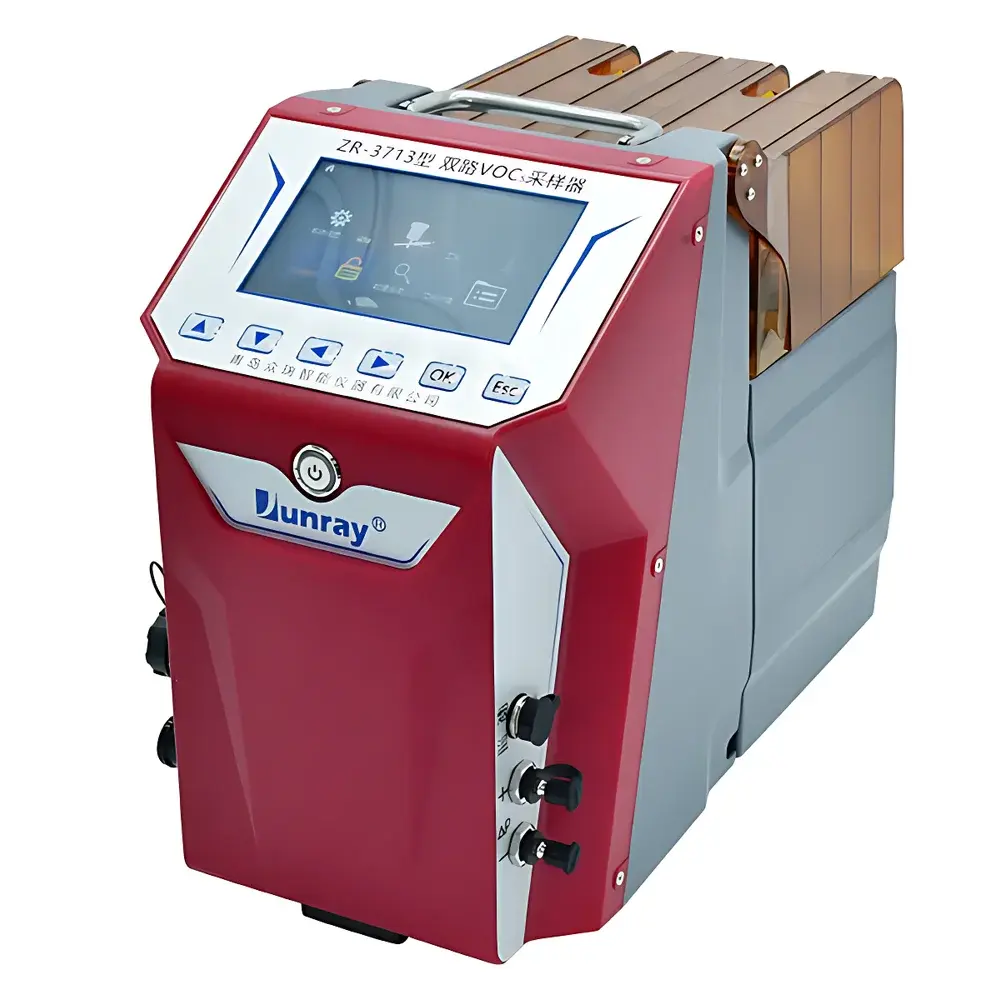
Junray ZR-3713 Dual-Channel VOC Sampler
| Brand | Junray |
|---|---|
| Origin | Shandong, China |
| Manufacturer Type | OEM Manufacturer |
| Product Category | Domestic |
| Model | ZR-3713 |
| Detection Principle | Solid-phase Adsorption (Adsorbent Tube-based Sampling) |
| Instrument Type | Portable |
| Typical Configuration | Multi-analyte VOC Sampling System |
| Flow Range | 10–200 mL/min |
| Pressure Resolution | 0.01 kPa |
| Accuracy | ±2.5% of full scale |
| Response Time | <60 s |
Overview
The Junray ZR-3713 Dual-Channel VOC Sampler is an engineered field-deployable sampling platform designed for quantitative collection of volatile organic compounds (VOCs) from ambient air and stationary source emissions using standardized solid-phase adsorption methodologies. It operates on the principle of controlled-flow, time-integrated sampling through sorbent tubes—enabling subsequent laboratory analysis via thermal desorption coupled with gas chromatography–mass spectrometry (TD-GC-MS), solvent elution followed by GC or HPLC, or direct quantification per regulatory protocols. Unlike real-time gas analyzers, the ZR-3713 functions as a precision volumetric sampler, delivering calibrated, traceable sample volumes under variable environmental conditions—including high-resistance media such as Tenax TA, Carbopack, activated carbon, and silica gel tubes. Its dual-channel architecture supports parallel or sequential sampling, facilitating method validation, duplicate analysis, and cross-comparison across sampling trains per EPA Method TO-17, ISO 16017-1, and Chinese national standards including HJ 644–2013, HJ 734–2014, and HJ 38–2017.
Key Features
- High-capacity vacuum system: Equipped with a brushless diaphragm pump capable of sustaining >30 kPa negative pressure, ensuring stable flow rates even when sampling through high-backpressure sorbent media (e.g., multi-bed tubes for C2–C12 hydrocarbons or polar aldehydes).
- Digital mass-flow control: Integrated high-accuracy electronic flowmeter with closed-loop PID regulation and proprietary low-flow compensation algorithm—maintaining ±2.5% accuracy across the full 10–200 mL/min range, including sub-30 mL/min operation critical for extended-duration ambient monitoring.
- Environmental parameter logging: Real-time measurement and storage of ambient temperature, barometric pressure, pre-meter temperature, and pre-meter pressure—automatically correcting sampled volume to standard conditions (273.15 K, 101.325 kPa) in accordance with GB/T 16157–1996 and HJ/T 47–1999.
- Robust field durability: Dual-stage inlet protection comprising particulate filter and desiccant-filled anti-backflow trap; PTFE-lined sample pathways to prevent analyte adsorption or leaching; IP54-rated enclosure for dust/moisture resistance.
- Extended operational autonomy: Rechargeable lithium-ion battery pack supporting ≥12 hours of continuous dual-channel sampling at 50 mL/min; intelligent power management with auto-resume functionality after power interruption and non-volatile memory retention of sampling timestamps and configuration parameters.
- Modular expandability: Optional integration with flue gas conditioning modules (for heated probe and particle filtration), Bluetooth thermal printer, GPS geotagging unit, and 4G LTE data uplink for remote status reporting and firmware updates.
Sample Compatibility & Compliance
The ZR-3713 accommodates industry-standard sorbent tubes (6 mm OD × 89 mm L, 1/4″ OD × 3.5″ L) filled with single- or multi-bed media—including Tenax GR, Carbograph 1TD, Carboxen 1000, coconut shell charcoal, and silica gel—as well as impinger solutions (e.g., DNPH for carbonyls per HJ 683–2014). It complies with method requirements for benzene homologues (HJ 583–2010, HJ 584–2010), halogenated VOCs (HJ 645–2013), nitrobenzenes (HJ 739–2015), and NMHC (HJ 38–2017). All internal wetted surfaces are inert (PTFE, stainless steel, borosilicate glass), minimizing blank contributions. The instrument’s automatic leak-check function performs pressure-decay verification per ASTM D6196–19 Annex A1 prior to each sampling event, satisfying GLP audit requirements for documented system integrity.
Software & Data Management
Data acquisition and configuration are managed via a 5.0-inch capacitive touchscreen interface running embedded Linux OS. Sampling protocols—including flow setpoints, duration, channel assignment (A/B parallel or sequential), and calibration offsets—are stored in encrypted configuration files. All raw sensor logs (flow, pressure, temperature, battery voltage) and calculated standard-volume metrics are timestamped and exportable via USB 2.0 mass storage mode in CSV format compatible with LIMS ingestion. Audit trails record operator ID (via optional RFID login), start/stop times, calibration events, and error flags—supporting 21 CFR Part 11–compliant workflows when paired with validated third-party data management software.
Applications
- Ambient air quality monitoring networks targeting BTEX, aldehydes, chlorinated solvents, and oxygenated VOCs.
- Compliance testing of industrial stack emissions per HJ 734–2014 and local VOC emission standards.
- Indoor air quality surveys in commercial buildings, schools, and healthcare facilities.
- Method development and validation studies requiring replicate or staggered sampling campaigns.
- Mobile monitoring deployments using vehicle-mounted or backpack configurations.
FAQ
Does the ZR-3713 support simultaneous dual-channel sampling with independent flow control?
Yes—each channel features its own dedicated flow sensor and proportional valve, enabling fully independent flow setpoints and real-time monitoring.
Is the instrument certified for use in explosion-hazardous areas?
No—the ZR-3713 is rated for non-explosive environments only (IEC 60079-0 unclassified) and must not be operated in Zone 0/1 or Class I Division 1 locations.
Can it be used with thermal desorption autosamplers directly?
Yes—tube dimensions and sealing interfaces conform to ASTM D6196 and ISO 16017 mechanical specifications, ensuring compatibility with common TD autosamplers (e.g., Markes UNITY, Gerstel MPS).
What calibration standards does Junray recommend for field verification?
Primary calibration should be performed using a NIST-traceable dry calibrator (e.g., Mesa Labs Gilian Gilibrator-2) at three points across the operating range (10, 100, and 200 mL/min) before initial deployment and semiannually thereafter.
How is data integrity ensured during extended unattended operation?
All measurements are written to non-volatile flash memory with cyclic redundancy check (CRC-32); power-loss recovery preserves elapsed time, remaining duration, and last valid flow reading without data corruption.
Related Products







