
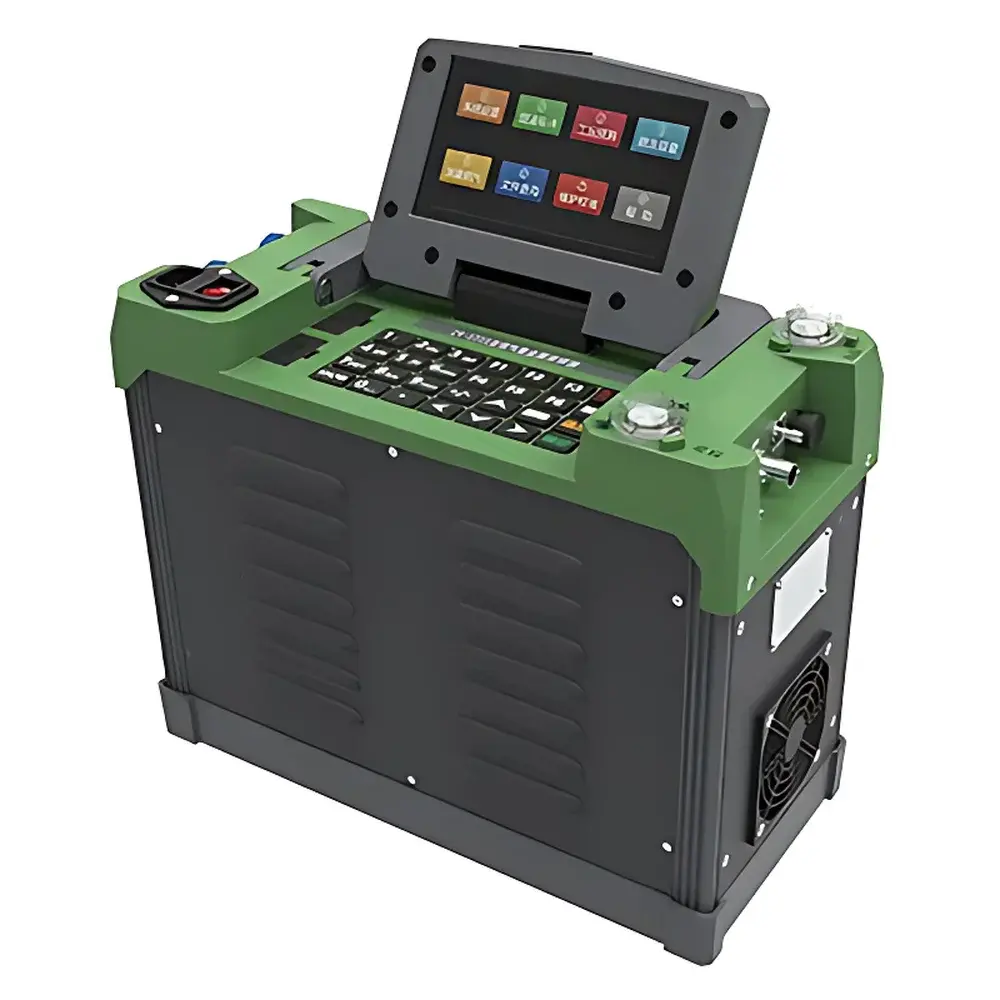
Junray ZR-3721 Flue Gas Heavy Metal Sampling System
| Brand | Junray |
|---|---|
| Origin | Shandong, China |
| Manufacturer Type | Direct Manufacturer |
| Product Category | Domestic |
| Model | ZR-3721 |
| Instrument Type | Flue Gas Heavy Metal Sampler |
| Target Analytes | Hg, Sb, As, Ba, Be, Cd, Cr, Co, Cu, Pb, Mn, Ni, P, Se, Ag, Tl, Zn |
| Flow Accuracy | ±2.5% |
| Sampling Flow Rate | 10–60 L/min |
| Flue Gas Velocity Range | 1–45 m/s |
| Moisture Content Handling | Up to 20% w/w |
| Sampling Medium | Quartz or Teflon-coated Filter Cartridge + Titanium Probe Assembly |
| Heating Control | Integrated Constant-Temperature Heating for Entire Sampling Train |
| Data Storage | USB Mass Storage Support (U-disk Export) |
| Display | 5.6-inch Color Touchscreen with Chinese UI |
| Pump | Imported Rotary Vane Vacuum Pump (Industrial-Grade, Maintenance-Free) |
| Leak Detection | Automated Positive-Pressure Air-Tightness Verification |
| Power Failure Recovery | Auto-Save & Resume Functionality |
| Isokinetic Sampling Capability | Yes |
| Compliance Framework | Designed in alignment with EPA Method 29, ISO 14883-2, and GB/T 16157–1996 (Chinese National Standard for Stationary Source Emission Monitoring) |
Overview
The Junray ZR-3721 Flue Gas Heavy Metal Sampling System is a field-deployable, isokinetic sampling instrument engineered for quantitative collection of trace heavy metal species—including mercury (Hg), arsenic (As), cadmium (Cd), lead (Pb), chromium (Cr), nickel (Ni), selenium (Se), and antimony (Sb)—from industrial flue gas streams. It operates on the principle of controlled isokinetic sampling, ensuring representative particulate and vapor-phase metal capture by dynamically matching probe inlet velocity to the actual flue gas velocity across a broad operational range (1–45 m/s). The system integrates a thermally regulated sampling train comprising a replaceable titanium probe, multi-orifice titanium sampling nozzles, heated transport lines, and a temperature-controlled filter cartridge holder—designed to minimize condensation, adsorption loss, and elemental re-volatilization during transit. Its architecture conforms to the fundamental physical and chemical requirements of regulatory sampling protocols, including U.S. EPA Method 29 for metals in stationary source emissions and ISO 14883-2 for sampling of airborne metallic compounds.
Key Features
- Isokinetic velocity tracking and real-time flow compensation across 10–60 L/min nominal sampling range, with flow accuracy maintained at ±2.5% of reading under variable backpressure conditions.
- Full-train thermal management: integrated PID-controlled heating (up to 180 °C) for probe, nozzle, transfer line, and filter holder to prevent water condensation and metal speciation artifacts in high-moisture flue gases (≤20% w/w).
- Modular titanium probe assembly with interchangeable nozzles (multiple diameters supplied) enables rapid adaptation to diverse stack geometries and velocity profiles without recalibration.
- Industrial-grade imported rotary vane vacuum pump—certified for continuous operation at elevated ambient temperatures and particulate-laden environments, with no scheduled maintenance required over ≥5,000 hours of service life.
- 5.6-inch capacitive touchscreen interface with localized Chinese firmware; supports parameter configuration, real-time diagnostics, and on-device data review without external PC dependency.
- Automated air-tightness verification via positive-pressure leak check prior to each sampling sequence, meeting GLP traceability requirements for method validation documentation.
- Power-interruption resilience: non-volatile memory retains all calibration coefficients, accumulated volume, timestamps, and environmental metadata; resumes sampling automatically upon power restoration.
Sample Compatibility & Compliance
The ZR-3721 is validated for use with standard quartz fiber filter cartridges (e.g., Pallflex EPM 2020) and inert sorbent media (e.g., iodinated carbon for Hg⁰ capture). All wetted surfaces—including probe, nozzle, and filter holder—are constructed from high-purity titanium or fluoropolymer-lined stainless steel to eliminate catalytic surface reactions and metal leaching. The system supports multiple moisture determination methods (manual input, psychrometric dry-wet bulb calculation, or chilled-mirror condensation) to ensure accurate volumetric normalization per ISO 14883-2 Annex C. It satisfies structural and procedural prerequisites for compliance with Chinese national standard GB/T 16157–1996, and its operational parameters align with the sampling train design criteria specified in EPA Method 29 Section 8.1 and EN 14385:2003 for metallic aerosols.
Software & Data Management
Onboard firmware records time-stamped sampling logs—including instantaneous flow rate, stack temperature, differential pressure, nozzle velocity, calculated isokinetic ratio, and cumulative sampled volume—with 1-second resolution. All data are stored in CSV format on removable USB flash drives, enabling direct import into LIMS platforms or statistical analysis tools (e.g., R, Python pandas). No proprietary software is required for data retrieval or report generation. Audit trails include operator ID entry, calibration date stamps, and firmware version identifiers—supporting basic 21 CFR Part 11 readiness when deployed in regulated QA/QC environments. Firmware updates are delivered via signed binary packages loaded from USB media.
Applications
The ZR-3721 serves laboratories and field teams conducting emission monitoring at coal-fired power plants, municipal waste incinerators, non-ferrous metal smelters, cement kilns, and chemical manufacturing facilities. It is routinely employed in pre-compliance stack testing, permit renewal audits, technology verification studies (e.g., evaluating activated carbon injection efficiency for Hg control), and research on metal partitioning between particulate and gaseous phases. Its modular portability and rapid setup make it suitable for short-duration surveys across multiple stacks during multi-point source assessments.
FAQ
What heavy metal species can the ZR-3721 quantitatively collect?
It is designed for collection of Hg, Sb, As, Ba, Be, Cd, Cr, Co, Cu, Pb, Mn, Ni, P, Se, Ag, Tl, and Zn in both particulate-bound and semi-volatile forms, provided appropriate filter/sorbent media are selected.
Does the system support automated isokinetic adjustment during sampling?
Yes—real-time velocity sensing and dynamic flow modulation maintain isokinetic ratio within ±10% throughout the sampling event, as required by ISO 14883-2 Clause 7.4.
Can the ZR-3721 be used in high-humidity flue gas applications?
Yes—the entire sampling train is actively heated to 120–180 °C, preventing water condensation and minimizing chloride-induced volatility artifacts for elements such as Hg and As.
Is third-party calibration certification available?
Junray provides NIST-traceable flow calibration certificates (per ISO/IEC 17025) upon request; field verification kits for velocity and moisture measurement are also supported.
What maintenance intervals are recommended for the rotary vane pump?
The pump is rated for maintenance-free operation up to 5,000 hours; routine inspection of inlet particulate filters and exhaust muffler integrity is advised every 500 operating hours.
Related Products







