
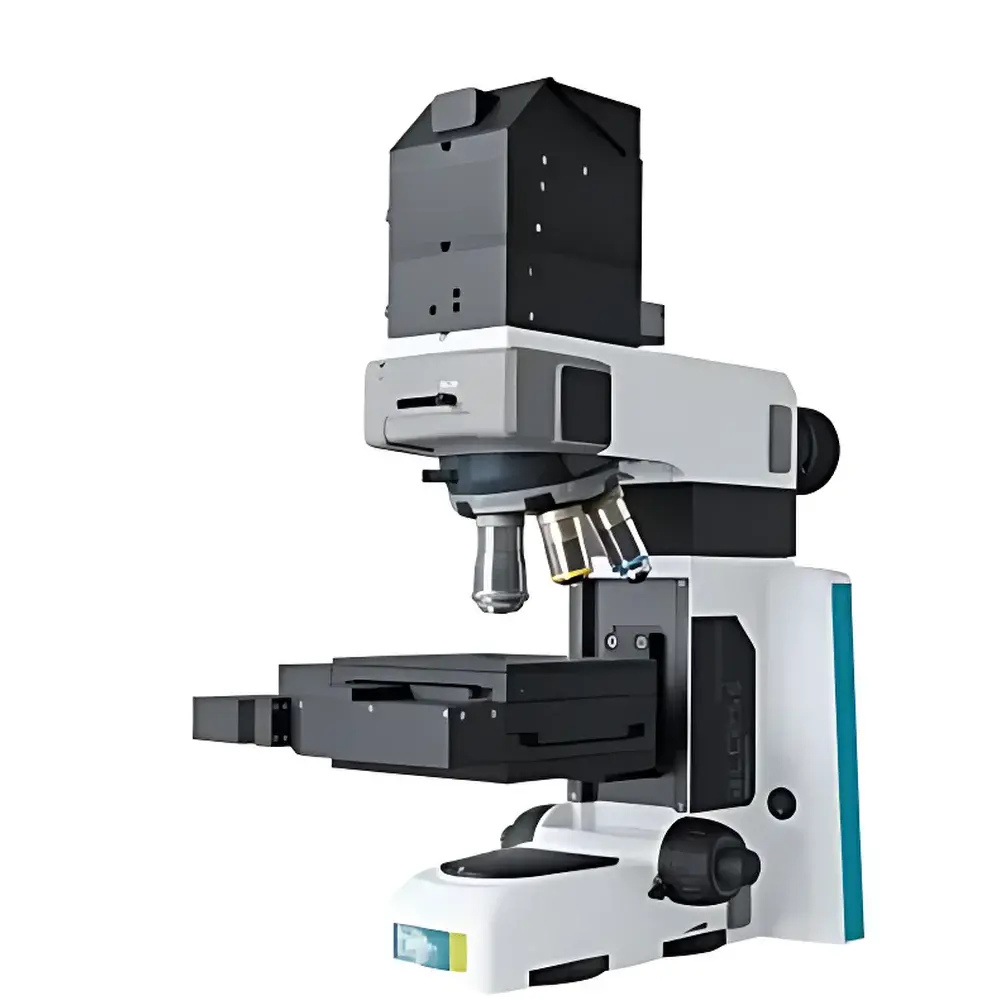
WITec alpha300 access Confocal Raman Imaging Spectrometer
| Brand | WITec |
|---|---|
| Origin | Germany |
| Model | alpha300 access |
| Sample Diameter Limit | <15 mm |
| Sample Thickness Limit | <5 mm |
| XYZ Stage Travel Range | ≤120 mm |
| Positional Noise | 625 nm (RMS) |
| Instrument Type | Confocal Raman Microscope |
| Optical Architecture | Integrated UHTS High-Throughput Spectrometer |
| Microscope Platform | Precision-Engineered Inverted/Epifluorescence-Compatible Optical Microscope |
Overview
The WITec alpha300 access is a high-performance confocal Raman imaging spectrometer engineered for quantitative, spatially resolved chemical characterization at submicron lateral resolution. Based on true confocal point-scan architecture—where excitation and detection are jointly focused through a shared diffraction-limited spot—the system delivers intrinsic optical sectioning capability without reliance on computational deconvolution. This physical optical filtering enables depth-resolved spectroscopic mapping of heterogeneous samples with minimal out-of-focus background interference. The instrument integrates a high-throughput UHTS (Ultra-High Throughput Spectrometer) designed specifically for Raman applications, featuring optimized grating efficiency across visible and near-infrared excitation wavelengths (e.g., 532 nm, 633 nm, and 785 nm), enabling rapid acquisition of high signal-to-noise spectra even from weak scatterers or photolabile materials. Its inverted microscope platform supports both transmission and epifluorescence-compatible configurations, facilitating multimodal correlative analysis when combined with optional fluorescence or AFM modules.
Key Features
- True confocal point-scanning design with motorized precision Z-stage for optical sectioning and 3D volumetric Raman tomography
- UHTS spectrometer with optimized throughput (>30% grating efficiency at 532 nm), low stray light (<10⁻⁵), and spectral resolution down to 0.2 cm⁻¹ (dependent on grating selection)
- High-stability XYZ motorized stage with ≤120 mm travel range, closed-loop encoders, and RMS positional noise of 625 nm for reproducible submicron registration
- Modular laser port architecture supporting up to four independently controlled solid-state lasers (532 nm, 633 nm, 785 nm, and optional UV/NIR sources)
- Integrated high-numerical-aperture (NA ≥ 0.9) microscope optics, including infinity-corrected objectives and automated filter turrets for rapid excitation/emission switching
- Designed for future hardware expansion: compatible with WITec’s TrueSurface topography module, AFM-Raman coupling, and time-resolved TCSPC fluorescence add-ons
Sample Compatibility & Compliance
The alpha300 access accommodates standard microscope-compatible specimens: solid thin films, polished cross-sections, biological tissue sections (mounted on glass slides), polymer blends, semiconductor wafers, and geological thin sections. Maximum sample dimensions are limited to Ø <15 mm and thickness <5 mm to ensure unobstructed objective working distance and stage clearance. All optical components comply with ISO 10110 surface quality standards; mechanical stages meet ISO 230-2 repeatability specifications. The system architecture supports GLP/GMP-aligned workflows via optional audit-trail-enabled software licensing and adheres to general laboratory safety requirements per IEC 61010-1 for Class 1 laser products (when operated with certified enclosed beam paths).
Software & Data Management
Control, acquisition, and analysis are unified within WITec’s proprietary Project software suite (v6.x), which provides full scripting support (Python API), batch processing pipelines, and multivariate statistical tools (PCA, cluster analysis, spectral unmixing). Raw hyperspectral data cubes (x, y, wavenumber) are stored in vendor-neutral HDF5 format with embedded metadata—including laser power calibration, objective magnification, grating configuration, and stage position logs—ensuring traceability and interoperability with third-party analysis platforms such as MATLAB, Python (SciPy, scikit-learn), or Thermo Fisher OMNIC. Software validation packages are available for laboratories requiring FDA 21 CFR Part 11 compliance, including electronic signatures, change control logs, and user-access tiering.
Applications
- Pharmaceutical solid-state analysis: polymorph distribution mapping in tablet cross-sections and API-excipient interactions
- Materials science: strain and doping heterogeneity in 2D materials (graphene, TMDCs), grain boundary chemistry in polycrystalline thin films
- Life sciences: label-free biochemical mapping of lipid droplets, protein aggregates, and nucleic acid conformation in fixed cells
- Geosciences: mineral phase identification and fluid inclusion characterization in petrographic thin sections
- Microelectronics: contamination identification, stress evaluation in interconnect layers, and failure analysis of solder joints
- Forensics: non-destructive identification of pigments, dyes, and illicit substances in trace evidence
FAQ
What is the maximum spatial resolution achievable with the alpha300 access?
Lateral resolution is diffraction-limited and depends on excitation wavelength and objective NA; typical values range from ~250 nm (532 nm, 100×/0.9 NA) to ~400 nm (785 nm, 100×/0.9 NA). Axial (Z) resolution is ~700–1200 nm under confocal conditions.
Can the system perform simultaneous Raman and fluorescence measurements?
Yes—via automated filter turret and dual-channel detection path, enabling sequential or interleaved acquisition of Raman and fluorescence signals using the same optical train.
Is vacuum or inert atmosphere operation supported?
The base system operates in ambient air; environmental chambers (temperature-controlled, N₂-purged, or vacuum-compatible) are available as optional accessories with custom stage integration.
How is laser power stability maintained during long-term mapping?
All integrated lasers feature active power stabilization circuits and real-time monitoring via internal photodiodes, with software logging of power drift (typically <±0.5% over 8 h).
Does the alpha300 access support automated focus tracking during large-area scans?
Yes—integrated piezo-driven objective Z-positioning and continuous autofocus algorithms (based on reflected intensity or sharpness metrics) maintain optimal focus across height-varied samples.





