
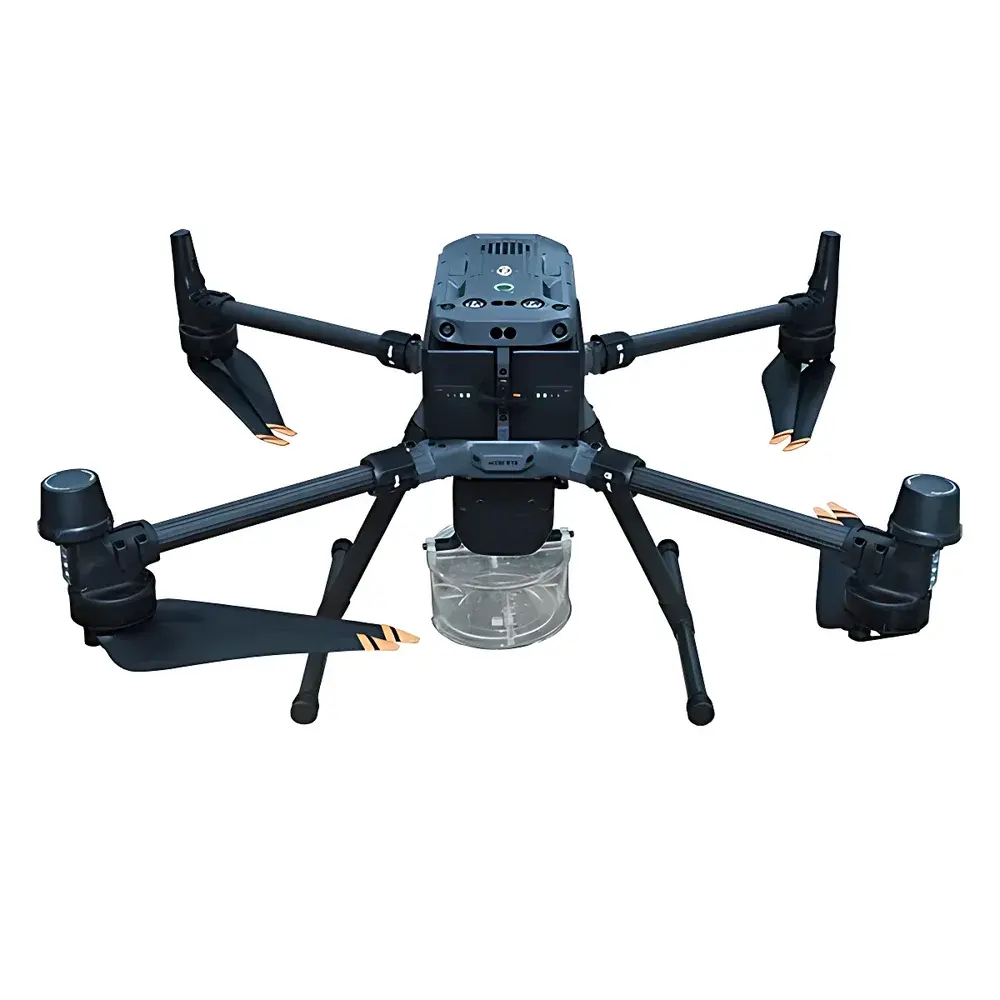
Junray ZR-7600 Unmanned Aerial Vehicle (UAV) Emergency Environmental Monitoring System
| Brand | Junray |
|---|---|
| Origin | Shandong, China |
| Manufacturer Type | Direct Manufacturer |
| Origin Category | Domestic (China) |
| Model | ZR-7600 |
| Detection Medium | Gaseous |
| Detection Capability | Multi-gas |
| Response Time | < 30 seconds (typical for electrochemical & PID sensors) |
Overview
The Junray ZR-7600 Unmanned Aerial Vehicle (UAV) Emergency Environmental Monitoring System is an integrated, field-deployable platform engineered for rapid situational awareness and real-time hazard assessment during environmental emergencies—including chemical spills, industrial accidents, illegal emissions, and post-disaster reconnaissance. Unlike conventional ground-based monitors constrained by terrain access or safety perimeters, the ZR-7600 leverages aerial mobility to position gas-sensing payloads directly within plumes, boundary layers, or confined zones inaccessible to personnel. Its core measurement architecture combines electrochemical (EC), photoionization detection (PID), and optional metal oxide semiconductor (MOS) sensor arrays—each calibrated and temperature-compensated for quantitative multi-gas analysis (e.g., Cl₂, H₂S, NH₃, SO₂, VOCs, CO, O₂, and combustible gases). The system operates on a physics-based principle: diffusion-limited gas interaction with selective transducers, generating linear current or voltage outputs proportional to target analyte concentration. Data acquisition is synchronized with GPS-tagged geospatial metadata, enabling dynamic plume mapping and time-resolved exposure modeling compliant with emergency response protocols.
Key Features
- Modular UAV-integrated payload design: Gas monitoring module, water sampling module, and dual-band telemetry unit are mechanically and electrically decoupled for rapid reconfiguration.
- Real-time airborne gas profiling: Simultaneous detection of up to 8 gases with configurable alarm thresholds and auto-scaling concentration ranges (ppb–%LEL).
- Ruggedized flight platform: IP54-rated airframe with 30-minute endurance, 5 km operational range, and wind resistance up to 12 m/s—certified for Class IIIB environmental operation per GB 12358-2006.
- Regulatory-aligned calibration traceability: Sensor modules include NIST-traceable calibration certificates; onboard zero/span verification supports GLP-compliant field validation.
- Emergency-grade response latency: End-to-end signal acquisition, processing, and transmission latency < 2.5 seconds—validated under HJ 872-2017 test conditions for toxic gas emergency response.
- Integrated water sampling capability: Motorized peristaltic pump with programmable depth targeting (0.5–3 m), sterile single-use tubing, and onboard sample stabilization (pH/temperature logging).
Sample Compatibility & Compliance
The ZR-7600 is validated for ambient air, stack effluent plumes, surface water interfaces, and semi-confined industrial spaces. It complies with Chinese national standards governing emergency instrumentation: GB 12358-2006 (performance requirements for workplace gas detectors), HJ 494-2009 (water sampling methodology), and HJ 872-2017 (electrochemical sensor-based emergency air monitoring). While not certified to ISO/IEC 17025 for accredited testing, its sensor output stability, cross-interference rejection (e.g., humidity compensation < ±3% RH drift), and data audit trail functionality align with internal QA/QC procedures required under the 2024 Ecological Environment Protection Comprehensive Law Enforcement Equipment Standardization Guidelines. All firmware logs retain immutable timestamps, operator ID, and GPS coordinates—supporting chain-of-custody documentation for regulatory reporting.
Software & Data Management
The ZR-7600 operates with Junray’s proprietary Emergency Monitoring Command Suite (EMCS v3.2), a Windows-based desktop application supporting real-time telemetry visualization, GIS overlay (via KML export), and automated report generation in PDF/CSV formats. Raw sensor data streams are stored locally on encrypted microSD cards (AES-256) and mirrored to secure cloud endpoints via TLS 1.3. EMCS enforces role-based access control (RBAC), electronic signatures, and full audit trails—including parameter changes, calibration events, and alarm acknowledgments—to satisfy basic FDA 21 CFR Part 11 principles for non-GxP field use. Data exports conform to ISO 13843:2022 metadata schema for environmental monitoring records.
Applications
- Rapid hazard zone delineation during chemical release incidents (e.g., chlorine leaks at water treatment plants)
- Post-fire air quality assessment for VOC and CO dispersion modeling
- Illegal discharge investigation: Upwind/downwind differential gas profiling near suspected wastewater outfalls
- Emergency water body screening: Simultaneous surface water collection + over-water H₂S/NH₃ flux estimation
- Perimeter monitoring during hazardous material transport incidents
- Support for provincial ecological law enforcement teams conducting routine compliance spot checks
FAQ
Is the ZR-7600 certified for use in intrinsically safe (IS) environments?
No—the system is rated for general industrial outdoor use (IP54, Class IIIB) but does not carry ATEX or IECEx certification. Operation within explosive atmospheres requires third-party IS barrier integration.
Can sensor modules be calibrated in the field without returning to the manufacturer?
Yes—onboard zero/span calibration is supported using certified gas standards; full multi-point calibration requires connection to Junray’s Calibration Station CS-200 (sold separately).
Does the system support integration with existing municipal emergency command platforms?
Yes—EMCS provides RESTful API and MQTT protocol support for interoperability with common environmental data hubs (e.g., China’s National Ecological Monitoring Platform, provincial EEMS).
What is the typical maintenance interval for gas sensors?
Electrochemical sensors require replacement every 18–24 months depending on cumulative exposure; PID lamps are rated for ≥5,000 hours of operation.
Is raw sensor data exportable for third-party statistical analysis?
Yes—time-stamped CSV files include all analog/digital channels, GPS coordinates, IMU orientation, and environmental compensation parameters (T, RH, pressure).
Related Products







