Junray ZR-1510 Dedicated Calibration Wind Tunnel for Pitot Tube Anemometers
| Brand | Junray |
|---|---|
| Origin | Shandong, China |
| Manufacturer Type | Original Equipment Manufacturer (OEM) |
| Country of Origin | China |
| Model | ZR-1510 |
| Dimensions | 700 × 700 mm (test section) + 500 × 500 mm (auxiliary section), overall footprint optimized for laboratory integration |
| Control System | Imported frequency converter with high-frequency resolution and wide-speed regulation range (0.1–30 m/s airflow velocity) |
| Thermal Stability | ΔT < 4.0 °C after 30 min continuous operation at 30 m/s |
| Compliance | JJG 518–1998 “Verification Regulation for Pitot Tubes”, JJF 1332–2011 “Type Evaluation Outline for Flue Gas Dust Samplers” |
Overview
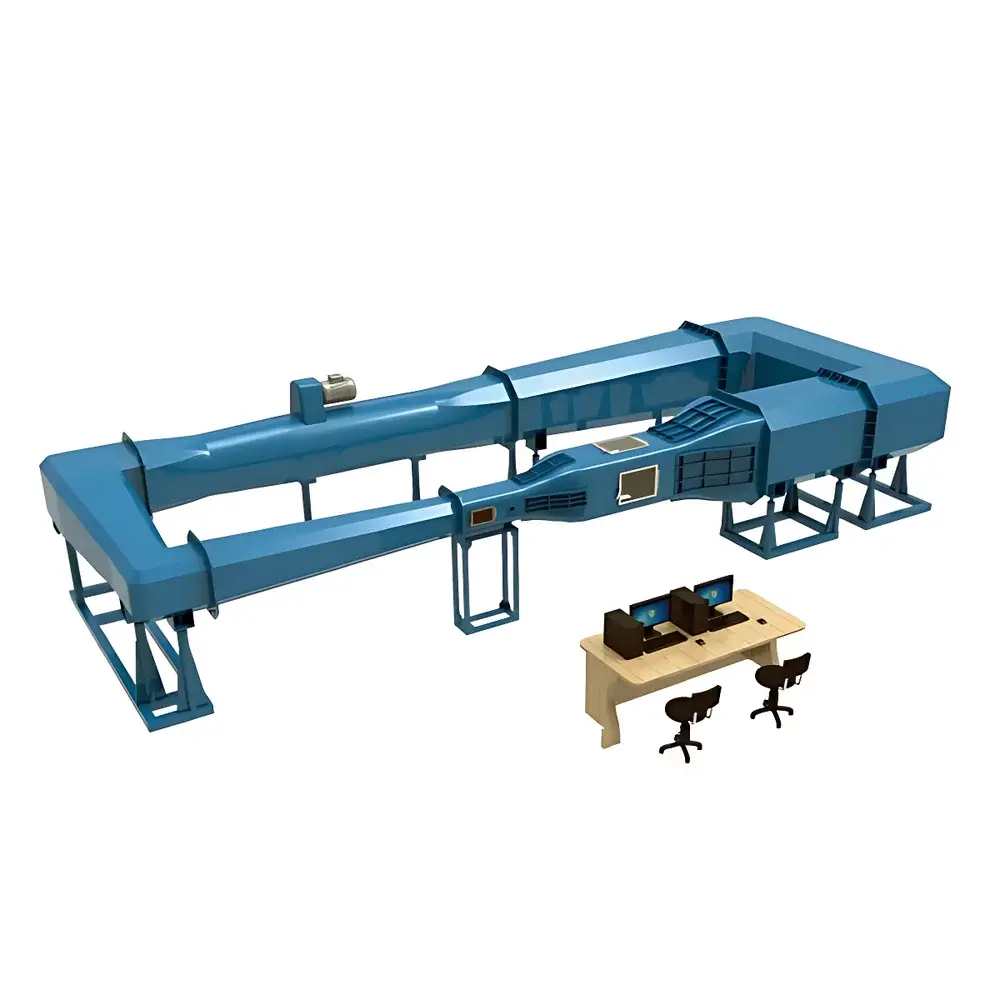
The Junray ZR-1510 Dedicated Calibration Wind Tunnel is a precision-engineered closed-loop aerodynamic facility designed exclusively for the metrological verification and calibration of pitot tubes, thermal anemometers, vane anemometers, and other air velocity sensing instruments. It operates on the principle of controlled laminar-to-turbulent transitional flow generation within a recirculating duct system, enabling stable, repeatable, and traceable airflow conditions across a defined velocity range (0.1–30 m/s). Unlike open-jet or blow-down tunnels, the ZR-1510’s fully enclosed annular flow path minimizes ambient interference—eliminating sensitivity to room temperature gradients, door openings, or personnel movement—thereby satisfying stringent requirements for metrology-grade calibration in non-dedicated laboratory spaces. Its design adheres to the physical and procedural constraints outlined in JJG 518–1998, ensuring alignment with national verification protocols for differential pressure-based velocity sensors.
Key Features
- Closed-loop recirculating architecture with low-turbulence test section (700 × 700 mm cross-section), engineered to maintain spatial velocity uniformity ≤ ±1.5% and temporal stability ≤ ±0.3% over 60-second averaging intervals.
- Externally mounted high-efficiency axial-flow fan motor, thermally isolated from the airflow path to suppress convective heating—validated to limit temperature rise to < 4.0 °C during sustained 30 m/s operation (30 min duration), critical for minimizing density drift and buoyancy-induced measurement bias.
- Imported industrial-grade frequency converter providing 0.01 Hz frequency resolution and linear speed control across the full operational range; supports both manual knob adjustment and analog/digital input interfaces for automated test sequencing.
- Compact footprint (total installed dimensions integrate test and auxiliary sections without requiring structural modifications), compatible with standard ISO Class 7–8 laboratory environments; no dedicated HVAC or acoustic shielding required.
- Modular construction with quick-access inspection panels and standardized flange interfaces (DN500), facilitating routine maintenance, flow profile validation (e.g., with hot-wire probes or traverse systems), and optional integration of turbulence grids or contraction nozzles.
Sample Compatibility & Compliance
The ZR-1510 accommodates a broad spectrum of velocity-sensing devices, including but not limited to: S-type and L-type pitot tubes (per ISO 10780 and ASTM D2513), bidirectional thermal anemometers (IEC 60751 Class A RTD-based), rotating-vane meters (EN 13790-compliant), and multi-hole pressure probes used in stack emission monitoring. All calibrations performed on this system are traceable to national standards via documented uncertainty budgets aligned with ISO/IEC 17025:2017 requirements. The wind tunnel satisfies the geometric, dynamic similarity, and repeatability criteria stipulated in JJG 518–1998—including mandatory upstream straightness (≥10× hydraulic diameter), static pressure tap placement tolerances (±1 mm), and verification point distribution (minimum 5 points per decade). It further supports type evaluation testing per JJF 1332–2011 for particulate emission sampling systems where flow rate accuracy directly impacts mass concentration calculations.
Software & Data Management
While the ZR-1510 operates as a hardware-calibration platform, it is fully compatible with third-party data acquisition systems supporting analog voltage (0–10 V), current (4–20 mA), and RS-485 Modbus RTU outputs. Integration with NIST-traceable reference instruments (e.g., primary-standard hot-wire anemometers or calibrated laminar flow elements) enables automated calibration workflows compliant with GLP and GMP documentation practices. Audit trails, calibration certificates (including expanded uncertainty statements per GUM), and raw velocity/time-series datasets can be generated in formats compatible with LIMS environments. Optional firmware upgrades support timestamped logging with UTC synchronization and digital signature authentication—facilitating compliance with FDA 21 CFR Part 11 electronic record requirements when deployed in regulated quality control laboratories.
Applications
- Metrological verification and periodic recalibration of pitot tubes used in flue gas monitoring, HVAC commissioning, and cleanroom airflow qualification.
- Performance validation of portable anemometers prior to field deployment in environmental emission testing (e.g., EPA Method 2, ISO 16911).
- Research-grade characterization of sensor response time, hysteresis, and directional sensitivity under controlled turbulence intensity (< 0.5% at 10 m/s).
- Support for inter-laboratory comparison studies and proficiency testing programs administered by national metrology institutes (NMIs) and accreditation bodies (e.g., CNAS, UKAS).
- Educational use in fluid mechanics laboratories for hands-on demonstration of boundary layer development, flow separation, and Bernoulli-based velocity derivation principles.
FAQ
What velocity range is supported, and how is linearity verified?
The ZR-1510 delivers calibrated airflow from 0.1 to 30 m/s. Linearity is confirmed using NIST-traceable reference standards and validated against polynomial fit residuals ≤ ±0.25% of reading across the full span.
Is the system suitable for ISO/IEC 17025-accredited calibration labs?
Yes—when operated with certified reference instruments and documented uncertainty analysis, it meets technical requirements for scope accreditation under clause 6.4 (equipment) and 6.5 (traceability) of ISO/IEC 17025:2017.
Can the wind tunnel be integrated into an automated calibration station?
Absolutely—the frequency converter and pressure/temperature sensor outputs support PLC and SCADA-level integration via standard industrial protocols (Modbus RTU, 0–10 V analog).
Does the system include uncertainty budget templates for calibration reports?
Junray provides a comprehensive uncertainty calculation guide aligned with GUM (JCGM 100:2008), including contributions from reference standard accuracy, flow uniformity, temperature drift, and operator repeatability.
What maintenance intervals are recommended for long-term metrological stability?
Biannual verification of fan balance, bearing lubrication, and flow straightener integrity is advised; annual recalibration of integrated PT100 temperature sensors and static pressure transducers is required for accredited use.